Shipping a phone case is easy. Shipping a three-seater sofa to a fourth-floor apartment in Pune with no lift? That is a completely different story.
If you sell furniture, mattresses, appliances, or home decor in India, you already know the pain. One order can weigh 80 kilos, arrive in four boxes, and need two people plus a toolkit at the customer’s doorstep. A standard courier setup simply was not built for this.
That is exactly where a WMS for furniture and bulky goods fulfillment comes in. In this guide, we will walk through why bulky goods are so hard to manage, what a furniture warehouse management system actually does, the features that matter most, and how Indian brands are using this technology to protect margins and keep customers happy. Let us get into it.
Why Furniture and Bulky Goods Fulfillment Is So Hard
Think about what happens when a customer orders a seven-piece dining set online. Your warehouse now has to find, reserve, pick, pack, and ship seven separate items as one order. If even one chair is missing, the whole order fails.
Now multiply that across hundreds of orders a day. Here is what makes big and bulky fulfillment such a challenge:
- Size and weight: A wardrobe cannot ride a conveyor belt. It needs forklifts, wide aisles, heavy-duty racking, and sometimes floor stacking.
- Multi-piece SKUs: One “product” is often three or four cartons. Lose track of one carton and you have an incomplete delivery and an angry customer.
- Damage risk: Furniture gets scratched, dented, and chipped in transit far more than parcels do. Every damaged item is a costly return.
- Delivery complexity: Bulky items need scheduled delivery slots, two-man teams, and often in-home assembly. Standard courier networks cannot handle building access issues, narrow stairwells, or lift size limits.
- Storage costs: A sofa takes up the warehouse space of a few hundred phone covers. Wasted space directly eats into your margin, and during peak season it can tip into full warehouse overflow.
To put a number on it, shipping a two-seater sofa between Bengaluru and Mumbai can cost Rs 4,000 to Rs 6,000, according to Edgistify’s analysis of bulky goods logistics. When one shipment costs that much, there is zero room for warehouse errors.
What Is a WMS for Furniture and Bulky Goods?
A warehouse management system (WMS) is software that controls everything that happens inside your warehouse: receiving, putaway, storage, picking, packing, and dispatch. If you are still weighing whether you need one at all, start with why businesses need a warehouse management system.
A WMS for furniture and bulky goods fulfillment takes that core and adds capabilities that oversized inventory demands. It understands that products come in multiple boxes. It knows a mattress and a glass-top table cannot be stored or handled the same way. And it connects warehouse operations to delivery scheduling and assembly teams.
In short, a regular WMS asks, “Where is this item?” A furniture warehouse management system asks, “Where are all four cartons of this item, are they damage-free, and when is the two-man delivery team booked?”
If you are new to warehouse software in general, our introduction to warehouse management covers the basics before you go deeper.
Bulky Goods Fulfillment vs Parcel Fulfillment: What Changes?
Many brands try to run furniture operations on a parcel-style setup. It rarely ends well. Here is a quick comparison:
| Aspect | Parcel Fulfillment | Bulky Goods Fulfillment |
|---|---|---|
| Handling | Conveyors, totes, single pickers | Forklifts, pallet jacks, team lifts |
| Storage | Shelving and bins | Heavy racking, floor stacking, wide aisles |
| SKU structure | One item, one box | One item, multiple cartons |
| Shipping | Courier networks | LTL freight, dedicated fleets |
| Last mile | Doorstep drop | Scheduled slots, white-glove delivery, assembly |
| Returns | Restock in minutes | Inspection, refurbishment, or liquidation |
The gap is wide. Therefore, the software running your warehouse needs to be built (or configured) for the bulky side of that table.
Key WMS Features for Furniture and Bulky Goods Brands
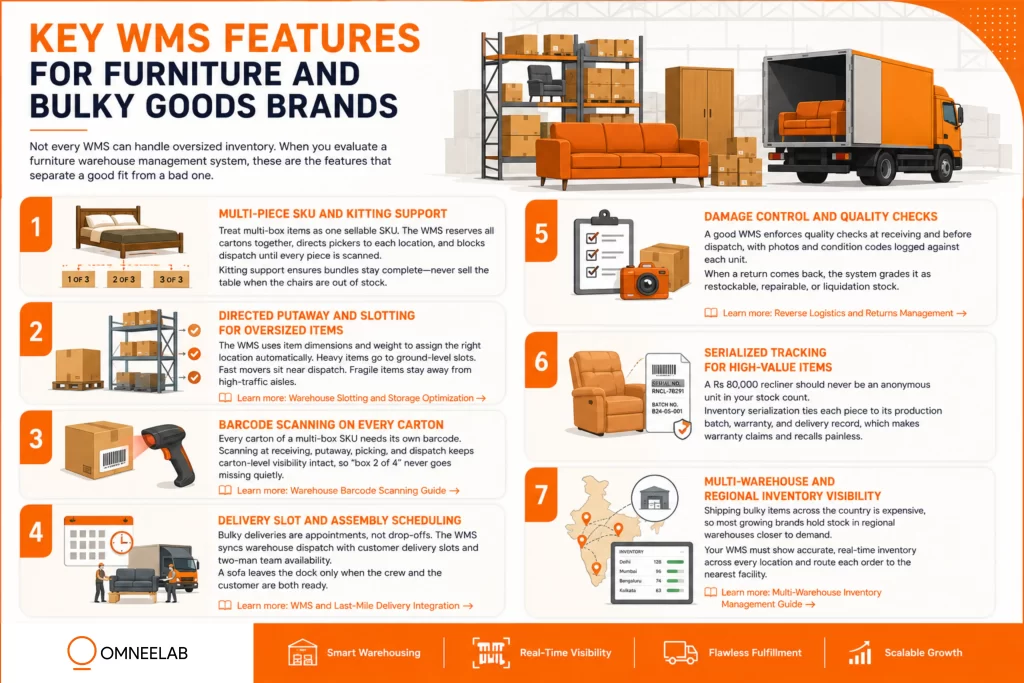
Not every WMS can handle oversized inventory. When you evaluate a furniture warehouse management system, these are the features that separate a good fit from a bad one.
1. Multi-Piece SKU and Kitting Support
This is non-negotiable. Your WMS must treat a bed frame that ships in three cartons as one sellable SKU. When an order comes in, the system should reserve all three cartons together, direct pickers to each location using the right order picking method, and block dispatch until every piece is scanned.
The same logic applies to kitting. Sell a dining set as a bundle? The WMS should manage the kit so you never sell the table when the chairs are out of stock.
2. Directed Putaway and Slotting for Oversized Items
Space is money in bulky goods warehousing. A smart WMS uses item dimensions and weight to assign the right storage location automatically. Heavy items go to ground-level slots. Fast movers sit near dispatch. Fragile glass tops stay away from high-traffic aisles.
This is really an extension of good slotting practice. We break down the fundamentals in our guide to warehouse slotting and storage optimization.
3. Barcode Scanning on Every Carton
Every carton of a multi-box SKU needs its own barcode. Scanning at receiving, putaway, picking, and dispatch keeps carton-level visibility intact, so “box 2 of 4” never goes missing quietly. If your team still runs on paper, start with our warehouse barcode scanning guide.
4. Delivery Slot and Assembly Scheduling
Bulky deliveries are appointments, not drop-offs. Your WMS should sync warehouse dispatch with customer delivery slots and two-man team availability. When the WMS talks to your delivery software, a sofa leaves the dock only when the crew and the customer are both ready. Here is how WMS and last-mile delivery integration works in practice.
5. Damage Control and Quality Checks
Damage is the silent margin killer in furniture. A good WMS enforces quality checks at receiving and before dispatch, with photos and condition codes logged against each unit. When a return comes back, the system grades it as restockable, repairable, or liquidation stock instead of dumping it in a corner.
Returns deserve their own playbook. Our article on reverse logistics and returns management goes deeper on this.
6. Serialized Tracking for High-Value Items
A Rs 80,000 recliner should never be an anonymous unit in your stock count. Inventory serialization ties each piece to its production batch, warranty, and delivery record, which makes warranty claims and recalls painless.
7. Multi-Warehouse and Regional Inventory Visibility
Shipping bulky items across the country is expensive, so most growing brands hold stock in regional warehouses closer to demand. Your WMS must show accurate, real-time inventory across every location and route each order to the nearest facility. We cover the mechanics in our multi-warehouse inventory management guide.
The India Angle: Why This Matters Right Now
India’s online furniture market is growing fast, but the economics are brutal. Cash-on-delivery preferences, high return-to-origin (RTO) rates, and long shipping distances squeeze margins from every side.
Look at how the leaders responded. Pepperfry built its own logistics arm with 31 distribution centers, a dedicated fleet, and in-home assembly teams, anchored by a 4,00,000 sq ft mother warehouse in Bhiwandi, as reported by Inc42. Wakefit scaled from mattresses to full furniture on the back of tight supply chain control.
You do not need Pepperfry’s budget to compete. However, you do need their discipline, and that discipline lives in software. A few India-specific realities your WMS should handle:
- Regional hub models: Brands are moving stock into Tier-2 hubs and micro-warehouses to cut the last-mile distance. That mirrors the dark store model from quick commerce, applied to bigger boxes.
- RTO reduction: Accurate inventory, correct multi-carton dispatch, and scheduled slots directly cut failed deliveries, which is where most RTO losses come from. This is how a WMS powers order fulfillment end to end.
- 3PL coordination: Many furniture brands outsource warehousing. If that is you, make sure your partner’s systems measure up. Our 3PL warehouse management guide shows what to look for.
- GST and interstate movement: Multi-state warehousing means e-way bills and clean documentation. Your WMS should generate dispatch data that makes compliance simple, not harder.
How to Choose the Right WMS for Your Furniture Business
Feeling ready to evaluate options? Ask every vendor these questions before you sign anything:
- Can it handle multi-carton SKUs natively, or is that a workaround?
- Does it support dimension and weight-based slotting for oversized items?
- Can it schedule deliveries and assembly teams, or integrate with tools that do?
- How does it manage damage grading and returns for bulky items?
- Does it scale across multiple warehouses with real-time sync?
- Will it integrate with your sales channels, marketplaces, and ERP? (WMS-ERP integration is where most projects stumble.)
- What does implementation look like in weeks, not quarters?
A vendor who hesitates on questions one, three, or four probably built their product for parcels. Keep looking. For a broader market view, see our roundup of the best warehouse management software in India.
Getting Started: A Simple Implementation Path
You do not have to transform everything overnight. Most furniture brands see results with a phased approach (our WMS implementation checklist for India covers the full rollout):
- Phase 1: Barcode every carton and digitize receiving and dispatch. This alone kills most “missing box” incidents.
- Phase 2: Turn on directed putaway, slotting, and multi-piece order validation.
- Phase 3: Connect delivery scheduling, returns grading, and multi-warehouse routing.
Measure as you go. Track order accuracy, damage rate, RTO percentage, and space utilization month over month on a proper warehouse KPI dashboard. If those four numbers improve, the system is paying for itself.
Wrapping Up
Furniture and bulky goods fulfillment punishes sloppy operations harder than almost any other category. The boxes are big, the shipping is costly, and one missing carton can ruin a customer relationship for good.
A purpose-fit WMS for furniture and bulky goods fulfillment changes the math. It keeps multi-piece SKUs together, puts every item in the right slot, cuts damage and RTO, and connects your warehouse to the two-man team at the customer’s door. Indian brands that get this right ship faster, break less, and keep more margin per order.
Ready to see what that looks like for your warehouse? Talk to the Omneelab team for a walkthrough of our WMS built for Indian fulfillment operations, or explore our complete WMS fulfillment guide for India to keep learning.
Frequently Asked Questions
It is a warehouse management system designed for oversized inventory. Beyond standard receiving, putaway, and picking, it handles multi-carton SKUs, kitting, dimension-based slotting, serialized tracking, and delivery slot scheduling for two-man and white-glove deliveries.
The system links every carton to one parent SKU. When an order arrives, it reserves all cartons together, directs pickers to each location, and requires a scan of every box before dispatch. This prevents incomplete deliveries, which are a leading cause of furniture returns.
White-glove delivery means scheduled, in-home delivery with room placement and assembly, usually by a two-man team. A WMS supports it by syncing dispatch with delivery appointments and crew availability, so the product, the vehicle, and the assembly team arrive together.
Start inside the warehouse. Quality checks at receiving and dispatch, proper heavy-duty racking, carton-level barcode scanning, and scheduled delivery slots all reduce damage and failed deliveries. Regional warehouses and dark-store style hubs also cut transit distance, which lowers both damage risk and RTO rates.
Yes. An ERP manages company-wide finance, purchasing, and sales. Basic inventory software tracks stock counts. A furniture warehouse management system controls the physical operations of the warehouse itself: slotting oversized items, picking multi-carton orders, grading returns, and coordinating bulky last-mile delivery. Most brands run a WMS integrated with their ERP rather than choosing one over the other.

Kapil Pathak is a Senior Digital Marketing Executive with over six years of experience specializing in the logistics and supply chain industry. His expertise spans digital strategy, search engine optimization (SEO), search engine marketing (SEM), and multi-channel campaign management. He has a proven track record of developing initiatives that increase brand visibility, generate qualified leads, and drive growth for D2C & B2B technology companies.