In 2026, Indian e-commerce is projected to cross $120 billion in GMV, and every single order behind that number must move through a warehouse. Whether you are a D2C brand shipping 200 orders a day from a single warehouse or a 3PL provider managing 50,000+ shipments across multiple states, one thing is clear: WMS for warehouse fulfillment in India is no longer optional. It is the backbone of every successful fulfillment operation.
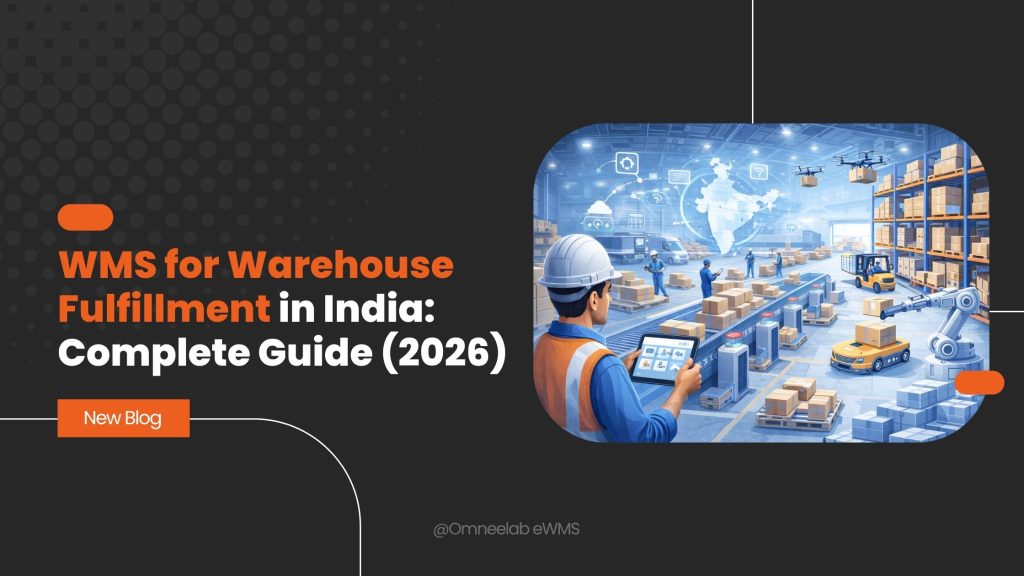
A Warehouse Management System (WMS) is a software solution designed to optimize warehouse operations by automating and streamlining processes such as inventory tracking, order fulfillment, and space utilization. But in the Indian context, WMS must do much more. It must handle COD verification, GST compliance, multi-carrier integration with providers like Delhivery and Shiprocket, festive season volume spikes, and the unique challenges of fulfilling orders across Tier 1, Tier 2, and Tier 3 cities.
This comprehensive guide covers everything Indian businesses need to know about using WMS for warehouse fulfillment in India: the step-by-step fulfillment process, WMS-powered automation, pricing, implementation, scaling strategies, and the KPIs that matter most. Whether you are evaluating your first WMS or upgrading from spreadsheets and manual processes, this guide will help you make the right decision for 2026 and beyond.
What is Warehouse Fulfillment and Why Does It Need WMS?
Warehouse fulfillment is the complete process of receiving, storing, processing, and shipping orders from a warehouse to the end customer. It is the physical execution layer that turns a customer’s online click into a delivered package.
In a traditional warehouse, this process relies heavily on manual effort: paper pick lists, visual inventory checks, and human decision-making at every step. The result is errors, delays, and costs that scale linearly with order volume.
A WMS transforms this equation. It digitizes every step, automates decisions, and provides real-time visibility into what is happening across the warehouse floor. Instead of a warehouse manager guessing which orders to prioritize, the WMS automatically allocates orders, optimizes pick paths, verifies packing accuracy through barcode scanning, and selects the best carrier for each shipment.
For Indian businesses specifically, a WMS must also handle:
- Multi-marketplace order aggregation (Flipkart, Amazon, Myntra, Shopify, WooCommerce)
- COD order verification and management (60%+ of Indian e-commerce orders are COD)
- GST-compliant documentation across multiple states
- Integration with Indian logistics providers (Delhivery, Shiprocket, BlueDart, Ecom Express)
Without WMS, warehouse fulfillment in India becomes a bottleneck that limits growth, increases costs, and damages customer experience.
Related reading: Introduction to Warehouse Management
The Warehouse Order Fulfillment Process: Step-by-Step
Understanding the fulfillment process is critical before understanding how WMS powers each stage. Here is the complete warehouse order fulfillment process broken into six stages:
Stage 1: Receiving (Inbound)
Goods arrive at the warehouse from suppliers or manufacturers. The receiving team verifies quantities, checks for damage, and records everything through a Goods Received Note (GRN).
Without WMS: Manual counting, paper-based GRN, errors in quantity recording, delayed putaway.
With WMS: Barcode/RFID scanning at dock, automated GRN generation, real-time inventory update, instant putaway instructions.
Deep dive: Goods Received Note (GRN): Complete Guide
Stage 2: Storage (Putaway)
Received goods are stored in designated warehouse locations: bins, racks, shelves, or zones. Intelligent putaway ensures fast-moving items are placed closer to packing stations.
Without WMS: Workers choose storage locations based on memory or convenience, leading to inefficient space utilization.
With WMS: System-directed putaway based on SKU velocity, size, weight, and zone rules. Dynamic slotting optimization ensures the most efficient use of warehouse space.
Stage 3: Picking
When an order is received, the relevant items must be picked from their storage locations. This is typically the most labor-intensive and error-prone stage of fulfillment.
Without WMS: Paper pick lists, single-order picking, excessive walking time, frequent wrong picks.
With WMS: Optimized pick paths using wave picking, zone picking, or batch picking strategies. Mobile devices guide workers to exact bin locations with barcode verification at each pick. Advanced WMS solutions use AI-driven algorithms to optimize picking paths, reducing the time and effort required to fulfill orders.
Deep dive: Guide to Warehouse Order Picking Process, Methods & Types | Also read: Paperless Picking Guide for Modern Warehouses
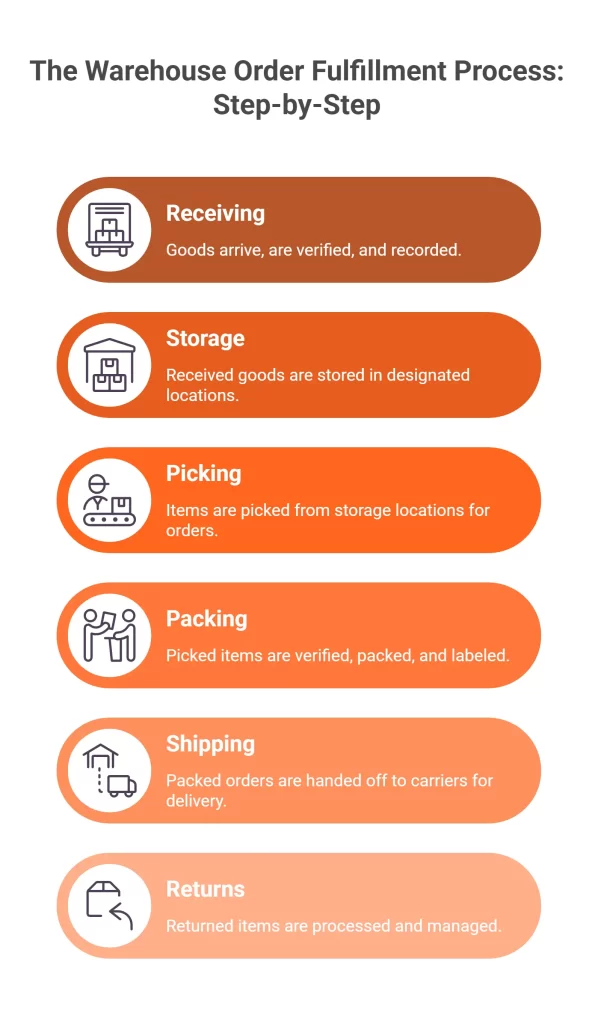
Stage 4: Packing
Picked items are brought to packing stations where they are verified, packed according to channel-specific requirements, and labeled for shipping.
Without WMS: Manual verification (visual check), wrong items shipped, inconsistent packing quality, manual label creation.
With WMS: Barcode scan verification at packing station (ensures 100% accuracy), automated packing slip generation, channel-specific packaging rules (Amazon requires different labeling than Flipkart), and automated shipping label generation with carrier selection.
Stage 5: Shipping (Dispatch)
Packed orders are handed off to carriers for last-mile delivery. In India, this involves managing multiple carriers, generating e-way bills for inter-state shipments, and handling both prepaid and COD orders differently.
Without WMS: Manual carrier selection, delayed dispatch, no real-time tracking handoff, e-way bill errors.
With WMS: Automated carrier allocation based on pin code, cost, and SLA. Real-time manifest generation. Integrated tracking updates pushed to marketplace/customer. Automated e-way bill generation for GST compliance.
Stage 6: Returns (Reverse Fulfillment)
Returns are inevitable in Indian e-commerce. RTO (Return to Origin) rates can reach 25 to 30% in fashion and lifestyle categories. The returns process must be just as systematic as outbound fulfillment.
Without WMS: Returns pile up, no quality check process, returned items do not re-enter sellable inventory, financial reconciliation delays.
With WMS: Automated return receiving with barcode verification, quality grading (Grade A/B/C), disposition rules (restock, refurbish, liquidate, dispose), and instant inventory update across all channels.
Deep dive: Reverse Logistics & Returns Management with WMS in India
How WMS Powers Each Stage of Warehouse Fulfillment in India
Now that we have mapped the fulfillment process, let us understand how WMS specifically drives efficiency, accuracy, and speed at each stage. This is where the real value of using WMS for warehouse fulfillment in India becomes clear.
1. Real-Time Inventory Accuracy
WMS maintains a single source of truth for inventory across all locations and channels. Every scan, whether at receiving, picking, packing, or returns, updates inventory in real-time. This eliminates overselling, stockouts, and ghost inventory.
For Indian e-commerce sellers managing inventory across Flipkart, Amazon, Shopify, and their own website, this real-time sync is critical. Without it, selling the same item on two platforms simultaneously leads to cancellations and penalties.
2. Intelligent Order Allocation
When orders come in from multiple channels simultaneously, WMS uses intelligent allocation logic to determine:
- Which warehouse should fulfill each order (for multi-warehouse operations)
- Which picking strategy to use (wave, batch, or zone)
- Which orders to prioritize (based on SLA deadlines, shipping method, or channel rules)
This is especially important during festive season sales (Diwali, Big Billion Days, Great Indian Festival) when order volumes spike 5x to 10x overnight. Without WMS-driven allocation, warehouses drown in manual prioritization decisions.
Related: Multi-Warehouse Inventory Management in India
3. Optimized Picking Strategies
Picking accounts for 55 to 65% of total warehouse labor costs. WMS reduces this dramatically through:
| Picking Strategy | How WMS Implements It | Best For |
|---|---|---|
| Wave Picking | Groups orders into waves by cut-off time, carrier, or zone | Medium to high volume warehouses |
| Batch Picking | One picker collects items for multiple orders simultaneously | High-SKU, low-units-per-order |
| Zone Picking | Each picker handles only their assigned zone | Large warehouses with distinct zones |
| Cluster Picking | Picker handles multiple orders on a single cart | Small to medium warehouses |
WMS automates the selection of the right picking strategy based on order volume, warehouse layout, and workforce availability.
4. Barcode-Verified Accuracy
At every touchpoint (receiving, picking, packing, dispatch), WMS requires barcode or RFID scanning for verification. This creates a chain of custody that virtually eliminates wrong shipments.
OmneeLab’s WMS has helped clients achieve 99%+ order accuracy by implementing scan-based verification at every stage, reducing customer complaints and marketplace penalties.
Related: Warehouse Barcode Scanning: Complete 3PL Guide
5. Automated Carrier Selection and Label Generation
For Indian businesses working with multiple carriers (Delhivery, Shiprocket, BlueDart, Ecom Express, DTDC, Xpressbees), WMS automates:
- Pin code-based carrier selection (which carrier services which location)
- Cost-optimized routing (cheapest carrier for the SLA requirement)
- Automated shipping label generation (marketplace-compliant labels)
- Manifest generation and carrier handoff
- E-way bill generation for inter-state shipments (GST compliance)
6. Returns Processing and Restocking
WMS does not just handle outbound fulfillment. It manages the complete reverse fulfillment loop:
- Return received, then barcode scanned, then quality checked, then graded
- Grade A items are restocked to sellable inventory (instant channel update)
- Grade B items are sent to refurbishment
- Grade C items go to liquidation or disposal
This automated disposition ensures returned items re-enter sellable inventory within hours, not days, which is critical for fast-moving categories like fashion and electronics.
7. Fulfillment KPI Dashboards
WMS provides real-time dashboards tracking every fulfillment metric that matters:
| KPI | What It Measures | WMS Target |
|---|---|---|
| Order Accuracy Rate | % of orders shipped correctly | 99%+ |
| Pick-to-Ship Time | Time from order received to dispatched | Under 4 hours |
| Fulfillment Cost per Order | Total cost to fulfill one order | Reduce by 20 to 35% |
| Inventory Accuracy | Match between system and physical stock | 99.5%+ |
| Return Processing Time | Time to process and restock a return | Under 24 hours |
| On-Time Shipping Rate | % of orders shipped within SLA | 95%+ |
| Units Per Hour (UPH) | Picker productivity metric | Increase by 40 to 60% |
Deep dive: Warehouse KPIs & Metrics Dashboard Guide
Fulfillment Models in India: How WMS Supports Self, 3PL, FBA and Hybrid
Indian businesses use various fulfillment models depending on their scale, category, and channel mix. Here is how WMS supports each:
Self-Fulfillment (Own Warehouse)
Who uses it: D2C brands, single-channel sellers, businesses wanting full control.
How WMS helps: Complete control over inventory, picking, packing, and shipping. WMS provides the operational backbone that makes self-fulfillment viable even at scale.
3PL Fulfillment (Third-Party Logistics)
Who uses it: Brands that want to outsource warehousing and fulfillment.
How WMS helps: 3PL providers use WMS to manage multiple clients in a single warehouse, with client-specific rules, billing, and reporting. WMS enables multi-tenant warehouse operations.
Related: 3PL Warehouse Management Guide: Scaling Logistics
Marketplace FBA (Fulfillment by Amazon/Flipkart)
Who uses it: Sellers leveraging marketplace fulfillment networks.
How WMS helps: WMS manages inventory allocation to FBA warehouses, tracks FBA vs self-fulfilled inventory, and handles the replenishment cycle.
Related: Amazon FBA vs WMS Integration
Hybrid Fulfillment
Who uses it: Most growing Indian businesses, combining self-fulfillment + 3PL + FBA.
How WMS helps: WMS acts as the central orchestration layer, routing orders to the optimal fulfillment channel based on inventory location, cost, speed, and SLA requirements. This is where WMS delivers its highest ROI.
Dark Store / Micro-Fulfillment
Who uses it: Quick commerce operators (Blinkit, Zepto model), hyperlocal delivery businesses.
How WMS helps: WMS manages high-velocity, limited-SKU operations with sub-3-minute pick-to-dispatch cycles, automated replenishment, and expiry tracking for perishables.
Related: Dark Store WMS for Quick Commerce in India
WMS Technology Stack for Fulfillment: Cloud, Mobile, AI and Integrations
A modern WMS for warehouse fulfillment in India is not just software. It is a technology ecosystem. Here is what the 2026 technology stack looks like:
Cloud-Based WMS vs On-Premise WMS
| Factor | Cloud WMS | On-Premise WMS |
|---|---|---|
| Deployment | Browser/app-based, hosted on cloud | Installed on local servers |
| Cost | SaaS subscription (₹2,000 to ₹15,000/month) | One-time license (₹5L to ₹50L+) |
| Scalability | Instant: add warehouses, users in minutes | Requires hardware upgrades |
| Updates | Automatic, continuous | Manual, scheduled downtime |
| Access | Anywhere, any device | Only on-site or VPN |
| Best For | SMEs, D2C, growing businesses, 3PLs | Large enterprises with dedicated IT teams |
For most Indian businesses in 2026, cloud-based WMS is the clear winner: lower upfront cost, faster implementation, and the ability to scale during peak seasons without infrastructure investment.
Related: Role of Cloud Retail WMS in Supply Chain
Mobile WMS
Warehouse workers use mobile devices (smartphones or handheld scanners) running the WMS app for:
- Receiving and putaway scanning
- Pick list execution with guided navigation
- Packing verification
- Dispatch confirmation
Mobile WMS eliminates paper entirely, reduces training time for new workers, and enables real-time task tracking from anywhere in the warehouse.
AI-Powered WMS Features
OmneeLab’s AI-powered WMS delivers intelligent capabilities including:
- Demand forecasting to predict order volumes and pre-position inventory
- Dynamic slotting that automatically reorganizes bin locations based on SKU velocity changes
- Smart carrier selection using ML-based carrier recommendation considering cost, speed, and delivery success rate
- Anomaly detection to flag unusual patterns such as potential shrinkage or process failures
Related: AI in Warehouse Management in India
WMS Integrations for Indian Fulfillment
A WMS is only as powerful as its integrations. For Indian businesses, critical integrations include:
| Integration Type | Examples | Why It Matters |
|---|---|---|
| Marketplaces | Flipkart, Amazon, Myntra, Meesho, JioMart | Auto-sync orders, inventory, returns |
| E-commerce Platforms | Shopify, WooCommerce, Magento, BigCommerce | D2C storefront connectivity |
| Logistics/Carriers | Delhivery, Shiprocket, BlueDart, Ecom Express | Automated shipping and tracking |
| ERP Systems | Tally, SAP, Oracle, Zoho | Financial sync, purchase orders |
| Payment/COD | Razorpay, COD verification tools | COD order management |
| Compliance | GST filing, E-way bill generation | Regulatory compliance |
Related: Top WMS Integration Types and Benefits
Also read: WMS-ERP Integration Guide
India-Specific Warehouse Fulfillment Challenges and How WMS Solves Them
Indian warehouse fulfillment has unique challenges that global WMS guides do not address. Here is what makes India different and how WMS handles each challenge:
| Challenge | India Context | How WMS Solves It |
|---|---|---|
| COD (Cash on Delivery) | 60%+ orders are COD, creating higher RTO risk and cash reconciliation complexity | COD verification workflows, automated RTO prediction, COD-specific dispatch rules |
| GST Compliance | Multi-state operations require state-wise tax calculation and documentation | Automated GST calculation, GSTIN-based invoicing, state-wise compliance reports |
| E-Way Bill | Mandatory for inter-state goods movement above ₹50,000 | Automated e-way bill generation integrated into dispatch workflow |
| Festive Season Spikes | 5x to 10x order volume during Diwali, Big Billion Days, Great Indian Festival | Auto-scaling wave planning, priority-based allocation, temporary worker onboarding via guided mobile workflows |
| Tier 2/Tier 3 Expansion | Infrastructure gaps, limited carrier coverage, longer delivery timelines | Multi-carrier integration with pin code serviceability mapping, regional warehouse allocation |
| High RTO Rates | 25 to 30% in fashion/lifestyle categories | Address verification at order level, RTO prediction analytics, automated reattempt workflows |
| Fragmented Logistics | 50+ carrier options with varying service quality | WMS-driven carrier scoring, automated selection based on pin code + cost + SLA + success rate |
| Temperature-Sensitive Goods | Pharma, food and beverage require cold chain compliance | Temperature zone management, batch and expiry tracking, FEFO (First Expiry First Out) picking rules |
Related: Batch and Expiry Tracking in FMCG
Also read: WMS for Cold Chain Warehousing in India
Scaling Warehouse Fulfillment: From 100 to 10,000+ Orders/Day with WMS
One of the most critical questions Indian businesses face is: “At what point do I need a WMS, and how does it help me scale?”
Here is a practical scaling roadmap:
| Daily Order Volume | Stage | Key Challenge | WMS Features Needed | Typical Business Profile |
|---|---|---|---|---|
| 50 to 200 | Startup | Manual processes still manageable | Basic WMS + barcode scanning | New D2C brand, single SKU range |
| 200 to 500 | Early Growth | Errors increasing, speed dropping | Inventory sync, automated pick lists | Growing D2C, 2 to 3 marketplace channels |
| 500 to 2,000 | Growth | Labor bottleneck, space crunch | Wave/batch picking, dynamic slotting, mobile WMS | Established D2C + marketplace seller |
| 2,000 to 5,000 | Scale | Multi-channel complexity, SLA pressure | Automated carrier selection, omnichannel sync, KPI dashboards | Multi-channel brand, possibly multi-warehouse |
| 5,000 to 10,000 | High Volume | System performance, multi-shift operations | Cloud scalability, real-time dashboards, AI-powered allocation | Large D2C or 3PL provider |
| 10,000+ | Enterprise | Full automation required | AI-powered WMS, IoT integration, AMRs, multi-warehouse orchestration | Enterprise brand or large 3PL |
Festive Season Scaling: The Indian Litmus Test
The true test of any WMS for warehouse fulfillment in India is festive season performance. During Diwali, Big Billion Days, and Great Indian Festival:
- Order volumes spike 5x to 10x overnight
- SLA windows tighten (same-day/next-day delivery expectations)
- Temporary workers must be onboarded quickly
- Inventory must be pre-positioned across warehouses
- Returns spike 2 to 3 weeks after the sale
WMS handles this through:
- Pre-sale wave planning to configure picking waves for anticipated volume
- Guided mobile workflows so new temporary workers can start picking within 30 minutes of onboarding
- Auto-scaling cloud infrastructure ensuring no performance degradation at 10x volume
- Priority-based order allocation to ensure SLA-critical orders are fulfilled first
- Real-time dashboards so warehouse managers see bottlenecks as they form, not after they have caused delays
Related: Smart Inventory Management During Festive Rush with Mobile WMS
WMS for E-commerce Fulfillment in India: Platform-Specific Considerations
Different e-commerce platforms and marketplaces have different fulfillment requirements. A good WMS handles these variations automatically:
WMS for Shopify Fulfillment in India
Shopify powers thousands of D2C brands in India. WMS integrates with Shopify to auto-sync orders, push tracking updates, manage inventory across Shopify + other channels, and handle Shopify-specific return workflows.
Detailed guide: WMS for Shopify E-commerce Fulfillment in India
WMS for Flipkart Sellers in India
Flipkart has strict SLA requirements, specific labeling rules, and penalty structures for late dispatch. WMS automates Flipkart-compliant packing, label generation, and dispatch within SLA windows.
Detailed guide: WMS for Flipkart Sellers in India
WMS for Amazon Sellers in India
For sellers using both FBA and self-fulfillment (FBM), WMS manages the split: tracking which inventory is in Amazon’s warehouses vs your own, and optimizing replenishment to FBA.
Detailed guide: Amazon FBA vs WMS Integration
WMS for D2C Brands in India
D2C brands need WMS that supports:
- Direct website order fulfillment (Shopify, WooCommerce, custom platforms)
- Marketplace order fulfillment (simultaneously selling on Amazon, Flipkart, Myntra)
- Omnichannel fulfillment (if they also have retail stores)
- Subscription box fulfillment (recurring orders)
- COD management (still 50%+ of D2C orders in India)
The best WMS for D2C brands in India is one that offers all these capabilities in a single cloud-based platform with quick implementation and affordable SaaS pricing. A reliable WMS for ecommerce provides instant updates across marketplaces, D2C websites, and offline stores, preventing overselling and ensuring accurate stock levels.
WMS for Industry-Specific Fulfillment in India
Different industries have unique fulfillment requirements that WMS must address:
FMCG and Food
- Batch and expiry tracking using FEFO (First Expiry, First Out) picking
- Temperature monitoring for cold chain products
- High SKU velocity requiring dynamic slotting for fast-moving items
Related: WMS for Food & Beverage Companies in India
Pharmaceutical
- Regulatory compliance including drug license tracking and batch traceability
- Temperature-controlled storage across 2 to 8°C and 15 to 25°C zones
- Serialization to track individual units for recall management
Related: Pharmaceutical Warehouse Management System
Fashion and Apparel
- Size/color/style variants requiring complex SKU management
- High return rates of 25 to 30% requiring efficient reverse processing
- Seasonal inventory with rapid clearance cycles
Related: Fashion Brand WMS: Seasonal Inventory Management Strategies in India
WMS Pricing and Implementation in India: What to Expect in 2026
One of the most frequently asked questions is: “How much does WMS software cost in India?” Here is a transparent breakdown:
WMS Pricing Models in India
| Model | Price Range | Best For | Implementation Time |
|---|---|---|---|
| SaaS / Cloud WMS | ₹2,000 to ₹15,000/month | SMEs, D2C brands, startups | 2 to 4 weeks |
| Mid-Market WMS | ₹50,000 to ₹2,00,000/month | Growing businesses, 3PLs | 4 to 8 weeks |
| Enterprise / Custom WMS | ₹5,00,000 to ₹50,00,000+ (one-time license) | Large enterprises, multi-warehouse | 3 to 6 months |
Factors Affecting WMS Implementation Timeline
| Factor | Impact on Timeline |
|---|---|
| Number of warehouses | More warehouses = longer rollout |
| Integration complexity | More integrations (ERP, marketplace, carrier) = more time |
| Data migration | Moving from spreadsheets/legacy systems adds 1 to 2 weeks |
| Team training | Larger teams need phased training |
| Customization | Custom workflows add 2 to 4 weeks |
OmneeLab WMS Pricing
OmneeLab offers cloud-based WMS starting from ₹2,000/month with implementation in as little as 2 weeks. This includes:
- Dedicated onboarding support
- Pre-built integrations with major Indian marketplaces and carriers
- Mobile WMS app for warehouse floor operations
- Training for your warehouse team
- Ongoing support and updates
Related: WMS Software for Small Business in India
Conclusion: Why WMS for Warehouse Fulfillment in India is Non-Negotiable in 2026
The Indian e-commerce landscape in 2026 demands speed, accuracy, and scalability that manual warehouse operations simply cannot deliver. Whether you are a D2C brand shipping 200 orders a day, a marketplace seller managing multiple channels, or a 3PL provider handling fulfillment for dozens of clients, WMS is the engine that makes modern warehouse fulfillment possible.
From receiving and putaway to picking, packing, shipping, and returns, every stage of the fulfillment process is faster, more accurate, and more cost-effective with WMS. Add India-specific capabilities like COD management, GST compliance, multi-carrier integration, and festive season scalability, and the case for WMS becomes undeniable.
The numbers speak for themselves:
- 99%+ order accuracy with barcode-verified fulfillment
- 30 to 50% faster order processing through optimized picking and automated workflows
- 20 to 35% reduction in fulfillment cost per order through carrier optimization and error elimination
- 40 to 60% improvement in picker productivity through mobile WMS and guided workflows
- 2 to 4 week implementation for cloud-based WMS solutions
Indian businesses that invest in WMS for warehouse fulfillment in India today are not just solving today’s operational challenges. They are building the infrastructure to scale 5x, 10x, or 50x over the next three to five years.
The question is no longer “Do I need a WMS?” The question is “How quickly can I implement one?”
Ready to transform your warehouse fulfillment? OmneeLab’s cloud-based WMS is built specifically for Indian e-commerce and D2C businesses. With pre-built integrations for Flipkart, Amazon, Shopify, Delhivery, Shiprocket, and 20+ other platforms, you can go live in as little as 2 weeks.
Frequently Asked Questions
A WMS is software that optimizes warehouse operations by automating inventory tracking, order fulfillment, picking, packing, shipping, and returns. It provides real-time visibility into warehouse activities and integrates with e-commerce platforms, marketplaces, carriers, and ERP systems.
WMS improves fulfillment by automating order allocation, optimizing picking routes, enabling barcode-verified packing, automating carrier selection, and providing real-time KPI dashboards. Businesses typically see 30 to 50% improvement in fulfillment speed and 99%+ order accuracy after WMS implementation.
OMS (Order Management System) handles what to fulfill, including order capture, routing, and customer communication. WMS handles how to fulfill, covering the physical warehouse operations of picking, packing, and shipping. Many businesses need both, working together. Detailed comparison: WMS vs OMS in Supply Chain Management
ERP manages business-wide processes (finance, HR, procurement, planning). WMS specializes in warehouse operations. While ERP may include a basic warehouse module, dedicated WMS offers far deeper functionality for fulfillment, including optimized picking, barcode scanning, carrier integration, and real-time floor management. Detailed guide: WMS-ERP Integration
WMS pricing in India ranges from ₹2,000/month for SaaS solutions (ideal for SMEs and D2C brands) to ₹5,00,000+ for enterprise on-premise solutions. Cloud-based WMS like OmneeLab offers the best value for growing Indian businesses with quick implementation and no upfront infrastructure cost.
Cloud WMS typically takes 2 to 4 weeks. Mid-market WMS takes 4 to 8 weeks. Enterprise on-premise WMS takes 3 to 6 months. Key factors include number of warehouses, integration complexity, data migration, and team size.
Yes. Modern WMS platforms like OmneeLab offer native integrations with 20+ Indian carriers including Delhivery, Shiprocket, BlueDart, Ecom Express, DTDC, Xpressbees, and more. This enables automated carrier selection, label generation, tracking updates, and manifest creation.
WMS handles festive season spikes through auto-scaling cloud infrastructure, pre-configured wave planning, priority-based order allocation, guided mobile workflows for temporary workers (onboarding in 30 minutes), and real-time dashboards for bottleneck detection.
For small businesses, a cloud-based SaaS WMS with pay-per-use pricing, pre-built marketplace integrations, and quick implementation is ideal. OmneeLab’s WMS starts at ₹2,000/month and can be live within 2 weeks. Detailed guide: WMS Software for Small Business in India
The best WMS for D2C brands offers Shopify/WooCommerce integration, multi-marketplace sync (Amazon + Flipkart + Myntra), COD management, automated carrier selection, returns processing, and affordable SaaS pricing. A reliable WMS for ecommerce provides instant updates across marketplaces, D2C websites, and offline stores, preventing overselling and ensuring accurate stock levels. OmneeLab’s WMS is built specifically for Indian D2C and e-commerce businesses.
Yes. A modern WMS like OmneeLab supports multi-warehouse inventory management across multiple states and cities. It provides a unified dashboard showing real-time stock levels at every location, enables intelligent order routing to the nearest warehouse with available inventory, and handles state-wise GST compliance automatically. Detailed guide: Multi-Warehouse Inventory Management in India

Kapil Pathak is a Senior Digital Marketing Executive with over six years of experience specializing in the logistics and supply chain industry. His expertise spans digital strategy, search engine optimization (SEO), search engine marketing (SEM), and multi-channel campaign management. He has a proven track record of developing initiatives that increase brand visibility, generate qualified leads, and drive growth for D2C & B2B technology companies.