Warehouse space in Indian metros is expensive and getting more costly every year. In Mumbai, Delhi NCR, and Bangalore, warehouse rent ranges from ₹25 to ₹60 per square foot per month. However, most Indian warehouses use only 60 to 70% of their available space effectively. As a result, businesses pay for space they do not fully utilize while their pickers walk unnecessary distances to fulfill orders. Warehouse slotting optimization in India is the WMS-powered solution that fixes both problems simultaneously.
Specifically, slotting optimization is the process of assigning the right product to the right storage location based on data, not guesswork. Instead of giving every SKU a permanent home based on when it arrived, WMS analyzes demand patterns, picking frequency, product dimensions, and order correlations to determine the optimal placement for every item in the warehouse.
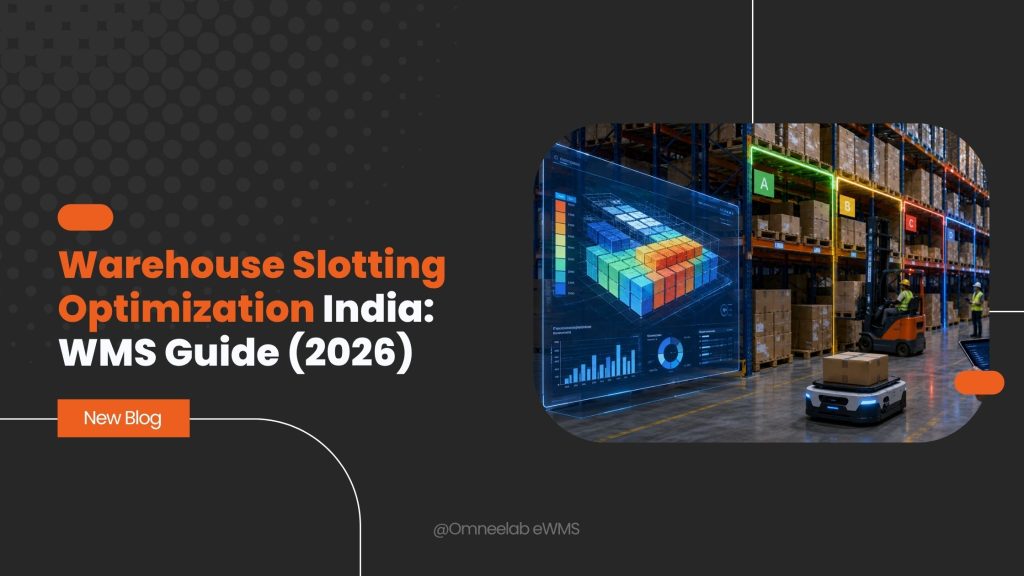
The impact is significant. Businesses that implement WMS-driven warehouse slotting optimization in India typically see 20 to 40% improvement in picking speed, 20 to 30% better space utilization, and measurable reduction in labor costs. For Indian e-commerce businesses handling thousands of orders daily across multiple marketplaces, this optimization directly translates to faster fulfillment, lower costs, and better customer experience.
This guide covers everything Indian businesses need to know about slotting optimization: what it is, how WMS automates it, the 5 key strategies, industry-specific applications, storage optimization techniques, and the KPIs that measure success.
Parent guide: Smart Warehouse Technology in India: WMS Guide (2026)
What is Warehouse Slotting Optimization?
Warehouse slotting optimization is the strategic process of determining the best storage location for every product in a warehouse. In other words, it answers the question: “Where should each item live so that the warehouse operates at maximum efficiency?”
Traditionally, Indian warehouses assign locations based on convenience or arrival sequence. For example, new stock goes wherever there is empty space. Consequently, fast-moving items end up in the back of the warehouse while slow-moving items occupy prime locations near packing stations.
In contrast, WMS-driven slotting uses data and algorithms to place products intelligently:
| Slotting Approach | How It Works | Limitation |
|---|---|---|
| No Slotting (Random) | Items stored wherever space is available | Maximum travel time, frequent errors |
| Fixed Slotting | Each SKU has a permanent assigned location | Does not adapt to demand changes |
| Dynamic Slotting | WMS continuously adjusts locations based on real-time data | Requires WMS, but delivers highest ROI |
The key difference between basic slotting and WMS-driven slotting optimization is intelligence. A WMS does not just assign locations once. Instead, it continuously analyzes picking data, demand patterns, and seasonal shifts to recommend re-slotting actions that keep the warehouse optimized as conditions change.
Related: Guide to Warehouse Order Picking Process, Methods and Types
How WMS Automates Warehouse Slotting Optimization in India
Without WMS, slotting optimization requires manual analysis of spreadsheets, physical observation of picker movements, and gut-feeling decisions about product placement. This is time-consuming, inaccurate, and impossible to maintain as SKU counts grow.
In contrast, WMS automates the entire slotting process through several capabilities:
Data Collection and Analysis
First, WMS continuously collects data on every warehouse activity:
- Picking frequency per SKU (how often each item is picked per day/week)
- Order correlation (which items are frequently ordered together)
- SKU dimensions and weight (physical characteristics affecting storage)
- Seasonal demand patterns (velocity changes during festive seasons, sales events)
- Current location performance (travel time, congestion, replenishment frequency)
Slotting Algorithm and Recommendations
Next, the WMS slotting module processes this data through optimization algorithms. Specifically, it calculates the ideal location for each product, taking into account the warehouse layout, picker movements, picking method, and equipment used. Furthermore, it recommends classification of products according to sales forecasts and demand analysis.
Automated Re-Slotting Execution
Finally, WMS generates recommended re-slotting actions on a weekly or bi-weekly basis. For example, the system identifies SKUs that have moved to a different velocity tier, recommends new locations, and guides warehouse workers through the physical re-slotting process via the mobile app with turn-by-turn instructions.
OmneeLab’s WMS provides these capabilities natively: the system continuously monitors velocity changes, generates re-slotting recommendations, and enables workers to execute moves efficiently without disrupting ongoing picking operations.
Related: AI in Warehouse Management in India
SKU Velocity Analysis: The Foundation of Smart Slotting
Before implementing any slotting strategy, WMS must first understand how fast each product moves. This is called SKU velocity analysis, and it is the foundation of all intelligent slotting decisions.
ABC Classification
The most common velocity framework is ABC analysis:
| Category | Definition | % of SKUs | % of Picks | Slotting Action |
|---|---|---|---|---|
| A Items | Fast movers, highest pick frequency | 10 to 20% | 60 to 80% | Place in golden zone, closest to packing stations |
| B Items | Medium movers, moderate pick frequency | 20 to 30% | 15 to 25% | Place in accessible but not prime locations |
| C Items | Slow movers, rarely picked | 50 to 70% | 5 to 10% | Place in upper racks, back of warehouse, reserve storage |
Heat Mapping
Additionally, WMS can generate velocity heat maps that visually represent picking activity across the warehouse. These heat maps show which zones are accessed most frequently, helping warehouse managers identify:
- Hot zones (high traffic, potential congestion)
- Cold zones (underutilized space that could store more)
- Bottleneck areas (where pickers cluster and slow each other down)
Continuous Velocity Recalculation
Importantly, SKU velocity is not static. In Indian e-commerce, velocity changes dramatically during:
- Festive seasons (Diwali, Big Billion Days) when certain categories spike 5x to 10x
- Seasonal shifts (winter clothing, monsoon products)
- New product launches that quickly become fast movers
- End-of-life products that slow down before discontinuation
Therefore, WMS continuously recalculates velocity and triggers re-slotting recommendations when items move between A, B, and C categories. This ensures the warehouse stays optimized even as demand patterns shift unpredictably.
Related: Demand-Driven Replenishment
5 WMS-Driven Slotting Strategies for Indian Warehouses
Here are the 5 most effective slotting strategies that WMS implements for Indian warehouses. Importantly, each strategy addresses a specific operational challenge.
Strategy 1: Velocity-Based Slotting
What it does: Places fast-moving items (A category) in the most accessible locations, closest to packing stations and at ergonomic picking heights.
How WMS implements it: WMS analyzes picking frequency data and automatically assigns high-velocity SKUs to the golden zone (waist to shoulder height, nearest to dispatch area). Consequently, slow movers are pushed to upper racks or back zones.
Impact: Reduces average pick path distance by 25 to 35%. As a result, picks per hour increase by 30 to 40%.
Best for: E-commerce fulfillment centers with high order volumes and diverse SKU ranges.
Strategy 2: Family Grouping (Affinity Slotting)
What it does: Stores items that are frequently ordered together in adjacent locations.
How WMS implements it: WMS analyzes order correlation data to identify product affinities. For example, if phone cases and screen protectors are ordered together 70% of the time, WMS places them in neighboring bins. As a result, pickers can grab both items without walking to different zones.
Impact: Reduces multi-item order pick time by 20 to 30%.
Best for: D2C brands with complementary product ranges, electronics accessories, beauty and personal care.
Strategy 3: Ergonomic Slotting
What it does: Places products based on physical handling requirements to reduce worker fatigue and injury risk.
How WMS implements it: Heavy items are stored at waist height (no bending or reaching). Light items go on upper and lower shelves. Fragile items are placed in protected locations. Specifically, WMS factors in weight, dimensions, and handling constraints for every SKU.
Impact: Reduces workplace injuries by 40 to 50%. Additionally, improves picker endurance over long shifts.
Best for: Warehouses with heavy products (electronics, appliances, beverages) or high shift durations.
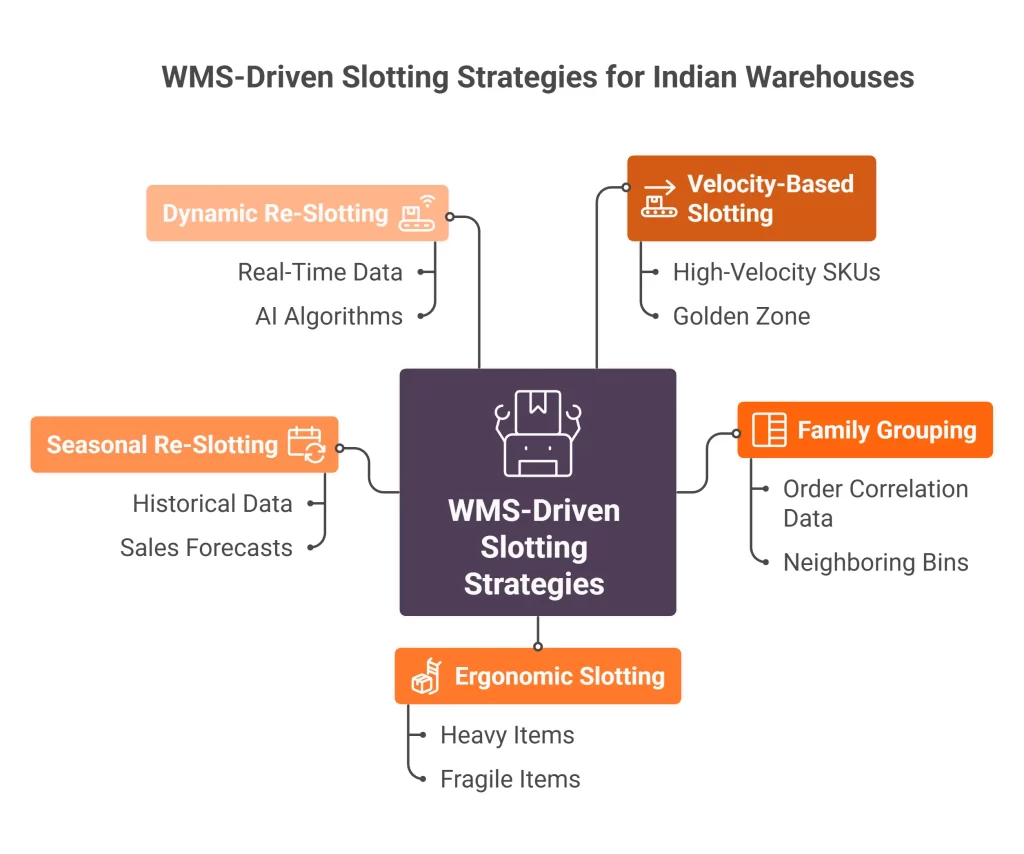
Strategy 4: Seasonal Re-Slotting
What it does: Proactively moves seasonal products to prime locations before demand spikes.
How WMS implements it: Based on historical data and sales forecasts, WMS identifies products that will spike during upcoming seasons (for example, diyas and decorations before Diwali, winter clothing before November). Consequently, it generates re-slotting recommendations 2 to 3 weeks before the season begins, moving these items to A-zone locations.
Impact: Eliminates the chaos of festive season fulfillment. Specifically, prevents the situation where suddenly high-demand items are stuck in the back of the warehouse.
Best for: Indian e-commerce businesses with strong seasonal patterns (fashion, gifting, home decor, FMCG).
Related: Smart Inventory Management During Festive Rush with Mobile WMS
Strategy 5: Dynamic Re-Slotting (AI-Driven)
What it does: Continuously adjusts product locations based on real-time demand changes without manual intervention.
How WMS implements it: Dynamic slotting uses real-time data and algorithms to adjust inventory placement continuously. As demand patterns shift, the system automatically recommends new, more optimal locations. Furthermore, re-slotting actions are queued in shift-based waves to avoid disruption during peak picking windows.
Impact: Throughput increases of 20 to 40% with dynamic slotting. Moreover, the warehouse stays optimized even as demand patterns change unpredictably.
Best for: High-volume warehouses with rapidly changing demand patterns, 3PLs managing multiple clients, quick commerce dark stores.
Related: Dark Store WMS for Quick Commerce in India
WMS Slotting for Different Warehouse Types in India
Different warehouse types require different slotting approaches. Here is how WMS adapts:
E-commerce Fulfillment Centers
- Challenge: High SKU count (5,000 to 50,000+), fast velocity changes, multi-channel orders
- Slotting approach: Velocity-based + family grouping + dynamic re-slotting
- WMS role: Continuous velocity recalculation, automated re-slotting recommendations weekly
3PL Multi-Client Warehouses
- Challenge: Multiple clients sharing space, client-specific zones, varying velocity patterns per client
- Slotting approach: Zone-based slotting per client + velocity-based within each zone
- WMS role: Client-specific slotting rules, cross-client space optimization
Related: 3PL Warehouse Management Guide: Scaling Logistics
FMCG and Food Warehouses
- Challenge: Batch and expiry management, FEFO (First Expiry First Out) compliance, temperature zones
- Slotting approach: Expiry-based slotting + velocity-based within expiry constraints
- WMS role: FEFO-compliant slot assignment ensuring oldest stock is picked first
Related: Batch and Expiry Tracking in FMCG
Also read: Managing Perishable Inventory
Cold Chain Warehouses
- Challenge: Temperature zones (2 to 8°C, 15 to 25°C), limited space per zone, high cost per sq ft
- Slotting approach: Temperature zone-based + velocity-based within each zone
- WMS role: Temperature zone-aware slot assignment, maximizing utilization within each expensive cold zone
Related: WMS for Cold Chain Warehousing in India
Fashion and Apparel Warehouses
- Challenge: Size/color/style variants creating thousands of SKUs, high return rates, seasonal collections
- Slotting approach: Family grouping by style + velocity-based within each family + seasonal re-slotting
- WMS role: Variant-aware slotting that keeps all sizes of a popular style together for efficient multi-pick
Storage Optimization Techniques Powered by WMS
Beyond slotting (which product goes where), WMS also optimizes how storage space itself is used. Here are the key storage optimization techniques:
Vertical Space Utilization
Most Indian warehouses underutilize vertical space. Specifically, while floor space is expensive, height is often free. WMS optimizes vertical storage by:
- Assigning heavy/bulky items to lower levels and light items to upper racks
- Tracking rack capacity by level and alerting when vertical space is underutilized
- Supporting multi-level racking configurations with bin-level tracking
Bin Size Optimization
WMS analyzes SKU dimensions and recommends optimal bin sizes for each location. For example, if a large bin holds only small items, WMS flags this as wasted cube utilization and recommends splitting into smaller bins. As a result, the same rack can hold 30 to 50% more SKUs.
Overflow Management and Zone Balancing
When primary pick locations overflow, WMS automatically identifies overflow storage locations and creates replenishment tasks to keep forward pick areas stocked. Furthermore, it balances inventory across zones to prevent congestion in any single area.
Related: Warehouse Overflow Challenges and Solutions
Pick Path Optimization Through Layout
WMS uses slotting data to recommend warehouse layout changes that minimize total travel distance. For instance, if analysis shows that 80% of picks happen in 20% of the warehouse, WMS recommends reorganizing the layout to bring that 20% closer to packing stations. Consequently, efficient slotting reduces travel time and congestion, which are two of the biggest warehouse efficiency killers.
Related: Warehouse KPIs and Metrics Dashboard Guide
Measuring Slotting Optimization Success: KPIs
How do you know if your warehouse slotting optimization in India is working? Here are the KPIs that WMS tracks:
| KPI | What It Measures | Before Slotting | After WMS Slotting |
|---|---|---|---|
| Average Pick Path Distance | Total distance walked per order | 150 to 250 meters | 80 to 120 meters (30 to 40% reduction) |
| Picks Per Hour (PPH) | Worker productivity | 40 to 60 picks/hour | 80 to 120 picks/hour |
| Space Utilization % | Effective use of available space | 60 to 70% | 85 to 95% |
| Replenishment Frequency | How often forward picks need restocking | 8 to 12 times/day | 3 to 5 times/day |
| Mis-Pick Rate | Errors due to location confusion | 2 to 4% | Under 0.5% |
| Congestion Incidents | Pickers blocking each other in aisles | Frequent | Rare (zone-balanced) |
| Pick-to-Ship Time | Total fulfillment speed | 6 to 12 hours | 2 to 4 hours |
WMS uses AI-driven analytics to determine optimal storage locations based on SKU velocity, order frequency, and warehouse layout. By dynamically adjusting slotting, the system reduces travel time and balances workloads across the warehouse floor.
Implementing Slotting Optimization in Your Existing Warehouse
Many Indian businesses worry that slotting optimization requires a complete warehouse overhaul. However, that is not the case. Here is a practical implementation roadmap that any warehouse can follow:
Phase 1: Data Collection (Week 1 to 2)
First, deploy your WMS and start tracking all picking activity across the warehouse floor. During this phase, collect 2 to 4 weeks of picking data for velocity analysis. Additionally, map your current warehouse layout and all bin locations within the WMS system.
Phase 2: Initial ABC Analysis (Week 3)
Once sufficient data is collected, the WMS classifies all SKUs into A, B, and C categories based on picking frequency. Next, generate heat maps that show current picking patterns across zones. Finally, identify the biggest mismatches where fast movers occupy poor locations.
Phase 3: First Re-Slotting Wave (Week 4)
Based on the ABC analysis, your WMS generates re-slotting recommendations for the top 20% of SKUs (A items). Workers then execute re-slotting via the mobile WMS app with guided step-by-step instructions. Importantly, schedule these moves during low-volume hours to avoid disruption to ongoing fulfillment.
Phase 4: Continuous Optimization (Ongoing)
From this point forward, the system monitors velocity changes weekly and recommends adjustments automatically. Before festive seasons, seasonal re-slotting is triggered based on historical demand patterns. In addition, monthly slotting performance reports track KPI improvements and highlight further optimization opportunities.
Key principle: You do not need to re-slot the entire warehouse at once. Instead, start with A items (top 20% of SKUs that drive 80% of picks). This alone delivers the majority of the benefit with minimal disruption.
Furthermore, your WMS should support continuous re-slotting based on order mix and inventory shifts. Ultimately, dynamic slotting does not just optimize space. It orchestrates flow, enabling faster, leaner, and more profitable operations.
Related: How WMS Powers Order Fulfillment in Indian Warehouses
Conclusion: Smarter Slotting Starts with WMS
Warehouse slotting optimization in India is one of the highest-ROI improvements any warehouse can make. Importantly, it requires no new infrastructure, no additional space, and no major capital investment. It simply requires placing products in smarter locations based on data rather than habit.
WMS makes this possible by continuously analyzing picking patterns, calculating optimal placements, and guiding workers through re-slotting execution. As a result, the warehouse adapts in real time, reducing footsteps, preventing bottlenecks, and keeping high-velocity inventory exactly where pickers need it most.
For Indian businesses facing rising warehouse rents, growing SKU counts, and increasing customer expectations for fast delivery, slotting optimization is not optional. On the contrary, it is the difference between a warehouse that costs money and a warehouse that makes money.
The best part is that you can start today. Deploy WMS, collect 2 to 4 weeks of data, and let the system tell you exactly where every product should live. The improvements begin immediately.
Ready to optimize your warehouse slotting? OmneeLab’s cloud-based WMS includes built-in slotting optimization with SKU velocity analysis, dynamic re-slotting recommendations, and mobile-guided execution. Go live in 2 weeks.
Book a Free Demo | Explore OmneeLab WMS
Frequently Asked Questions
Slotting Basics
In essence, warehouse slotting optimization India is the process of assigning the right product to the right storage location based on data such as picking frequency, product dimensions, order correlations, and seasonal demand. Specifically, WMS automates this process by continuously analyzing warehouse activity and recommending optimal placements that minimize travel time and maximize space utilization.
Fixed slotting assigns each SKU a permanent location that does not change. In contrast, dynamic slotting uses WMS data and algorithms to continuously adjust locations based on real-time demand changes. Consequently, dynamic slotting delivers significantly higher ROI because it adapts to changing conditions automatically.
The golden zone refers to the most ergonomic and accessible picking locations in a warehouse, typically at waist to shoulder height on racks closest to packing stations. As a result, WMS assigns the highest-velocity SKUs to golden zone locations to minimize bending, reaching, and walking.
With WMS, slotting is reviewed continuously. Specifically, the system monitors velocity changes daily and generates re-slotting recommendations weekly or bi-weekly. Additionally, major re-slotting events should occur before festive seasons (2 to 3 weeks in advance) and after significant catalog changes.
India-Specific Slotting Questions
Before festive seasons like Diwali and Big Billion Days, WMS identifies products expected to spike in demand based on historical data. Consequently, it generates seasonal re-slotting recommendations that move these items to prime A-zone locations 2 to 3 weeks before the event. After the season, WMS recommends reverting to normal slotting patterns.
Absolutely, yes. In fact, small warehouses benefit even more from slotting optimization because space is more constrained. Even a 2,000 sq ft warehouse can see 20 to 30% improvement in picking speed through basic velocity-based slotting. Cloud-based WMS like OmneeLab makes this accessible starting at ₹2,000/month.
Typically, WMS-driven slotting optimization reduces average pick path distance by 25 to 40% and increases picks per hour by 30 to 50%. For example, a warehouse processing 1,000 orders per day can save 2 to 3 hours of total picker labor daily through optimized slotting alone.
Yes. Modern WMS platforms like OmneeLab provide automated re-slotting recommendations based on changing velocity patterns. The system identifies SKUs that have moved between velocity tiers, recommends new locations, and guides workers through the physical re-slotting process via the mobile app with step-by-step instructions.

Kapil Pathak is a Senior Digital Marketing Executive with over six years of experience specializing in the logistics and supply chain industry. His expertise spans digital strategy, search engine optimization (SEO), search engine marketing (SEM), and multi-channel campaign management. He has a proven track record of developing initiatives that increase brand visibility, generate qualified leads, and drive growth for D2C & B2B technology companies.