Every order that reaches an Indian customer’s doorstep starts its journey inside a warehouse. From the moment an order is placed on Flipkart, Amazon, Shopify, or any D2C website, a complex chain of warehouse operations must execute flawlessly: inventory must be verified, items must be picked from the right locations, packed correctly, labeled for the right carrier, and dispatched within tight SLA windows. WMS order fulfillment in India is the technology that makes this entire chain work with speed, accuracy, and consistency.
A Warehouse Management System (WMS) does not just track inventory. It actively orchestrates every step of the order fulfillment process inside the warehouse, from the moment an order enters the system to the moment the packed shipment leaves the dock. For Indian businesses dealing with COD orders, multi-marketplace SLAs, GST compliance, and festive season volume spikes, WMS is not a luxury. It is the operational backbone that separates businesses that scale from businesses that struggle.
This article explores the 7 specific ways WMS powers order fulfillment in Indian warehouses, the India-specific challenges WMS solves, how WMS compares to OMS, and which business models benefit most from WMS-driven fulfillment.
For the complete fulfillment ecosystem overview: WMS for Warehouse Fulfillment in India: Complete Guide (2026)
The Order Fulfillment Journey Inside a Warehouse
Before understanding how WMS powers fulfillment, it is important to understand the order fulfillment process in a warehouse. Every order goes through six stages:
| Stage | What Happens | Where Errors Occur Without WMS |
|---|---|---|
| 1. Order Received | Order enters the system from marketplace/website | Orders missed, duplicated, or delayed |
| 2. Inventory Allocated | System checks stock availability and assigns inventory | Overselling, wrong warehouse allocation |
| 3. Picking | Worker retrieves items from storage locations | Wrong item picked, item not found, excessive walking |
| 4. Packing | Items verified, packed, and labeled | Wrong item packed, incorrect label, missing items |
| 5. Dispatch | Package handed to carrier for delivery | Wrong carrier, delayed handoff, missing e-way bill |
| 6. Returns | Returned items received, inspected, restocked | Returns pile up, inventory not updated, items lost |
WMS automates, optimizes, and verifies every single stage. The result is faster processing, fewer errors, and lower costs at every step of the order-to-ship cycle.
Deep dive into picking methods: Guide to Warehouse Order Picking Process, Methods and Types
7 Ways WMS Powers Order Fulfillment in India
Here are the 7 specific ways WMS transforms order fulfillment in Indian warehouses, each tied to a concrete WMS feature and measurable business impact.
Way 1: Real-Time Inventory Accuracy Prevents Overselling
The foundation of accurate order fulfillment is knowing exactly what inventory you have, where it is stored, and how much is available to sell. WMS maintains a single source of truth for inventory across all channels and warehouse locations.
Every scan at receiving, putaway, picking, packing, and returns updates inventory in real-time. This means:
- Zero overselling because stock levels sync instantly across Flipkart, Amazon, Shopify, and your own website
- Zero ghost inventory because every item has a verified physical location
- Zero stockouts because WMS triggers replenishment alerts before stock runs out
For Indian e-commerce sellers managing inventory across 3 to 5 marketplaces simultaneously, this real-time sync is the difference between smooth operations and a flood of cancellations and penalties.
Impact: Inventory accuracy improves from 85 to 90% (manual) to 99%+ (WMS-driven).
Related: Inventory Visibility in 2025: Why It Matters
Also read: Stock Management for Ecommerce India 2026: Complete Guide
Way 2: Intelligent Order Allocation Across Warehouses and Channels
When orders pour in from multiple channels simultaneously, someone (or something) must decide:
- Which warehouse should fulfill each order?
- Which orders should be prioritized?
- How should orders be grouped for efficient picking?
Without WMS, a warehouse manager makes these decisions manually, often based on gut feeling or first-come-first-served logic. This leads to suboptimal allocation, missed SLAs, and wasted resources.
WMS order allocation uses intelligent logic to make these decisions automatically:
| Allocation Factor | How WMS Handles It |
|---|---|
| Nearest warehouse | Routes order to the warehouse closest to the delivery pin code, reducing shipping cost and time |
| Stock availability | Checks real-time inventory at each location before allocating |
| SLA deadline | Prioritizes orders with the tightest dispatch deadlines (Flipkart 24-hour SLA gets priority over a 3-day order) |
| Channel rules | Applies marketplace-specific rules (Amazon FBM has different requirements than Shopify orders) |
| Order splitting | If one warehouse does not have all items, WMS splits the order across locations intelligently |
| Cost optimization | Selects the allocation that minimizes total fulfillment cost (shipping + handling) |
This intelligent allocation is especially critical during festive season order fulfillment when volumes spike 5x to 10x and manual prioritization becomes impossible.
Related: Multi-Warehouse Inventory Management in India
Way 3: Optimized Picking Strategies Reduce Time and Errors
Picking is the most labor-intensive and error-prone stage of order fulfillment, accounting for 55 to 65% of total warehouse labor costs. WMS picking optimization in India transforms this stage through:
| Picking Strategy | How WMS Implements It | Best For |
|---|---|---|
| Wave Picking | Groups orders into waves by cut-off time, carrier, or zone | Medium to high volume warehouses |
| Batch Picking | One picker collects items for multiple orders simultaneously | High-SKU, low-units-per-order businesses |
| Zone Picking | Each picker handles only their assigned zone | Large warehouses with distinct zones |
| Cluster Picking | Picker handles multiple orders on a single cart | Small to medium warehouses |
Beyond strategy selection, WMS provides:
- Optimized pick paths that calculate the shortest walking route through the warehouse
- Mobile device guidance with step-by-step instructions showing exact bin locations
- Scan-verified picking where the picker must scan the item barcode to confirm the correct SKU before the system accepts the pick
If the scanned barcode does not match the expected item, WMS immediately rejects the pick and alerts the worker. This single feature alone can push picking accuracy from 95% to 99.5%+.
Deep dive: Paperless Picking Guide for Modern Warehouses
Way 4: Barcode-Verified Packing Eliminates Wrong Shipments
After picking, items arrive at the packing station. This is where WMS automated packing verification ensures that what was picked is exactly what gets shipped.
The WMS packing workflow:
1. Scan verification at packing station confirms every item matches the order
2. Channel-specific packing rules are applied automatically:
- Amazon orders get Amazon-compliant labels and packing slips
- Flipkart orders get Flipkart-specific labeling
- D2C orders get branded packaging with custom inserts
3. Weight verification compares actual package weight against expected weight to catch missing or extra items
4. Automated packing slip generation with order details, return instructions, and invoice
5. Shipping label generation with carrier-specific formatting
This multi-step verification process creates a chain of custody from pick to pack to ship. The result is near-zero wrong shipments, which directly reduces returns, marketplace penalties, and customer complaints.
Impact: Wrong shipment rate drops from 3 to 5% (manual) to under 0.5% (WMS-driven).
Related: Warehouse Barcode Scanning: Complete 3PL Guide
Way 5: Automated Carrier Selection and Dispatch
Indian e-commerce businesses typically work with 5 to 15 carriers (Delhivery, Shiprocket, BlueDart, Ecom Express, DTDC, Xpressbees, and more). Choosing the right carrier for each order manually is slow, error-prone, and often suboptimal.
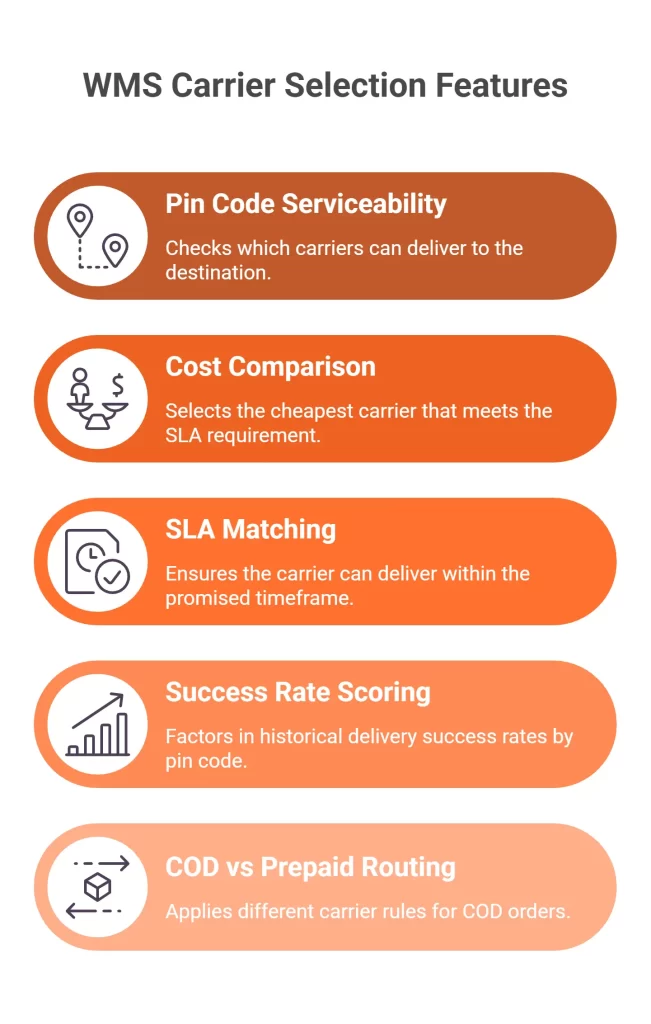
WMS carrier selection in India automates this entirely:
- Pin code serviceability check determines which carriers can deliver to the destination
- Cost comparison selects the cheapest carrier that meets the SLA requirement
- SLA matching ensures the carrier can deliver within the promised timeframe
- Success rate scoring factors in historical delivery success rates by pin code
- COD vs prepaid routing applies different carrier rules for COD orders (higher RTO risk)
Once the carrier is selected, WMS automatically:
- Generates the shipping label in the carrier’s required format
- Creates the manifest for carrier pickup
- Pushes tracking information back to the marketplace/customer
- Generates e-way bills for inter-state shipments (GST compliance)
This end-to-end automation reduces dispatch time from hours to minutes and ensures every order leaves the warehouse with the optimal carrier.
Related: Integrating WMS with Last Mile Delivery in India
Way 6: Real-Time Order Tracking and Visibility
Once an order enters the WMS, its status is tracked in real-time through every stage. WMS order tracking in India provides:
For Warehouse Managers
- Live order dashboard showing orders in each stage (allocated, picking, packing, dispatched)
- Bottleneck detection highlighting stages where orders are stuck or delayed
- Worker performance tracking showing picks per hour, packing speed, and error rates per worker
- SLA countdown timers flagging orders approaching their dispatch deadline
For Marketplace and Customer Communication
- Automated status updates pushed to Flipkart, Amazon, Shopify order management
- Tracking number sync so customers receive carrier tracking information instantly
- Exception alerts when orders cannot be fulfilled (out of stock, damaged item)
This visibility transforms order fulfillment from a black box into a transparent, measurable, and controllable process. Warehouse managers can see problems forming in real-time and take corrective action before they impact customers.
Related: Warehouse KPIs and Metrics Dashboard Guide
Way 7: Fulfillment KPI Dashboards Drive Continuous Improvement
WMS does not just execute fulfillment. It measures everything and provides actionable insights through KPI dashboards:
| KPI | What It Measures | Manual Warehouse | WMS-Driven Target |
|---|---|---|---|
| Order Accuracy Rate | % of orders shipped correctly | 95 to 97% | 99.5%+ |
| Pick-to-Ship Time | Time from order received to dispatched | 8 to 24 hours | Under 4 hours |
| Fulfillment Cost per Order | Total cost to fulfill one order | High, untracked | Reduce by 20 to 35% |
| Inventory Accuracy | System vs physical stock match | 85 to 90% | 99%+ |
| Units Per Hour (UPH) | Picker productivity | 30 to 50 | 80 to 150+ |
| On-Time Dispatch Rate | % orders dispatched within SLA | 80 to 85% | 95%+ |
| Return Processing Time | Time to process and restock returns | 3 to 5 days | Under 24 hours |
These KPIs are not just numbers on a screen. WMS uses them to automatically optimize operations: if pick-to-ship time increases, WMS adjusts wave planning. If a specific zone shows higher error rates, WMS flags it for investigation. This creates a continuous improvement loop that gets better over time.
WMS for India-Specific Order Fulfillment Challenges
Indian order fulfillment has unique challenges that global WMS guides do not address. Here is how WMS handles each one:
| Challenge | India Context | How WMS Solves It |
|---|---|---|
| COD Orders | 60%+ of e-commerce orders are COD, creating higher RTO risk | COD verification workflows, automated RTO prediction, COD-specific dispatch rules |
| Marketplace SLAs | Flipkart and Amazon penalize late dispatch with financial penalties and ranking drops | Auto-prioritization by SLA deadline, countdown timers, alert escalation |
| GST Compliance | Multi-state operations require state-wise tax calculation | Automated GST calculation, GSTIN-based invoicing, state-wise compliance reports |
| E-Way Bills | Mandatory for inter-state goods movement above ₹50,000 | Auto-generation integrated into dispatch workflow |
| Festive Season Spikes | 5x to 10x volume during Diwali, Big Billion Days | Wave planning, priority allocation, temp worker onboarding via guided mobile WMS |
| High RTO Rates | 25 to 30% in fashion/lifestyle categories | Address verification at order level, RTO prediction analytics |
| Multi-Carrier Complexity | 50+ carrier options with varying service quality | Pin code-based auto carrier selection, carrier scoring by success rate |
Related: Smart Inventory Management During Festive Rush with Mobile WMS
WMS vs OMS: Which Do You Need for Order Fulfillment?
A common question Indian businesses ask is whether they need a WMS or an OMS (Order Management System) for order fulfillment.
The simple answer:
- OMS handles what to fulfill: order capture, routing across channels, customer communication, and order lifecycle visibility
- WMS handles how to fulfill: the physical warehouse operations of picking, packing, shipping, and returns
For most Indian e-commerce businesses, WMS is the more critical investment because it directly controls the warehouse operations where errors, delays, and costs occur. OMS becomes necessary when you scale to omnichannel operations with complex order routing logic across multiple fulfillment nodes.
Many businesses start with WMS alone and add OMS later as they grow. Some modern WMS platforms like OmneeLab include basic order management capabilities, reducing the need for a separate OMS for most use cases.
Detailed comparison: WMS vs OMS in Supply Chain Management
WMS Order Fulfillment for Different Business Models in India
Different business models have different fulfillment requirements. Here is how WMS adapts:
WMS for D2C Order Fulfillment
D2C brands need WMS that handles direct website orders (Shopify, WooCommerce), marketplace orders simultaneously, branded packaging workflows, subscription fulfillment, and COD management. The best WMS for D2C order fulfillment offers all these in a single cloud platform.
Related: WMS for Shopify E-commerce Fulfillment in India
WMS for Marketplace Seller Fulfillment
Marketplace sellers need WMS that auto-imports orders from Flipkart, Amazon, Myntra, and Meesho, applies marketplace-specific packing and labeling rules, meets strict SLA deadlines, and handles marketplace-specific returns workflows.
Related: WMS for Flipkart Sellers in India
WMS for 3PL Order Fulfillment in India
3PL providers need multi-tenant WMS that manages multiple clients in a single warehouse with client-specific rules, billing (per order, per pallet, per sq ft), SLA tracking, and reporting. WMS for 3PL order fulfillment in India must also support rapid client onboarding and scalable architecture.
Related: 3PL Warehouse Management Guide: Scaling Logistics
WMS for Omnichannel Fulfillment
Businesses selling through online + offline channels need WMS that unifies inventory across all channels, supports ship-from-store, handles BOPIS (Buy Online Pick Up In Store), and manages split shipments across locations.
Related: WMS-ERP Integration
Conclusion: WMS is the Engine Behind Every Successful Order in India
Every order that reaches an Indian customer on time, with the right product, in the right packaging, is the result of a warehouse that executes flawlessly. And behind that flawless execution is a WMS.
From real-time inventory accuracy that prevents overselling, to intelligent order allocation that routes each order to the optimal warehouse, to scan-verified picking and packing that eliminates wrong shipments, to automated carrier selection that chooses the best delivery partner for every pin code, WMS order fulfillment in India is the technology that makes modern e-commerce possible.
The 7 ways outlined in this guide are not theoretical. They are practical, measurable capabilities that Indian businesses are using today to:
- Achieve 99%+ order accuracy
- Process orders 30 to 50% faster
- Reduce fulfillment costs by 20 to 35%
- Handle festive season spikes without breaking
- Meet Flipkart and Amazon SLAs consistently
The businesses that invest in WMS-driven order fulfillment today are building the operational foundation to scale 5x, 10x, or 50x over the next three to five years.
Ready to power your order fulfillment with WMS? OmneeLab’s cloud-based WMS is built for Indian e-commerce businesses. Go live in 2 weeks with pre-built integrations for Flipkart, Amazon, Shopify, Delhivery, Shiprocket, and 20+ platforms.
Book a Free Demo | Explore OmneeLab WMS
Frequently Asked Questions
WMS and Order Fulfillment Basics
WMS improves order fulfillment by automating order allocation, optimizing picking routes, enabling barcode-verified packing, automating carrier selection, and providing real-time KPI dashboards. Businesses typically see 30 to 50% faster order processing and 99%+ order accuracy after WMS implementation.
WMS manages the entire order processing workflow inside the warehouse: receiving the order from marketplaces/websites, allocating inventory, generating optimized pick lists, guiding pickers via mobile devices, verifying packing accuracy through barcode scanning, selecting the optimal carrier, generating shipping labels, and tracking the order through dispatch.
The order fulfillment process has six stages: order received, inventory allocated, items picked from storage, items packed and labeled, package dispatched to carrier, and returns processed. WMS automates and optimizes every stage.
India-Specific Order Fulfillment Questions
WMS applies COD-specific workflows including address verification before dispatch, RTO prediction scoring based on pin code and order history, COD-specific carrier selection (carriers with better COD delivery rates), and automated reconciliation of COD payments received.
WMS auto-prioritizes orders by SLA deadline, showing countdown timers for each order. Orders approaching their dispatch deadline are escalated automatically. Marketplace-specific packing rules and label formats are applied without manual intervention, ensuring compliance.
Yes. Modern WMS platforms like OmneeLab offer native integrations with 20+ Indian carriers including Delhivery, Shiprocket, BlueDart, Ecom Express, DTDC, and Xpressbees. This enables automated carrier selection, label generation, tracking updates, and manifest creation.
WMS handles festive spikes through pre-configured wave planning for anticipated volume, guided mobile workflows for rapid temporary worker onboarding (start picking within 30 minutes), auto-scaling cloud infrastructure, priority-based order allocation, and real-time dashboards for bottleneck detection.
WMS Evaluation and ROI Questions
Yes. Cloud-based WMS starts at ₹2,000/month and can be live within 2 weeks. Even for businesses processing 100 to 500 orders per day, WMS delivers measurable ROI through error reduction (fewer returns and penalties), faster dispatch (better marketplace rankings), and labor productivity gains (fewer workers needed per order).
The best WMS for order fulfillment in India offers real-time inventory sync across all channels, optimized picking strategies, barcode-verified packing, automated multi-carrier selection, marketplace integration (Flipkart, Amazon, Shopify), COD management, GST compliance, and affordable cloud-based pricing. OmneeLab’s WMS is built specifically for Indian e-commerce and D2C businesses with all these capabilities.
Key KPIs include order accuracy rate (target 99.5%+), pick-to-ship time (under 4 hours), fulfillment cost per order (reduce by 20 to 35%), inventory accuracy (99%+), units per hour per picker (80 to 150+), on-time dispatch rate (95%+), and return processing time (under 24 hours).

Kapil Pathak is a Senior Digital Marketing Executive with over six years of experience specializing in the logistics and supply chain industry. His expertise spans digital strategy, search engine optimization (SEO), search engine marketing (SEM), and multi-channel campaign management. He has a proven track record of developing initiatives that increase brand visibility, generate qualified leads, and drive growth for D2C & B2B technology companies.