Picture a shelf at the back of your warehouse. It holds boxes you ordered with great hope a year or two ago. Nobody has touched them since. Yet every month they cost you rent, insurance and attention.

That shelf is dead stock in inventory, and almost every Indian business has some. A small retailer may have a few cartons. A manufacturer may have lakhs of rupees locked in spare parts that nobody orders.
The good news? Dead stock is fixable. In this guide, you will learn:
- What dead stock means and how it differs from slow-moving stock
- Why it builds up and what it really costs you
- How to spot it using simple reports
- Seven ways to clear it
- The GST and accounting rules around write-offs in India
- How to stop it from coming back
Let’s start with the basics.
What Is Dead Stock in Inventory?
Dead stock is inventory that has not sold for a long time and is unlikely to sell at full price. It sits in your warehouse, takes up space and holds cash you cannot use.
Many businesses treat 90 days with no sales as an early warning. Others use 180 or 365 days. The right cut-off depends on what you sell. Fresh food and medicines go bad fast. Machine spares can wait years for the right buyer.
You may also hear the terms dead inventory, non-moving stock or obsolete stock. In daily talk, they overlap. In practice, though, they are not the same thing.
Dead stock vs slow-moving vs obsolete vs excess
| Type | What it means | Can it recover? | Typical action |
|---|---|---|---|
| Slow-moving stock | Still sells, but slower than planned | Yes, often on its own | Adjust price, placement and reorders |
| Excess stock | More than current demand needs | Yes, given time | Pause reorders, transfer to other locations |
| Dead stock | Has stopped selling | Only with active effort | Discount, bundle or liquidate |
| Obsolete stock | Outdated, expired or unusable | Rarely | Return, scrap or write off |
Why does this split matter? Because each type needs a different fix. Treat slow movers like dead stock, and you discount items that would have sold at full price. Treat dead stock like slow movers, and you wait forever.
Also, unsold does not always mean dead. Winter jackets in May are not dead. They are simply waiting for November.
Why Dead Stock Builds Up
Nobody orders dead stock on purpose. It sneaks in through everyday decisions. Here are the most common causes.
- Weak demand forecasting. Guessing demand from gut feel or last year’s festive peak often leads to over-ordering.
- Supplier MOQ pressure. A supplier offers a better rate for 5,000 units. You need 1,500. The extra units sit and wait.
- Product lifecycle changes. A new model, new packaging or a new compliance rule can make older stock hard to sell.
- Missed seasons. Festive, wedding and winter goods lose value quickly once the season ends.
- Returns and RTO. Returned parcels often come back opened, damaged or without tags. If nobody re-inspects them, they pile up in a corner.
- Expiry and damage. Weak FEFO discipline, poor storage and rough handling turn good stock into waste.
- Poor visibility. With several warehouses or sales channels, stock can hide in one place while another place reorders the same item.
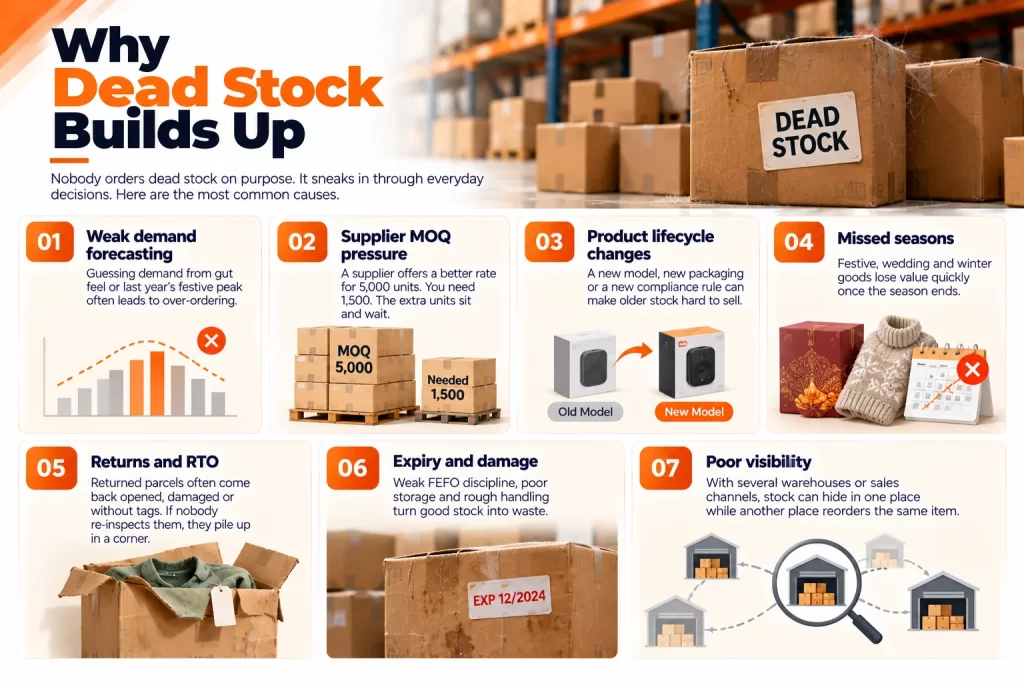
Notice the pattern? Most causes come down to missing information. You did not know what was selling, what was ageing or where stock was sitting.
Fix that, and you have won half the battle.
The Real Cost of Dead Stock
It is easy to shrug and say, “I already paid for it.” That is the trap. The purchase price is only the start of the bill.
Think of dead stock like a gym membership you never use. You keep paying, and you get nothing back.
Here is what dead stock quietly drains:
- Blocked cash. Money stuck in boxes cannot pay suppliers, salaries or ad spends.
- Storage space. Dead items occupy shelves that fast sellers could use.
- Holding costs. Rent, power, insurance, handling and staff time all add up. Many businesses estimate carrying costs at roughly 15% to 25% of inventory value each year.
- Shrinkage risk. Old stock gets damaged, misplaced or stolen more often than fresh stock.
- Tax and accounting impact. A write-off hits your profit and may trigger GST credit reversal. More on that soon.
- Planning noise. Dead items distort your turnover numbers and make forecasting harder.
A quick formula and an INR example
Start with this simple ratio:
Dead stock % = (Cost of dead stock ÷ Total inventory cost) × 100
Say a mid-sized accessories seller holds ₹60 lakh of inventory. Of that, ₹12 lakh has not moved in a year.
- Dead stock % = 12 ÷ 60 × 100 = 20%
- Yearly holding cost at 20% = ₹12 lakh × 0.20 = ₹2.4 lakh
So this business pays about ₹2.4 lakh a year to store things it cannot sell. The 20% rate is an illustration, not a benchmark. Still, it shows why a small pile is rarely small.
How to Identify Dead Stock
You cannot clear what you cannot see. Here is a simple five-step way to find it.
- Step 1: Run a stock ageing report
An ageing report shows how long each SKU has been in your warehouse. Group items into buckets:
– 0 to 90 days: healthy
– 91 to 180 days: watch closely
– 181 to 365 days: slow-moving, act now
– Over 365 days: likely dead, review each item
Adjust the buckets to your trade. A pharma distributor needs tighter windows than an auto-parts dealer. - Step 2: Check the last-sale date
Ageing tells you when stock arrived. The last-sale date tells you when it last left.
An item received 200 days ago that sold last week is not dead. An item received 100 days ago that never sold might be. - Step 3: Use ABC analysis
ABC analysis ranks items by their value to your business. A items drive most of your revenue. C items drive very little. Dead stock usually hides in the C group.
Our guide on ABC analysis in inventory management shows you how to set it up. - Step 4: Look at your turnover
The inventory turnover ratio shows how many times you sell and replace stock in a year. A very low number for a category is a red flag.
Compare category by category. A healthy overall ratio can hide one weak product line. - Step 5: Confirm with a physical count
Systems can be wrong. Before you label anything as dead, verify it. A cycle count helps you confirm quantity, condition and location.
You may find stock that was never dead, only misplaced. You may also find items the system lists but the shelves do not hold.
Once you have your list, tag each item as slow-moving, dead or obsolete. That tag decides your next move.
7 Ways to Clear Dead Stock
Do not jump straight to scrapping. Work through the options in order, from highest recovery to lowest.
1. Return to the supplier
Ask whether your supplier takes back unsold goods, even with a restocking fee. It is the cleanest exit. Check your purchase terms first.
Many suppliers agree if you offer a fresh order in return.
2. Bundle or kit
Pair slow items with fast sellers. A phone case that never moves may sell well when packed with a charger. Kitting works nicely in e-commerce because buyers see value, not clearance.
3. Run a flash sale or progressive markdown
Discount in steps, not in one deep cut. Try 10%, then 20%, then 30%.
Waiting for the end-of-season sale often costs you most of the value. Start with your own customers through WhatsApp broadcasts, email and your website.

4. Sell on marketplaces and outlets
List items as clearance on Amazon, Flipkart or Meesho. You can also use factory outlets and local wholesale markets.
Check brand rules and return policies before you list.
5. Sell to B2B liquidators
India now has surplus-stock platforms that connect sellers with bulk buyers. Excess2Sell and The Purchase House are two examples. They suit large lots, mixed lots and discontinued lines.
Expect a discount. In return, you get speed and your space back. Ask for GST invoices and written terms.
6. Donate
Donating usable goods to a registered charity clears shelves and supports a good cause. However, goods given away may also trigger GST credit reversal.
Check with your CA first, and keep clear records.
7. Write off or scrap
This is the last resort. Scrapping removes stock from your books, but it can also cost you the GST credit you already claimed. The next section explains why.
Here is a simple rule: sell it, even at a loss, before you scrap it.
Dead Stock Write-Off in India: GST and Accounting Basics
This is where many guides stop short. Foreign articles treat write-off as a plain accounting entry. In India, it can also carry a tax cost.
Quick note: this is general information, not tax advice. Please confirm the details with your chartered accountant.
How accounting treats dead stock
Under Ind AS 2 and AS 2, inventory is shown at the lower of cost and net realisable value (NRV). NRV is the price you expect to get, minus the cost of selling. If NRV drops below cost, you write the stock down.
If NRV is zero, the whole cost is written off as an expense. This is explained well in a guide to write-off rules for slow-moving, dead and obsolete stock in India.
Keep working papers for every item: quantity, cost, NRV and the write-down amount. Auditors will ask for them.
The GST trap: ITC reversal
Under Section 17(5)(h) of the CGST Act, input tax credit is blocked on goods that are written off, destroyed, lost or stolen. If you claimed ITC when you bought them, you may need to reverse it when you write them off.
Many sellers miss this step. GST audits often check for it.
Sell or scrap? A worked example
Say you hold 1,000 units that cost ₹100 each. You paid 18% GST on purchase and claimed the credit.
- Cost of goods: ₹1,00,000
- ITC claimed: ₹18,000
If you scrap them: you lose ₹1,00,000 in goods. You may also reverse ₹18,000 of ITC. Total hit: about ₹1,18,000.
If you sell them at ₹40 each: you receive ₹40,000. Your loss on the goods is ₹60,000. You charge GST on the sale as usual, and your original ITC stays in place.
Same stock, very different outcome. This example is simplified, so your actual numbers depend on your books.
Provision is not the same as write-off
A provision in your accounts is an estimate of future loss. Stock that is still physically available has not been written off or disposed of.
Tax professionals debate this difference often. Ask your CA how it applies to your case.
A 2026 update worth watching
Reports say the GST Council, at its 57th meeting on 8 October 2026, recommended easing the ITC restriction for goods destroyed or written off on expiry of shelf life, where the law requires such treatment. You can read the details in this Taxguru summary of the proposal.
This is a recommendation. It does not cover every dead stock case. Check the latest notification before you act on it.
How to Prevent Dead Stock
Clearing dead stock feels good. Not creating it feels better. Here are habits that help.
- Set reorder points and safety stock with data. Do not guess. Our guides on the reorder point and the safety stock formula explain the maths in simple steps.
- Move to demand-driven replenishment. Order based on real sales trends, not last year’s peak.
- Use FEFO for expiry items. First-expiry, first-out keeps short-life products moving. Learn more about batch and expiry tracking.
- Rationalise your SKUs. Review your catalogue every quarter. Drop items that take up space and give little return.
- Negotiate your MOQs. Ask for smaller lots, mixed-SKU orders or staggered deliveries.
- Buy seasonal stock in stages. Order around 60% early, then top up based on actual sales.
- Handle returns fast. Inspect, grade and restock returned items within days, not months.
- Control losses. Damage and theft quietly add to your unsellable stock.
None of these steps is hard. The trick is doing them on a schedule, not only when the shelves look full.
How a WMS Helps You Control Dead Stock
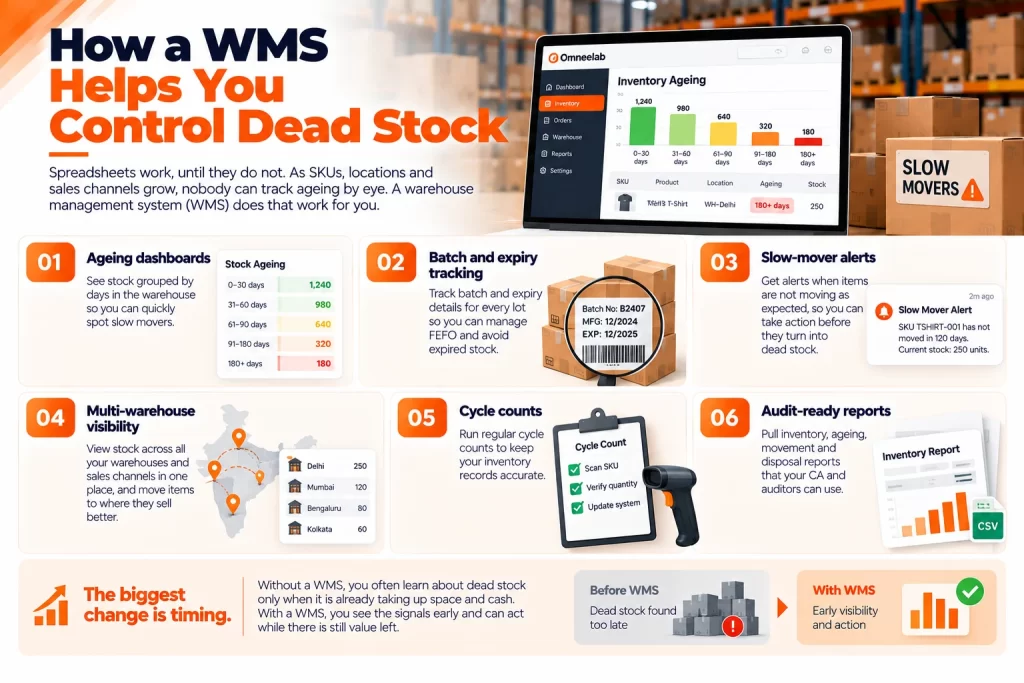
Spreadsheets work, until they do not. As SKUs, locations and sales channels grow, nobody can track ageing by eye. A warehouse management system (WMS) does that work for you.
With a WMS such as Omneelab’s, you can:
- See ageing dashboards that group stock by days in the warehouse
- Track batch and expiry details for every lot
- Get slow-mover alerts before items turn dead
- View multi-warehouse stock in one place and move items to where they sell
- Run cycle counts to keep records accurate
- Pull reports that your CA and auditors can use
The biggest change is timing. Without a WMS, you often learn about dead stock at year-end. With one, you can spot it at 90 days, when you still have good options.
Dead Stock Review Checklist
Use this list every quarter.
- Run the stock ageing report
- Flag items with no sales in 90, 180 and 365 days
- Cross-check with ABC analysis and turnover
- Verify with a physical count
- Tag each item as slow-moving, dead or obsolete
- Pick an exit route for each tagged item
- Check the GST and accounting impact with your CA
- Fix the root cause: forecast, MOQ, returns or expiry
- Update reorder levels based on what you learned
Conclusion
Dead stock is not a failure. It is a signal that something in your buying, selling or tracking needs attention.
To recap: know the difference between slow-moving, dead and obsolete stock. Find it early with ageing reports, ABC analysis, turnover and cycle counts. Clear it in order, starting with supplier returns and ending with write-off. Remember that in India, scrapping stock can also reverse your GST credit.
Most of all, fix the causes so the pile does not grow back.
Ready to see what is sitting on your shelves? Book a free demo of Omneelab WMS and see how ageing dashboards and slow-mover alerts can keep your inventory healthy.
Frequently Asked Questions
Dead stock is inventory that has not sold for a long period and is unlikely to sell at full price. Many businesses flag items with no sales for 90 days or more. It is also called dead inventory or non-moving stock.
Slow-moving inventory still sells, just slowly, so it may recover with a price or placement change. Dead stock has stopped selling and usually needs active steps like bundling, liquidation or write-off. Obsolete inventory is outdated, expired or unusable.
Use this formula: dead stock % = (cost of dead stock ÷ total inventory cost) × 100. First, find items with no sales in your chosen window, such as 180 or 365 days, using an ageing report. Then add up their cost.
Under Ind AS 2 and AS 2, stock is valued at the lower of cost and net realisable value. If NRV is zero, the cost is written off as an expense. Under Section 17(5)(h) of the CGST Act, ITC on written-off goods may need to be reversed. Always confirm with your CA.
Try returning it to the supplier first. Then bundle it, run progressive markdowns, or sell through marketplaces and B2B surplus platforms. Donate usable goods if it suits you. Scrap or write off only as a last resort, since it can trigger ITC reversal.

Kapil Pathak is a Senior Digital Marketing Executive with over six years of experience specializing in the logistics and supply chain industry. His expertise spans digital strategy, search engine optimization (SEO), search engine marketing (SEM), and multi-channel campaign management. He has a proven track record of developing initiatives that increase brand visibility, generate qualified leads, and drive growth for D2C & B2B technology companies.