Picture this. It is two weeks before Diwali, and your warehouse team is drowning in orders for a gift hamper that contains a diya set, a box of dry fruits, and a scented candle. Every single order means three separate picks, three chances to grab the wrong item, and three times the walking. Now imagine if those three products were already packed together as one ready-to-ship box, sitting on a shelf with its own barcode. One pick. One scan. Done.
That, in a nutshell, is kitting.
In this guide, we will break down what kitting in ecommerce really means, how the kitting process works step by step, how it differs from bundling and assembly, and why a warehouse management system (WMS) is the backbone of any serious kitting operation. We will also look at examples from Indian ecommerce, where combo orders and festive gift hampers make kitting more relevant than ever.
Let’s get into it.
What is Kitting? Kitting Meaning Explained
Kitting is the process of grouping multiple individual products into a single new unit, assigning it a unique SKU, and storing, picking, and shipping it as one item.
Here is the simplest way to understand the kitting meaning: you take products that already exist in your inventory, combine them into a “kit,” and treat that kit as a brand-new product. The individual items keep their own component SKUs, but the kit gets a new SKU of its own.
Think of a skincare brand that sells a cleanser, a toner, and a moisturizer separately. When it packs all three into a “3-Step Starter Kit” with its own barcode and price, that is product kitting in action.
Kitting shows up across the supply chain, not just in ecommerce:
- Kitting in ecommerce: Gift sets, combo packs, subscription boxes, and festive hampers sold as single listings.
- Kitting in logistics: 3PL warehouses pre-assembling kits for brands as a value-added service.
- Kitting in manufacturing: Grouping components into kits so assembly lines get everything they need in one tray. This is often called manufacturing support kitting.
Wherever it happens, the goal is the same: fewer touches, faster fulfillment, and fewer mistakes.
How the Kitting Process Works: Step by Step
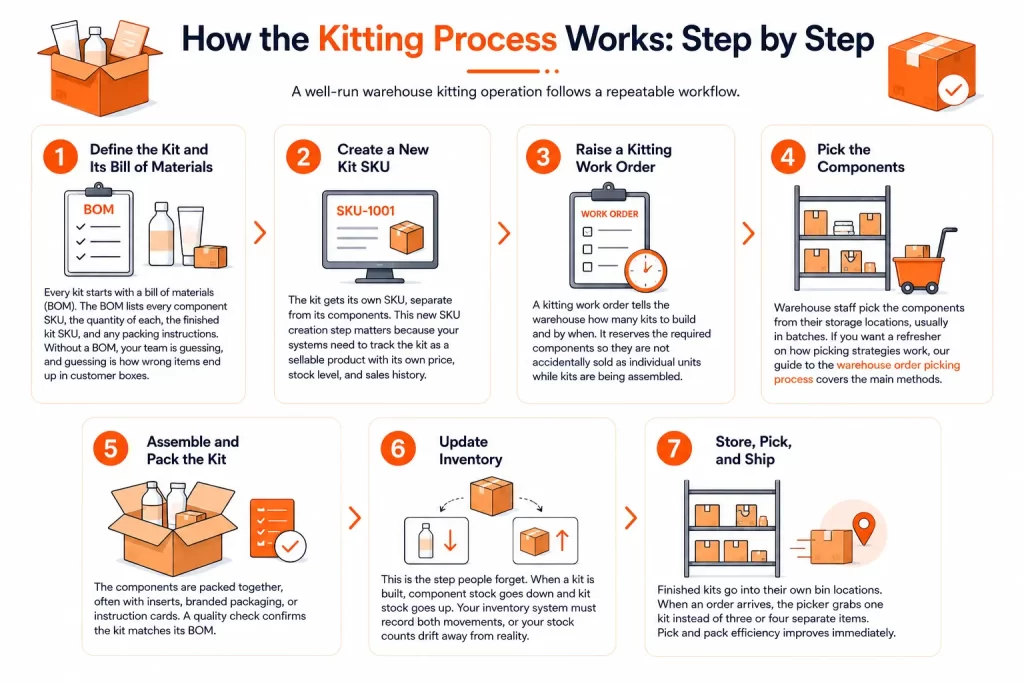
The kitting process is more structured than simply taping two boxes together. A well-run warehouse kitting operation follows a repeatable workflow.
- Step 1: Define the Kit and Its Bill of Materials
Every kit starts with a bill of materials (BOM). The BOM lists every component SKU, the quantity of each, the finished kit SKU, and any packing instructions. Without a BOM, your team is guessing, and guessing is how wrong items end up in customer boxes.
- Step 2: Create a New Kit SKU
The kit gets its own SKU, separate from its components. This new SKU creation step matters because your systems need to track the kit as a sellable product with its own price, stock level, and sales history.
- Step 3: Raise a Kitting Work Order
A kitting work order tells the warehouse how many kits to build and by when. It reserves the required components so they are not accidentally sold as individual units while kits are being assembled.
- Step 4: Pick the Components
Warehouse staff pick the components from their storage locations, usually in batches. If you want a refresher on how picking strategies work, our guide to the warehouse order picking process covers the main methods.
- Step 5: Assemble and Pack the Kit
The components are packed together, often with inserts, branded packaging, or instruction cards. A quality check confirms the kit matches its BOM.
- Step 6: Update Inventory
This is the step people forget. When a kit is built, component stock goes down and kit stock goes up. Your inventory system must record both movements, or your stock counts drift away from reality.
- Step 7: Store, Pick, and Ship
Finished kits go into their own bin locations. When an order arrives, the picker grabs one kit instead of three or four separate items. Pick and pack efficiency improves immediately.
Types of Kitting in Ecommerce
Not all kitting looks the same. Most operations fall into one of these categories.
Pre-Kitting vs On-Demand Kitting
Pre-kitting means building kits in advance and storing them as finished goods. It is ideal when demand is predictable, like festive hampers before Diwali or rakhi combos in August. Orders ship fast because the work is already done.
On-demand kitting means assembling the kit only after an order arrives. It keeps inventory flexible because components stay available for individual sale. The trade-off? Each order takes longer to fulfill.
Most growing brands use a mix of both. Pre-kit your bestsellers, and build slower movers on demand.
Subscription Box Kitting
Subscription box fulfillment is kitting on a schedule. Beauty boxes, snack boxes, and book boxes all rely on assembling a curated set of products into thousands of identical kits each month.
Promotional Kitting
Limited-time offers, influencer drops, and seasonal promotional bundles fall here. Think “Buy the shampoo, get a travel-size conditioner free,” packed as one unit.
Gift Sets and Combo Packs
This is the bread and butter of Indian ecommerce kitting. Gift sets, starter kits, and combo packs let brands raise average order value while giving customers a better deal than buying items separately.
Kitting vs Bundling: What is the Difference?
People use these words interchangeably, but in fulfillment they mean different things.
Kitting is an operations strategy. Bundling is a sales strategy.
Here is the practical difference:
| Kitting | Bundling | |
|---|---|---|
| When items are combined | Before the order, in the warehouse | At the time of sale or picking |
| New SKU created? | Yes, the kit gets its own SKU | Often no, items keep separate SKUs |
| Inventory impact | Component stock converts to kit stock | Components stay as individual stock |
| Speed at fulfillment | Very fast, one pick | Slower, multiple picks per order |
| Flexibility | Lower, stock is locked in kits | Higher, items sell separately too |
So when someone asks “what is bundling in ecommerce,” the honest answer is: it is the merchandising side of the same coin. You bundle to sell more. You kit to fulfill faster. The best operations do both, and a good system handles kit SKU and bundle SKU logic without breaking your stock counts.
Kitting vs Assembly: Are They the Same?
Not quite, and the difference trips up a lot of teams.
- Kitting combines finished products that each have their own SKU into a new kit SKU. A razor, shaving cream, and aftershave become a grooming kit.
- Assembly combines raw components into a finished product. Blades, a handle, and packaging become the razor itself.
The rule of thumb: if the parts could be sold on their own, you are kitting. If they only make sense as pieces of a final product, you are assembling. Many 3PLs offer both under the banner of kitting and assembly services, which is why the terms get blurred.
Benefits of Kitting for Ecommerce Businesses
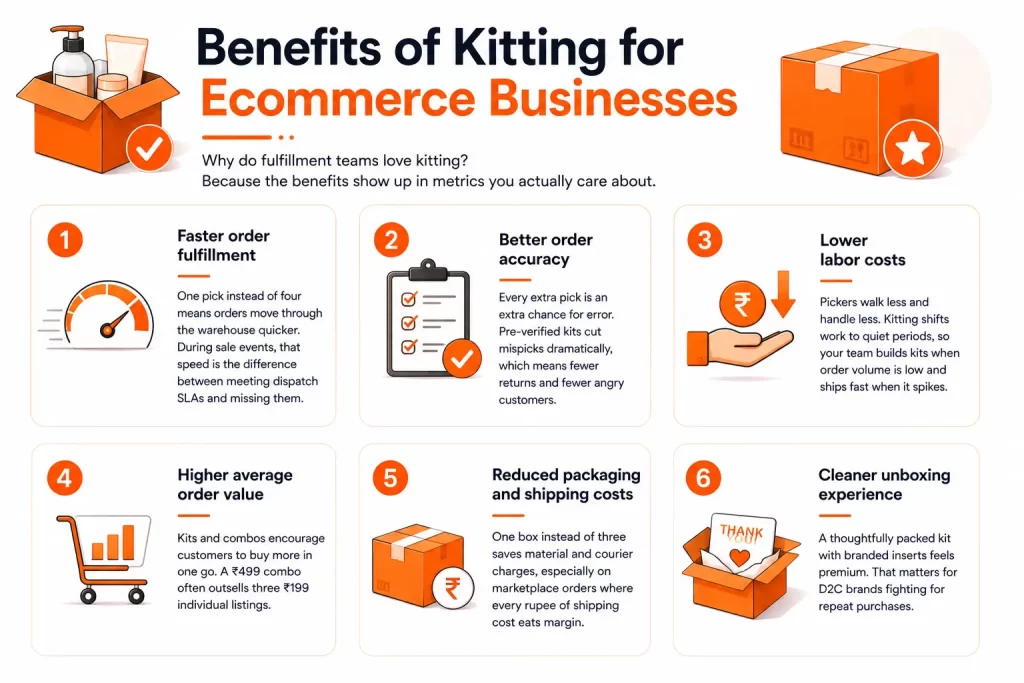
Why do fulfillment teams love kitting? Because the benefits of kitting show up in metrics you actually care about.
- Faster order fulfillment. One pick instead of four means orders move through the warehouse quicker. During sale events, that speed is the difference between meeting dispatch SLAs and missing them.
- Better order accuracy. Every extra pick is an extra chance for error. Pre-verified kits cut mispicks dramatically, which means fewer returns and fewer angry customers.
- Lower labor costs. Pickers walk less and handle less. Kitting shifts work to quiet periods, so your team builds kits when order volume is low and ships fast when it spikes.
- Higher average order value. Kits and combos encourage customers to buy more in one go. A ₹499 combo often outsells three ₹199 individual listings.
- Reduced packaging and shipping costs. One box instead of three saves material and courier charges, especially on marketplace orders where every rupee of shipping cost eats margin.
- Cleaner unboxing experience. A thoughtfully packed kit with branded inserts feels premium. That matters for D2C brands fighting for repeat purchases.
Disadvantages of Kitting: What Can Go Wrong?
Kitting is not free money. It has real costs, and pretending otherwise is how projects fail.
- Upfront labor and planning. Someone has to build the kits, and that takes time, space, and people before a single kit is sold.
- Locked-up inventory. Once a moisturizer goes into a gift set, it cannot be sold on its own unless you de-kit it. Overbuild kits and you may face stockouts on individual listings while kits gather dust.
- Extra warehouse space. Finished kits need their own storage locations on top of component storage.
- Inventory complexity. Every kit build touches multiple SKUs. Track this on spreadsheets and your stock accuracy will fall apart within weeks.
- De-kitting costs. When a kit does not sell, breaking it back into components (de-kitting) takes labor and careful inventory adjustments.
The pattern here is clear. Almost every disadvantage of kitting is really a systems problem. Which brings us to the WMS.
How Does a WMS Handle Kitting?
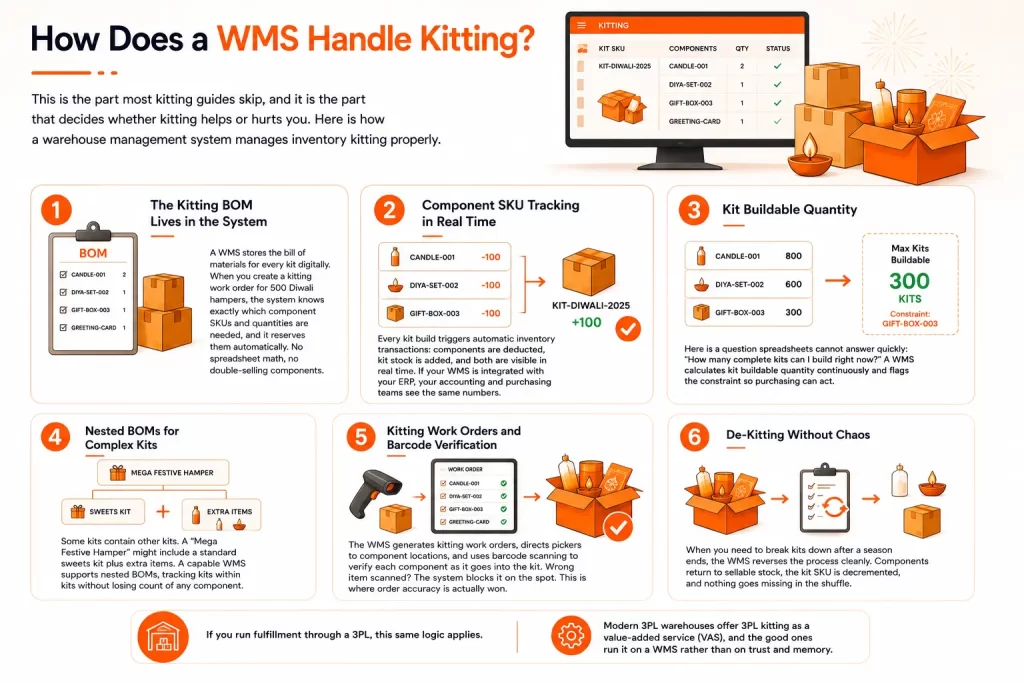
This is the part most kitting guides skip, and it is the part that decides whether kitting helps or hurts you. Here is how a warehouse management system manages inventory kitting properly.
The Kitting BOM Lives in the System
A WMS stores the bill of materials for every kit digitally. When you create a kitting work order for 500 Diwali hampers, the system knows exactly which component SKUs and quantities are needed, and it reserves them automatically. No spreadsheet math, no double-selling components.
Component SKU Tracking in Real Time
Every kit build triggers automatic inventory transactions: components are deducted, kit stock is added, and both are visible in real time. If your WMS is integrated with your ERP, your accounting and purchasing teams see the same numbers.
Kit Buildable Quantity
Here is a question spreadsheets cannot answer quickly: “How many complete kits can I build right now?” A WMS calculates kit buildable quantity continuously. If you have 800 candles, 600 diya sets, and 300 gift boxes, the system tells you the true answer is 300 kits, and flags the gift box as your constraint so purchasing can act.
Nested BOMs for Complex Kits
Some kits contain other kits. A “Mega Festive Hamper” might include a standard sweets kit plus extra items. A capable WMS supports nested BOMs, tracking kits within kits without losing count of any component.
Kitting Work Orders and Barcode Verification
The WMS generates kitting work orders, directs pickers to component locations, and uses barcode scanning to verify each component as it goes into the kit. Wrong item scanned? The system blocks it on the spot. This is where order accuracy is actually won.
De-Kitting Without Chaos
When you need to break kits down after a season ends, the WMS reverses the process cleanly. Components return to sellable stock, the kit SKU is decremented, and nothing goes missing in the shuffle.
If you run fulfillment through a 3PL, this same logic applies. Modern 3PL warehouses offer 3PL kitting as a value-added service (VAS), and the good ones run it on a WMS rather than on trust and memory.
Kitting in India: Combo Orders, Hampers, and Marketplace Bundles
Kitting in India has its own flavor, shaped by festivals and marketplaces.
Festive gift hampers are the biggest driver. Diwali, Rakhi, Holi, and the wedding season create massive, predictable spikes in demand for multi-item gift boxes. Brands that pre-kit hampers in September sail through October. Brands that do not end up panic-packing at midnight. Our guide on managing inventory during the festive rush digs deeper into this.
Marketplace combo listings are the second driver. On Flipkart, Amazon, Meesho, and Myntra, combo orders routinely outperform single listings in categories like personal care, kitchenware, and fashion accessories. Each combo needs its own SKU, its own stock count, and accurate mapping back to component inventory. Sellers who track combos manually usually discover the problem the hard way, through oversells and marketplace penalties.
D2C subscription and trial kits are growing fast too. Beauty and wellness brands on Shopify use trial kits and minis boxes to acquire customers, and every one of those is a kitting operation behind the scenes.
Real Examples of Kitting in Action
Still feeling abstract? Here are five concrete examples:
- Beauty starter kit. A D2C skincare brand pre-kits cleanser, serum, and sunscreen into a “Morning Routine Kit” before a payday sale. Dispatch time per order drops from four minutes to ninety seconds.
- Festive hamper. A dry fruits seller builds 5,000 Diwali boxes in September using kitting work orders, then ships same-day through October.
- Subscription box. A snack brand assembles 3,000 identical monthly boxes, each with eight rotating products, all tracked through a single kit BOM.
- Electronics combo. A mobile accessories seller lists a charger, cable, and case as one combo SKU on Flipkart, cutting packaging costs by a third.
- Manufacturing support kit. An appliance maker kits screws, brackets, and manuals into installation packs that ship with every unit.
When Should You Use Kitting?
Kitting earns its keep when a few conditions line up. Use it when:
- Certain products are frequently bought together and demand is fairly predictable.
- You face seasonal spikes where dispatch speed decides your ratings and SLAs.
- Your pick error rate on multi-item orders is hurting you.
- You want to raise average order value with combos and gift sets.
- You run subscription boxes or recurring curated shipments.
Hold off on kitting when demand is unpredictable, components are expensive to lock up, or your inventory system cannot track component-to-kit movements. Fix the system first, then kit.
Conclusion: Kitting Works When Your System Does
Let’s recap. Kitting in ecommerce means combining multiple products into a single new SKU that is stored, picked, and shipped as one unit. It is different from bundling, which is a sales tactic, and from assembly, which builds new products from components. Done well, kitting speeds up fulfillment, improves order accuracy, cuts costs, and lifts average order value. Done badly, it locks up stock and wrecks your inventory counts.
The difference between “done well” and “done badly” is almost always the system underneath. A WMS with proper BOM support, kit buildable quantity, barcode verification, and clean de-kitting turns kitting from a risky experiment into a reliable growth lever.
Ready to run kitting without the spreadsheet headaches? Omneelab’s eWMS handles kit SKUs, BOMs, combo orders, and marketplace integrations out of the box. Book a demo and see how much faster your combos can ship.
Ship combos, kits & hampers with a single scan
See how Omneelab WMS manages kit SKUs, BOMs, and buildable quantity in real time, so your gift sets and combo orders fly out without breaking inventory counts.
Frequently Asked Questions
A kit SKU represents a pre-assembled unit whose components were physically combined in advance, with inventory converted from component stock to kit stock. A bundle SKU is usually a virtual grouping: the items remain separate in the warehouse and are picked together at order time. A good WMS supports both and keeps component SKU tracking accurate either way.
Yes. Most 3PLs offer kittings and assembly as value-added services (VAS) alongside storage and shipping. Brands send components, and the 3PL builds gift sets, subscription boxes, or promotional bundles using kitting work orders. Pricing is typically per kit built, so a clear BOM helps control costs.
A kittings bill of materials lists every component SKU, its quantity, the finished kit SKU, and packing instructions for one kit. It matters because it is the single source of truth for building kits, calculating kit buildable quantity, and reversing the process during de-kitting. No BOM, no reliable kitting.
De-kitting is breaking a finished kit back into its individual components, usually after a season ends or a promotion underperforms. The components return to individually sellable stock. In a WMS, de-kitting is a controlled transaction that updates both kit and component counts, so nothing is lost or double-counted.
It is practically made for it. Subscription box fulfillment is repetitive, high-volume kittings: the same BOM is built thousands of times each cycle. Pre-kitting the month’s boxes during quiet weeks, verifying contents by barcode, and tracking components in real time keeps costs down and ship dates on schedule.

Kapil Pathak is a Senior Digital Marketing Executive with over six years of experience specializing in the logistics and supply chain industry. His expertise spans digital strategy, search engine optimization (SEO), search engine marketing (SEM), and multi-channel campaign management. He has a proven track record of developing initiatives that increase brand visibility, generate qualified leads, and drive growth for D2C & B2B technology companies.