Ask ten people in a factory what “logistics” means and you will probably get ten different answers. Some will point at the trucks lined up outside the gate. Others will point at the shelves inside the warehouse. Both are right, and that is exactly where the confusion starts.
In-plant logistics and warehouse management sound like they should be the same thing. They are not. One is about everything that happens the moment a truck rolls through your gate until it rolls back out. The other is about what happens to your stock once it is sitting on a shelf. Mix them up, and you end up buying the wrong software, building the wrong workflows, or worse, leaving a gap between production and the warehouse that nobody notices until a line stops.
This article breaks down the real difference between in-plant logistics and warehouse management, shows you where the two overlap, and explains why more manufacturers are choosing a single WMS platform that handles both instead of stitching together three or four separate tools.
What Is In-Plant Logistics?
In-plant logistics generally refers to the management of everything that moves inside your facility’s boundaries, from the moment a vehicle enters the gate to the moment it leaves. The exact scope varies by organization and software architecture, some plants fold yard and dock activity into a broader WMS, others run it as a separate system, but the core idea stays the same: think of it as the choreography that happens before, during, and after production, not the production itself.
It typically covers:
- Gate entry and security checks
- Weighbridge operations (tare and gross weight)
- Yard management and vehicle sequencing
- Dock scheduling for loading and unloading
- Internal transport of raw materials to the production line
- Line-side replenishment so operators never run out of parts mid-shift
- Work-in-progress movement between stations
- Documentation and gate exit
In short, in-plant logistics is the plumbing that keeps materials flowing to and from the production line without anyone standing around waiting. Our in-plant logistics software guide covers the tools involved in more detail. Plants that still run this manually, using paper gate passes or spreadsheets, tend to lose real throughput. Logistics automation provider Fretron estimates that Indian manufacturing plants lose 15 to 20 percent of their throughput capacity to in-plant inefficiencies like trucks waiting for dock slots or manual weighbridge queues. Exact figures vary by plant, but the direction is consistent: manual gate and yard processes quietly eat into capacity that never shows up on a P&L line labeled “logistics.”
The Main Components of In-Plant Logistics
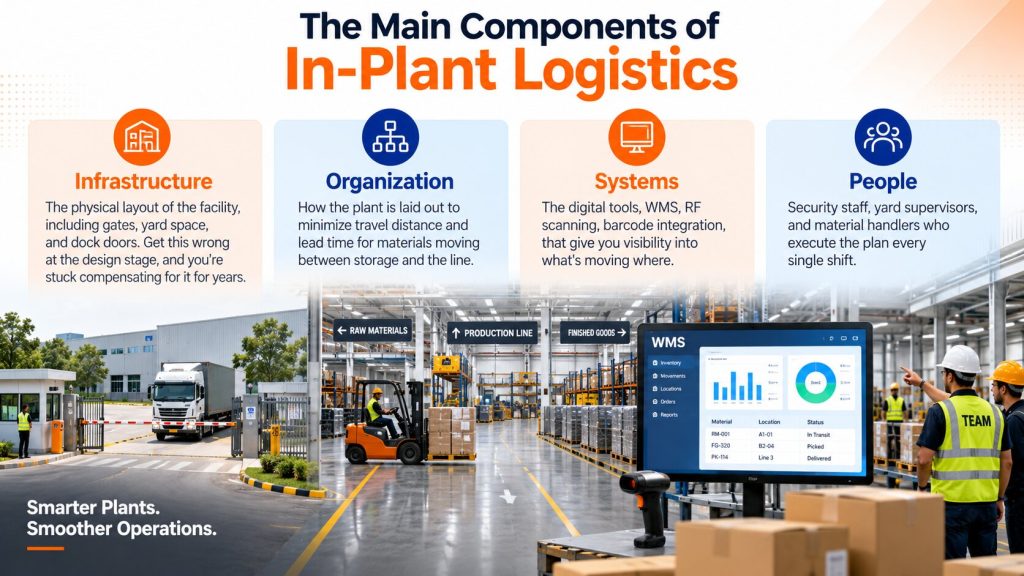
If you strip it down, in-plant logistics really comes down to four things: infrastructure, organization, systems, and people. The physical layout of your plant matters just as much as the software you use to manage it. A perfectly designed WMS will not save you if your dock doors are on the wrong side of the building.
- Infrastructure: The physical layout of the facility, including gates, yard space, and dock doors. Get this wrong at the design stage, and you’re stuck compensating for it for years.
- Organization: How the plant is laid out to minimize travel distance and lead time for materials moving between storage and the line.
- Systems: The digital tools, WMS, RF scanning, barcode integration, that give you visibility into what’s moving where.
- People: Security staff, yard supervisors, and material handlers who execute the plan every single shift.
Picture a mid-sized auto parts plant running three shifts. If a delivery truck sits at the gate for forty minutes because someone has to manually check paperwork, that delay ripples down the line, and production ends up waiting on a part that was, technically, already on-site. That’s the everyday reality in-plant logistics is meant to solve.
Unlike outbound logistics, which is concerned with moving finished goods from your facility to a customer or distributor, in-plant logistics happens entirely inside your fence line. It doesn’t care what happens once a truck leaves the yard. It only cares about what happens while that truck, or that pallet, or that operator, is still inside your walls.
What Is Warehouse Management?
Warehouse management, on the other hand, is primarily focused on one question: where does your stock live, and how do you keep track of it? It can stretch into labor management, slotting strategy, and workflow automation depending on the platform, but storage and accuracy remain its center of gravity. If you’re new to the topic, our introduction to warehouse management is a good starting point.
A warehouse management system, or WMS, handles:
- Receiving and put-away
- Storage location and slotting
- Inventory tracking and cycle counts
- Order picking, packing, and dispatch
- Barcode or RFID scanning for accuracy
- Reporting on stock levels and stock accuracy
If in-plant logistics is about movement, warehouse management is about storage and control. As one logistics provider puts it, warehouse management is about where your stock lives, while logistics is about how it moves. That single sentence probably explains the difference better than any diagram could.
Is warehouse management part of logistics? Technically, yes. Broader logistics management includes warehousing as one piece of a much bigger puzzle that also covers transportation, order fulfillment, and inventory across the entire supply chain. Warehouse management is the specialist. Logistics is the generalist.
Think about a distribution center that supplies retail stores. The warehouse team doesn’t need to know how a shipment got from Supplier A to the receiving dock. Their job starts the moment that pallet is scanned in: where does this item go, how fast can someone find it again, and how quickly can it be picked, packed, and shipped when an order comes in.
That narrower focus is actually a strength. A good WMS doesn’t try to be everything. It tries to be excellent at storage, accuracy, and fulfillment, which is exactly what a manufacturing floor or a distribution network needs from it.
Key Differences: In-Plant Logistics vs Warehouse Management
Here is where most people get stuck, so let’s make it dead simple with a side-by-side comparison.
| In-Plant Logistics | Warehouse Management | |
|---|---|---|
| Scope | Gate entry to gate exit, across the whole plant | A specific storage facility or zone |
| Focus | Movement, sequencing, and flow of vehicles and materials | Storage, accuracy, and order fulfillment |
| Key activities | Weighbridge, yard, dock scheduling, line feeding | Receiving, put-away, picking, packing, dispatch |
| Primary users | Security, yard supervisors, production teams | Warehouse staff, pickers, inventory controllers |
| Success metric | Vehicle turnaround time, dock utilization | Order accuracy, inventory accuracy, pick rate |
| Typical pain point | Trucks idling, paper gate passes, manual weighment | Misplaced stock, stockouts, slow order fulfillment |
Notice that neither one works well in isolation. A warehouse can have perfect inventory accuracy and still create bottlenecks if trucks are stuck at the gate for two hours. Likewise, in-plant logistics can move materials efficiently but still fail if the warehouse cannot tell production what is actually in stock.
Where the Two Overlap
This is the part that gets lost in most explanations. In-plant logistics and warehouse management are not neighbors that never talk to each other. They share a fence, and honestly, they share quite a bit of yard too.
Here’s where the overlap happens:
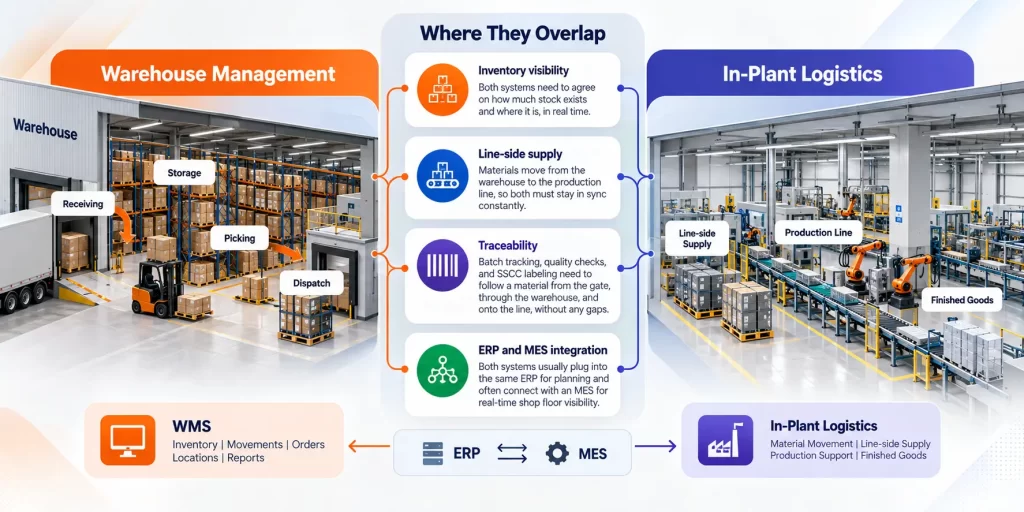
- Inventory visibility. Both systems need to agree on how much stock exists and where it is, in real time.
- Line-side supply. Materials move from the warehouse to the production line, which means warehouse management and in-plant logistics have to sync constantly.
- Traceability. Batch tracking, quality checks, and SSCC labeling need to follow a material from the gate, through the warehouse, and onto the line, without any gaps.
- ERP and MES integration. Both systems usually plug into the same ERP for planning and often connect with an MES for real-time shop floor visibility.
According to one industrial software provider, traditional setups keep ERP handling planning and business management on one side, while WMS handles advanced warehouse operations on the other, but neither typically gives full real-time visibility into what is actually happening on the plant floor. That gap is exactly why so many manufacturers end up dealing with production line stoppages, outdated stock counts, and operators standing around waiting for materials that should already be there.
Do You Need a WMS, a YMS, and a TMS, or One Integrated Platform?
It’s worth being precise here, because “in-plant logistics” isn’t strictly a WMS function in every organization. Depending on how a plant is set up, you might see these systems referenced separately:
- WMS (Warehouse Management System): storage, put-away, picking, and inventory accuracy.
- YMS (Yard Management System): vehicle sequencing, dock scheduling, and trailer tracking in the yard.
- TMS (Transportation Management System): route planning and carrier management once goods leave the facility.
- MES (Manufacturing Execution System): real-time execution and tracking on the shop floor itself.
In smaller or mid-sized plants, these functions often get consolidated into a single platform because running four separate logins for four separate teams isn’t practical. In larger, more complex operations, it’s common to keep WMS, YMS, and TMS as distinct systems that are tightly integrated rather than merged into one. Neither approach is wrong. The real question isn’t “does everything have to live inside the WMS,” it’s “does your technology stack give everyone the same numbers at the same time,” whether that’s through one platform or several that talk to each other cleanly.
Why Manufacturers Need Both in One Platform
Here’s an honest question. If your warehouse team uses one system, your yard team uses another, and your production planners are checking a third dashboard, how many times a day does someone have to pick up the phone to confirm something that should already be visible on a screen?
Probably more than you would like to admit.
Running in-plant logistics and warehouse management as two disconnected systems creates a few predictable headaches:
- Double data entry. Someone has to manually reconcile what the yard system says against what the warehouse system says.
- Delayed visibility. By the time information travels from the gate to the warehouse to production planning, it is already outdated.
- Miscommunication between departments. Production, warehouse, and shipping teams often end up working off different numbers.
- Higher software costs. Licensing, training, and maintaining multiple platforms adds up fast, and none of them talk to each other cleanly.
A single, well-integrated platform covering in-plant logistics and warehouse management removes that friction. Instead of three systems arguing with each other, you get one source of truth that everyone, from the security guard at the gate to the plant manager in the office, can trust.
There’s also a cost angle here that’s easy to overlook. Every additional disconnected system means another vendor contract, another training program, and another support line to call when something breaks. Multiply that across three or four point solutions and the “savings” from picking cheaper tools tend to disappear fast, usually somewhere between the integration invoice and the six months it takes to get everyone comfortable using yet another login.
How an Integrated Platform Covers Both
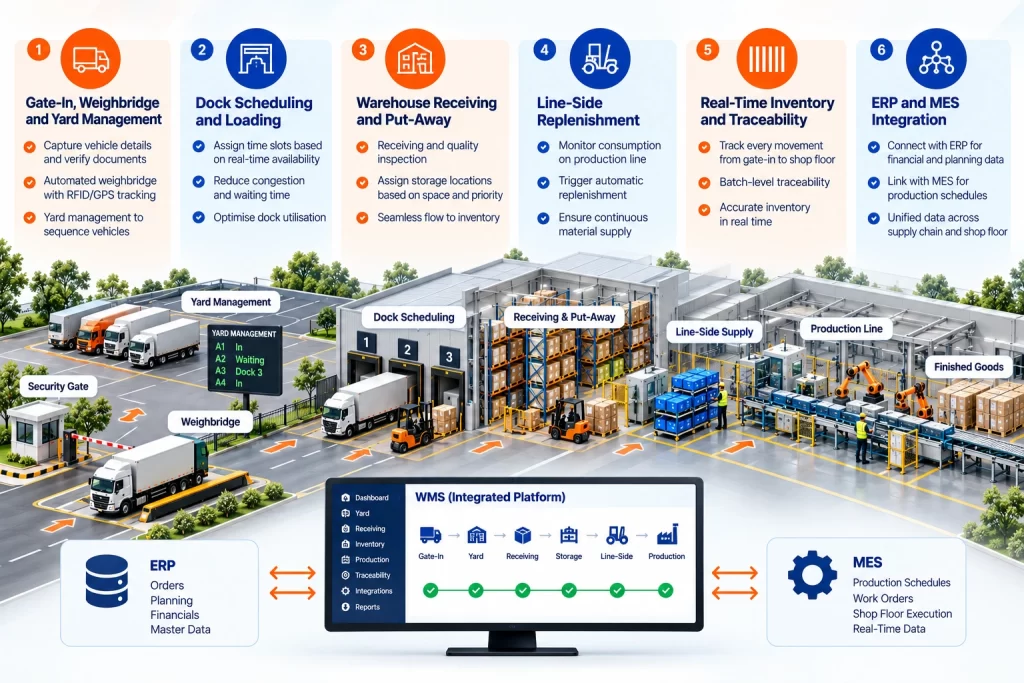
So what does it actually look like when a single, integrated platform handles both sides of the equation? Let’s walk through it stage by stage.
Gate-In, Weighbridge, and Yard Management
The moment a truck arrives, the platform captures vehicle details, verifies documentation, and routes the vehicle through an automated weighbridge. RFID and GPS-based tracking eliminate the manual data entry that usually leads to errors or, worse, fraud at the weighbridge. From there, the yard management module sequences vehicles so they are not just circling the lot waiting for a dock to open up.
Dock Scheduling and Loading
Dock scheduling assigns each vehicle a time slot based on real availability, not guesswork. This alone can cut down on the kind of gridlock where five trucks show up at once and three dock doors are free.
Warehouse Receiving and Put-Away
Once material clears the dock, the same platform handles receiving, quality inspection, and put-away, assigning storage locations based on space utilization and how quickly that material needs to reach production.
Line-Side Replenishment
This is where in-plant logistics and warehouse management genuinely merge. The platform monitors consumption on the production line and triggers automatic replenishment before a shortage happens, rather than after an operator has already stopped working.
Real-Time Inventory and Traceability
Every movement, from gate-in to shelf to shop floor, gets logged automatically. That means full batch-level traceability without anyone manually updating a spreadsheet, and it means your inventory numbers are accurate the moment someone looks at them, not the moment someone gets around to updating them.
ERP and MES Integration
A modern WMS platform does not operate in a silo. It plugs into your ERP for financial and planning data, and our guide on WMS-ERP integration walks through exactly how that connection works, while also linking with your MES so that production schedules, material availability, and shop floor execution are all working off the same information.
Choosing the Right WMS for In-Plant Logistics
If you’re shopping around, not every WMS on the market actually handles in-plant logistics well. Plenty of platforms are built purely for storage and picking, with no real yard or weighbridge functionality bolted on. Here’s what to actually check before you commit:
- Does it include yard and dock management, not just warehouse racking?
- Can it integrate with weighbridge hardware and RFID or barcode systems?
- Does it offer real-time dashboards, or does data update in batches overnight?
- Can it sync with your existing ERP and MES without heavy custom development?
- Is it cloud-based, so multiple sites and teams can access the same data?
- Does the vendor have manufacturing experience, or only retail and e-commerce warehousing?
That last point matters more than people expect. A WMS designed for an e-commerce fulfillment center will not necessarily understand the realities of a manufacturing plant, where line-side supply and production synchronization matter just as much as pick rates. Before you sign anything, it’s worth running through our WMS implementation checklist to make sure nothing gets missed during rollout.
It’s also worth thinking about scalability. If your plant runs one facility today but expects to add more locations, a cloud-based WMS built for multi-site operations saves you a painful migration later.
Finally, don’t underestimate vendor experience. Ask how many manufacturing clients they support and whether they can show live gate-to-shelf visibility rather than just a slide deck. A platform that looks impressive in a demo but has never handled a busy weighbridge queue at 7 a.m. on a Monday will struggle once it meets your actual operation.
Where Omneelab Fits In
This is the platform we’ve been describing throughout this article, so it’s worth naming directly. Omneelab positions itself as an AI-driven supply chain execution platform built to cover the full “plant to door” journey, not just one slice of it.
A few specifics worth knowing:
- Omneelab WMS is Omneelab’s core warehouse management module, handling real-time inventory tracking, order fulfillment automation, picking and slotting, and warehouse layout optimization.
- Multi-warehouse and multi-plant visibility. Instead of a fragmented view across separate inventory points, Omneelab consolidates stock data across plants and warehouses into a single dashboard, which is exactly the kind of gap this article has been describing between in-plant operations and warehouse data.
- ERP integration. The platform is built to connect with existing ERP systems rather than forcing a rip-and-replace, which matters if you already have SAP, Oracle, or another ERP running your planning.
- Last-mile coverage. Through its Metaport last mile module, Omneelab also handles courier aggregation and last-mile delivery, extending visibility past the warehouse door rather than stopping at dispatch.
- Industry experience. The team has worked across automobile, pharma, and FMCG-style operations, which is relevant if you’re evaluating whether a vendor actually understands manufacturing-specific workflows versus pure e-commerce fulfillment.
None of this means Omneelab is automatically the right fit for every plant, that depends on your existing tech stack, scale, and how much of your in-plant logistics currently runs on separate yard or weighbridge systems. But if the core problem you’re solving is disconnected visibility between the plant floor and the warehouse, it’s a platform built specifically around closing that gap rather than bolting warehouse features onto a generic inventory tool.
Wrapping It Up
In-plant logistics and warehouse management are two different jobs that happen to share the same building. One keeps vehicles, materials, and information flowing through the plant. The other keeps your stock organized, accurate, and ready to ship or feed into production. They are related, they overlap constantly, and honestly, running them as separate systems creates more problems than it solves.
A single, integrated platform that covers both gives your team one dashboard, one source of truth, and far less back-and-forth between the yard, the warehouse, and the production floor. If your plant is still juggling separate tools for gate management, yard operations, and inventory, it might be time to see what a platform like Omneelab can actually do for your throughput.
Ready to see how Omneelab could work for your plant? Get in touch for a walkthrough of how in-plant logistics and warehouse management come together in one system.
FAQs
Logistics is the broader discipline covering how materials and goods move, including transportation, in-plant movement, and order fulfillment. Warehouse management is a subset of logistics focused specifically on storage, inventory accuracy, and order picking within a facility.
Modern, manufacturing-focused WMS platforms increasingly include yard management, dock scheduling, and weighbridge integration alongside traditional warehouse functions. Older or retail-focused WMS platforms often cannot, so it’s worth checking before you buy.
A WMS focuses on what happens inside a facility, storage, picking, and inventory. An LMS typically has a wider scope, covering transportation planning, carrier management, and multi-site logistics beyond a single warehouse or plant.
ERP handles planning, finance, and business-level decisions. MES manages real-time production execution on the shop floor. WMS manages inventory and storage. When integrated, all three share data so that material availability, production schedules, and stock levels stay in sync.
Intra-plant logistics and in-plant logistics refer to the same thing: the management of material and vehicle flow within a single facility’s boundaries, as opposed to logistics between separate locations or facilities.

Kapil Pathak is a Senior Digital Marketing Executive with over six years of experience specializing in the logistics and supply chain industry. His expertise spans digital strategy, search engine optimization (SEO), search engine marketing (SEM), and multi-channel campaign management. He has a proven track record of developing initiatives that increase brand visibility, generate qualified leads, and drive growth for D2C & B2B technology companies.