A WMS for automotive parts India is no longer a nice-to-have. It’s the backbone of efficient spare parts operations in a market that’s growing faster than most warehouses can keep up with.
Here’s a scenario you’ve probably lived through. Your warehouse in Chennai has 40,000 SKUs. A dealer in Hyderabad urgently needs a clutch plate for a 2018 model. Your team scrambles through aisles, checks three different racks, and finally discovers the part was superseded last quarter. Twenty minutes wasted. One frustrated customer lost.
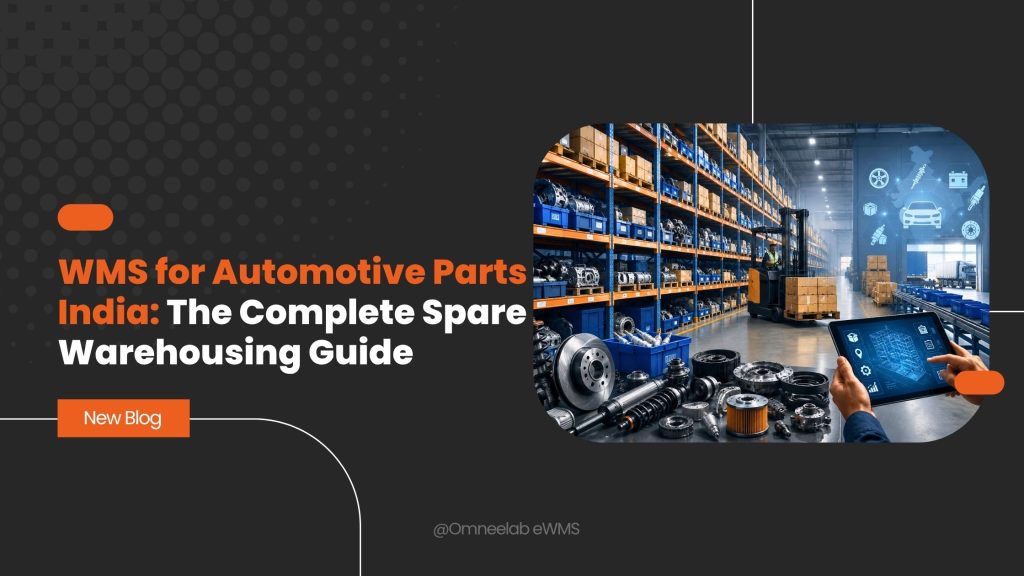
This is the daily reality for most auto parts warehouses in India.With over 300 million registered vehicles on Indian roads and the aftermarket projected to cross $32 billion by 2027, demand for spare parts is only accelerating. Yet most warehouses still run on outdated spreadsheets, manual registers, or generic ERPs that can’t handle automotive complexity.
In this guide, we’ll cover why auto parts warehousing is uniquely difficult, what features matter most, and how to pick the right solution for your business. Let’s dive in.
Why Automotive Spare Parts Warehousing Is So Complex
Before we talk solutions, let’s understand the problem. Automotive spare parts warehousing isn’t like managing an apparel or FMCG warehouse. The challenges are fundamentally different.
SKU Proliferation That Never Stops
A mid-sized auto parts distributor in India typically manages 20,000 to 100,000 SKUs. Every new vehicle model, every year of production, every engine variant adds more part numbers. A single brake pad category alone might have 200+ variants across different vehicle applications.
Supersession Chains
Manufacturers constantly discontinue old part numbers and replace them with updated versions. Without tracking these supersession chains, your warehouse stocks obsolete parts while showing “unavailable” for items you actually carry under newer numbers.
Multi-Brand Complexity
Most distributors handle Bosch, Denso, Valeo, Minda, Lumax, and dozens of other brands simultaneously. Each has its own numbering system, packaging, and compatibility matrix. Managing this without intelligent systems creates daily confusion on the warehouse floor. If you’re dealing with inventory management challenges like these, you’re not alone.
Interchangeable Parts and OEM Cross-Referencing
One component might be made by four different manufacturers but fit the same vehicle. Tracking OEM compatibility and cross-references manually is nearly impossible at scale.
Dead Stock Accumulation
Parts for older vehicle models sit idle for months, then suddenly spike when those vehicles hit certain mileage thresholds. Without demand forecasting, warehouses bleed capital on slow-moving inventory.
What Is a WMS for Automotive Parts?
A WMS for automotive parts is specialized warehouse management software designed specifically for the workflows of auto component storage, retrieval, and distribution. Unlike generic inventory tools, it handles the nuances that make automotive warehousing unique.
It acts as the central brain of your warehouse operations, directing every movement from inbound receipt to final dispatch. Here’s what it manages:
- Inbound processing — GRN verification, quality checks, automated putaway
- Storage optimization — Intelligent slotting, bin location management, zone allocation
- Order fulfillment — System-directed picking, packing verification, dispatch planning
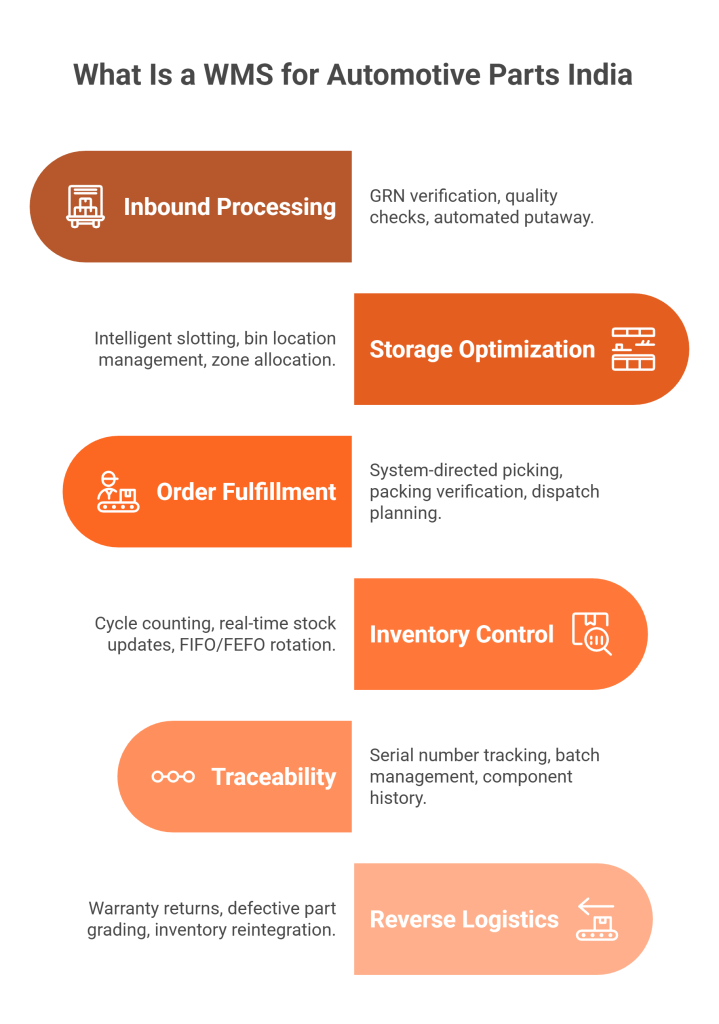
- Inventory control — Cycle counting, real-time stock updates, FIFO/FEFO rotation
- Traceability — Serial number tracking, batch management, component history
- Reverse logistics — Warranty returns, defective part grading, inventory reintegration
The key difference from a generic WMS? It understands supersession, part number cross-referencing, kitting for service packages, and the high-SKU-low-volume nature of automotive inventory. For a broader understanding of how warehouse management systems work, check out our introduction to warehouse management.
Challenges Specific to the Indian Market
India’s automotive aftermarket has unique characteristics that demand localized solutions.
GST Compliance Across States
Every inter-state stock transfer needs precise GST documentation. A WMS for automotive parts India must generate GST-compliant invoices, e-way bills, and delivery challans automatically. Manual GST reconciliation across multiple warehouses is a nightmare no one needs.
Tier-2 and Tier-3 City Distribution
Auto parts demand isn’t limited to metros. Mechanics in Indore, Coimbatore, Raipur, and Guwahati need parts delivered fast. Managing multi-warehouse inventory across India with real-time visibility across tier-2 city locations is essential for same-day or next-day fulfillment.
Workforce Realities
Most Indian auto parts warehouses rely on semi-skilled labor. The WMS must offer simple mobile interfaces, regional language support, and scan-based workflows that minimize training time and eliminate dependence on memory-based picking.
Seasonal Demand Patterns
Vehicle servicing spikes before monsoons, festivals, and long weekends. Your warehouse operations must scale up during these periods without collapsing under pressure.
Must-Have Features in a WMS for Automotive Parts India
When evaluating a WMS for automotive parts India, prioritize these capabilities:
1. Supersession Management
The system should maintain complete supersession chains. When a discontinued part is ordered, it automatically identifies the replacement and directs the picker to the correct bin location.
2. Part Number Cross-Referencing
Your WMS should map OEM numbers, aftermarket equivalents, and brand-specific codes to a single vehicle application. This eliminates confusion and improves fill rates.
3. Intelligent Bin Location and Slotting
Fast-movers (filters, brake pads, spark plugs) go in golden zones. Slow-movers occupy upper racks or deep storage. The system should re-optimize slotting based on real-time picking frequency data. Learn more about how WMS warehouse slotting and storage optimization works in practice.
4. Barcode and RFID Integration
Manual identification of auto parts is error-prone. A small bearing looks identical to five other bearings on the shelf. Barcode scanning eliminates picking errors, while RFID tracking enables bulk scanning for high-value items and faster cycle counts. Our detailed comparison of barcode vs RFID for warehouse management can help you decide which fits your budget.
5. Kitting and Assembly Workflows
Service kits (timing belt kit, clutch kit, brake service kit) require bundling multiple components. The WMS should manage Bills of Materials, direct component picking, and track kit assembly status. Understanding what a Bill of Materials (BOM) is is essential for getting this right.
6. Serial Number and Batch Tracking
For high-value components (ECUs, engines, transmissions), serial number tracking is essential. For consumables (rubber parts, lubricants, adhesives), batch tracking with expiry management ensures you ship fresh stock and manage FIFO rotation properly. Our guide on unit-level vs batch-level traceability explains the differences in detail.
7. Multi-Warehouse Visibility
A unified dashboard showing real-time stock across all locations enables intelligent order routing. Fulfill from the nearest warehouse with available stock instead of defaulting to a single hub.
8. ERP Integration
Seamless connectivity with SAP, Oracle, or Tally ensures purchase orders, sales orders, and financial data stay synchronized without manual double-entry. Here’s our complete guide on WMS-ERP integration to understand how this works.
9. Demand Forecasting and Reorder Alerts
Historical consumption analysis helps predict demand patterns. Automated reorder point alerts prevent both stock-outs and overstocking.
10. Reverse Logistics for Warranty Returns
Structured workflows for receiving returns, inspecting quality, grading items (resale, refurbish, scrap), and reintegrating good stock back into sellable inventory. Our article on reverse logistics and returns management with WMS covers this in depth.
How a WMS Solves Daily Pain Points
| Problem | WMS Solution |
|---|---|
| Parts can’t be located quickly | Bin mapping + barcode scan = instant location |
| Superseded parts causing stock confusion | Automatic supersession chain tracking |
| High picking errors | System-directed picks with scan verification |
| Dead stock piling up | Aging reports + demand-based reorder alerts |
| GST compliance issues | Auto-generated compliant documentation |
| Multi-brand inventory chaos | Brand-wise zoning + unified cross-reference database |
| Slow order processing | Optimized pick paths + wave/zone picking |
| Inventory mismatches | Scheduled cycle counts + real-time updates |
WMS vs. ERP: You Need Both
“We already use SAP. Why do we need a WMS?”
We hear this constantly. Here’s the distinction.
Your ERP knows you have 500 brake pads in stock. Your WMS knows they’re in Rack B, Shelf 3, Bin 7, Batch #2024-March expires next month, and the fastest pick path avoids the congested Zone A.
ERPs manage transactions. A WMS manages physical operations. When integrated properly, they create a seamless flow from purchase order to customer delivery. One doesn’t replace the other.
Barcode vs. RFID: What Works for Indian Auto Parts Warehouses?
Barcode scanning is the practical starting point for most Indian warehouses. It’s affordable, easy to implement, and eliminates picking errors through scan verification at every step.
RFID tracking makes sense for high-value components (engines, gearboxes, ECUs) where individual asset tracking justifies the higher tag cost. It also speeds up cycle counting with bulk-read capabilities.
The recommended approach? Start with barcodes across all SKUs. Add RFID selectively for premium components. This gives you maximum coverage without unnecessary cost. For a deeper dive into RFID technology, read our guide on what is RFID technology and how it works.
Just-in-Time Warehousing for OEM Suppliers
If you supply directly to automobile manufacturers, just-in-time delivery isn’t optional. Production lines stop when parts don’t arrive on schedule.
A WMS for automotive parts India supports JIT operations through:
- Precise real-time inventory visibility
- Automated dispatch scheduling aligned with production requirements
- Vendor-managed inventory (VMI) programs with consumption-based replenishment
- Cross-docking workflows for time-critical components
How to Choose the Right WMS for Your Auto Parts Business
Assess Your Scale
Under 5,000 SKUs? A simpler solution works. Over 20,000 SKUs with multi-brand complexity? You need a system built for automotive-grade operations.
Verify Automotive Features
Ask specifically about supersession tracking, part cross-referencing, and kitting support. If the vendor can’t demonstrate these, they’re selling a generic WMS with an automotive label.
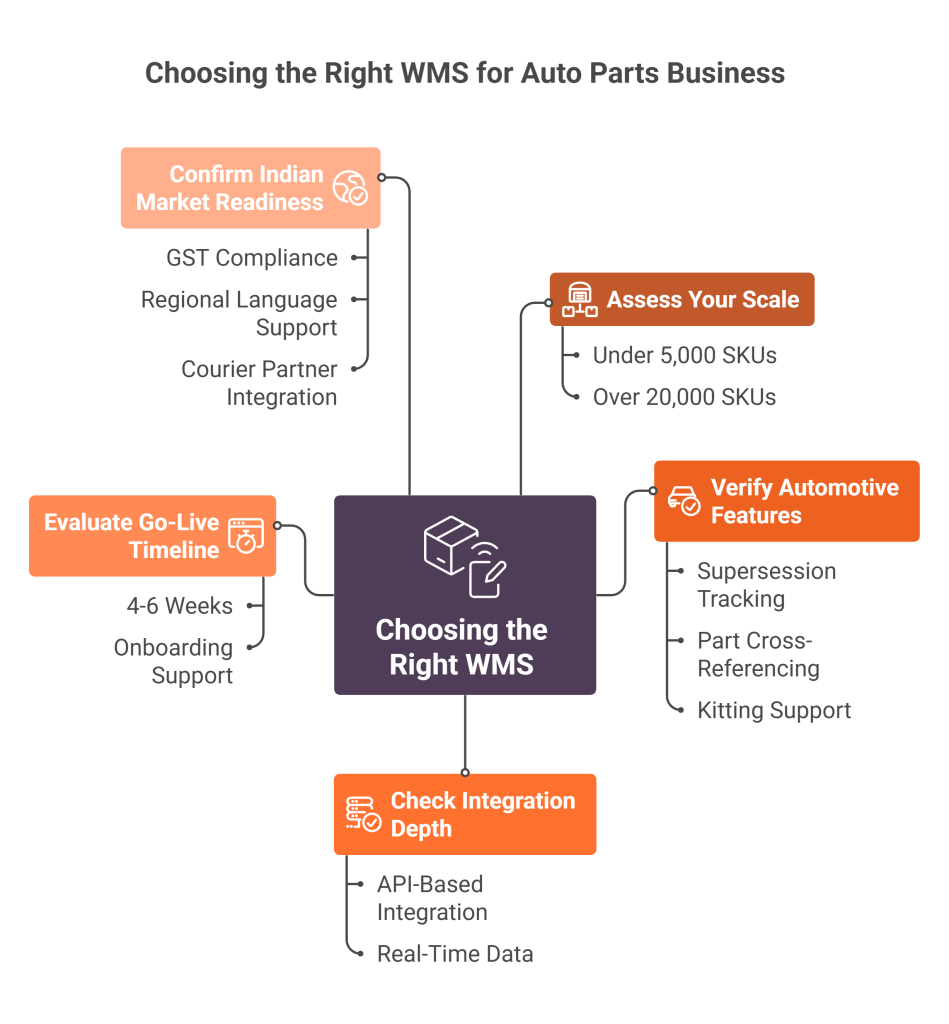
Check Integration Depth
API-based real-time integration with your ERP, e-commerce platform, and logistics partners is non-negotiable. Batch file uploads aren’t enough for modern operations.
Evaluate Go-Live Timeline
A WMS that takes 6 months to implement delays your ROI by 6 months. Look for solutions that go live in 4-6 weeks with proper onboarding support.
Confirm Indian Market Readiness
GST compliance, regional language support, integration with Indian courier partners, and understanding of local warehouse infrastructure are must-haves. Check out our guide on choosing the best warehouse management software in India for a detailed evaluation framework.
Results You Can Expect
When Indian auto parts businesses implement a purpose-built WMS, measurable improvements follow:
- Order accuracy: 92% to 99.5%+
- Picking productivity: 30-40% improvement
- Inventory accuracy: Reaches 99%+
- Dead stock: Reduces by 20-25%
- Fulfillment time: Drops by 50%
- Return processing: 60% faster
These numbers aren’t aspirational. They’re documented outcomes from warehouses that moved from manual or basic systems to automotive-specific WMS platforms.
The Road Ahead: EVs, AI, and Connected Warehouses
The automotive industry is transforming, and warehousing must evolve with it.
EV component warehousing introduces new requirements around temperature-controlled storage for batteries, hazardous material compliance, and specialized traceability. Our article on traceability in manufacturing explores how modern systems handle these requirements.
AI-powered demand forecasting predicts part demand based on vehicle age patterns, seasonal trends, and regional driving conditions.
IoT-enabled warehouses use connected sensors for environmental monitoring, automated threshold alerts, and predictive maintenance of warehouse equipment.
The best WMS for automotive parts India today is already preparing for these shifts. Choose a platform that’s investing in AI, IoT, and EV-readiness.
Conclusion
India’s automotive aftermarket is massive, growing, and increasingly competitive. Managing tens of thousands of SKUs across multiple brands, locations, and channels with manual systems or generic ERPs simply doesn’t work anymore.
Investing in a WMS for automotive parts India is no longer optional for businesses that want to stay competitive. It’s the difference between a warehouse that loses money through errors, dead stock, and slow fulfillment versus one that operates as a precision-driven profit center.
Whether you’re an OEM distributor, aftermarket wholesaler, or multi-brand auto parts retailer, the right WMS transforms your operations from chaotic to controlled.
Ready to upgrade your automotive parts warehouse? Discover how Omneelab’s WMS handles supersession tracking, multi-brand inventory, barcode integration, and seamless ERP connectivity built specifically for India’s auto parts industry. Get in touch today.
Frequently Asked Questions (FAQs)
Supersession happens when manufacturers replace old part numbers with newer versions. A WMS tracks these chains automatically, so discontinued parts are instantly mapped to their replacements instead of showing as “out of stock.”
Auto parts often look identical on the shelf. Barcode scanning forces verification at every pick, ensuring the correct part is selected. This alone improves accuracy from around 92% to over 99.5%.
Yes. A good WMS for automotive parts India handles multi-brand inventory through zone-based allocation, unified part cross-referencing, and compatibility mapping that links different brands to the same vehicle application.
Kitting bundles multiple individual components into a single service package, like a clutch kit containing the disc, pressure plate, and release bearing. The WMS manages the bill of materials and directs accurate component picking.
Integration works through real-time APIs. Purchase orders flow from ERP to WMS, while GRN confirmations, stock movements, and dispatch details sync back automatically, eliminating manual double-entry and keeping records aligned.

Kapil Pathak is a Senior Digital Marketing Executive with over six years of experience specializing in the logistics and supply chain industry. His expertise spans digital strategy, search engine optimization (SEO), search engine marketing (SEM), and multi-channel campaign management. He has a proven track record of developing initiatives that increase brand visibility, generate qualified leads, and drive growth for D2C & B2B technology companies.