Picture day two of a big sale. Your best-selling kurta set is moving fast. Then the stock count hits zero, but orders keep arriving because your Flipkart listing has not caught up yet.
By evening you are cancelling orders, paying penalties, and watching shoppers buy from someone else. That is a stockout. It costs far more than the one sale you missed.
The timing matters. The 2026 festive window runs from October 9 to November 15, so the damage from this season is still fresh. This week is the best moment to measure it.
In this guide, you will learn:
- What a stockout is and how it differs from a backorder
- The real causes of stockouts in Indian e-commerce
- A stockout cost formula built for Indian sellers, with a ₹ worked example
- How Amazon India and Flipkart penalties add to the bill
- Practical ways to prevent stockouts, from safety stock to multi-warehouse setups
What Is a Stockout? (Stock Out Kya Hota Hai?)
A stockout happens when a product has no sellable units left and a customer wants to buy it. In simple Hinglish: stock out kya hota hai? Stock khatam ho gaya, aur order pura nahi ho sakta.
A few points make the idea clearer:
- The stock can be zero in your warehouse, or zero only in your software.
- It can hit one SKU, one warehouse, or one sales channel at a time.
- It is different from low stock. Low stock is a warning. A stockout is the loss.
Online, stockouts are also harder to see. In a shop, an empty shelf is obvious. Online, shoppers simply click away to a competitor. You never see the sale you lost, which is why most sellers underestimate the cost.
Backorder vs Out of Stock: What Is the Difference?
People mix up these two terms all the time. The key difference is simple. With a backorder, the customer can still place the order. With an out-of-stock item, they cannot.
| Out of stock | Backorder | |
|---|---|---|
| Can the customer order? | No | Yes |
| Stock on hand | Zero | Zero |
| Restock date | Often unknown | Usually known |
| Main risk | Lost sale | Late delivery or cancellation |
Here is the easiest way to remember it. Every backorder starts with a stockout, but not every stockout becomes a backorder. You choose whether to keep selling.
Backorder meaning in Hindi, in plain words: order le liya, maal baad mein bhejenge.
Backorder vs preorder
A preorder sells a product before it exists or before it first arrives. A backorder sells a product you normally carry that has temporarily run out. Both need a clear ship date. Without one, shoppers lose trust fast.
Can you accept backorders on Amazon or Flipkart?
Often not. One fulfilment source notes that Amazon has no native backorder status for FBA, and a listing suppresses once inventory hits zero. Check each marketplace’s current rules. For backorders, your own D2C store is usually the safer place.
Why Stockouts Happen in Indian E-commerce: Five Types and Common Causes
Most sellers say, “We did not order enough.” Sometimes that is true. Often it is not.
The five types of stockout
One Indian inventory-software blog splits stockouts into five types. Each needs a different fix.
| Type | What is happening | Typical fix |
|---|---|---|
| True zero | No units anywhere | Reorder faster or in larger lots |
| Phantom | System says zero, but stock is on the shelf | Cycle counts, careful receiving |
| Latency | Stock exists, but the channel has not been told | Faster inventory sync |
| Allocation | Stock sits in the wrong warehouse or channel pool | Routing rules, shared pool |
| Reservation | Units are held for carts or orders that never ship | Release rules for held stock |
Check which type you have before you buy more stock. Buying more fixes only the first one.
Root causes behind the five types
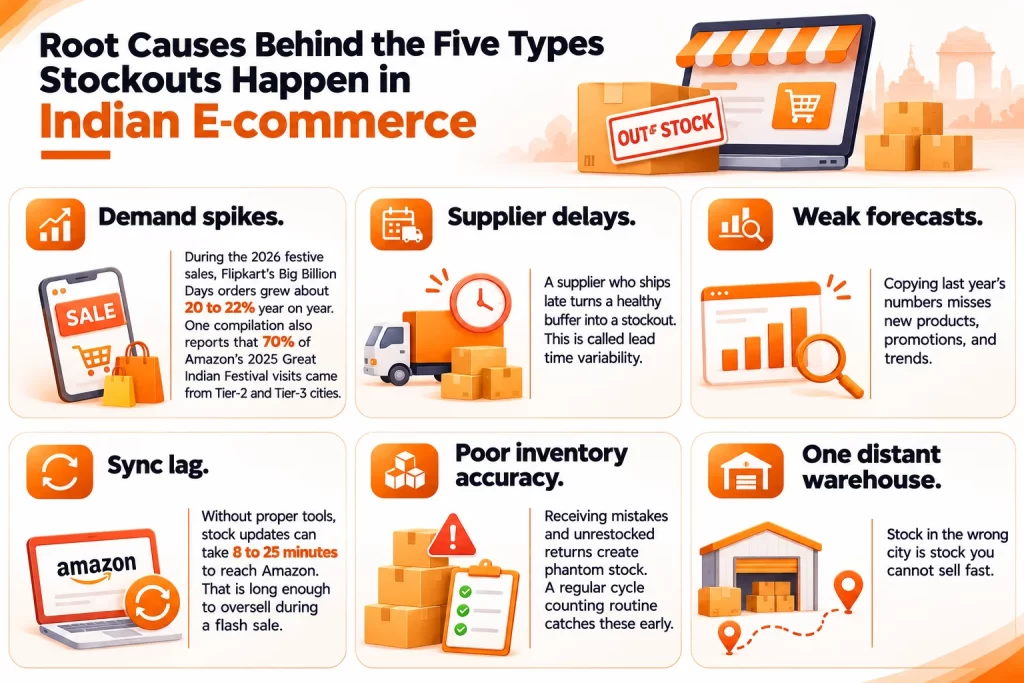
- Demand spikes. During the 2026 festive sales, Flipkart’s Big Billion Days orders grew about 20 to 22% year on year, according to Business Standard. One compilation also reports that 70% of Amazon’s 2025 Great Indian Festival visits came from Tier-2 and Tier-3 cities. Demand now arrives from everywhere at once.
- Supplier delays. A supplier who ships late turns a healthy buffer into a stockout. This is called lead time variability.
- Weak forecasts. Copying last year’s numbers misses new products, promotions, and trends.
- Sync lag. Without proper tools, stock updates can take 8 to 25 minutes to reach Amazon. That is long enough to oversell during a flash sale.
- Poor inventory accuracy. Receiving mistakes and unrestocked returns create phantom stock. A regular cycle counting routine catches these early.
- One distant warehouse. Stock in the wrong city is stock you cannot sell fast.
Stockout Cost Formula for Indian Sellers
Most guides give you a formula in dollars, with Shopify examples. They skip two things Indian sellers face: marketplace cancellation penalties, and 18% GST on some of those fees. Here is a version that includes both.
Stockout cost = Lost margin + Penalties and fees (with GST) + Recovery costs + Lost future margin
What goes into each part
- Lost margin = days out of stock × normal daily units × margin per unit. Use margin, not revenue. Revenue makes the loss look bigger than it is.
- Penalties and fees = cancellation fees and dispatch penalties, plus GST where it applies.
- Recovery costs = rush freight, emergency buying at a higher price, and staff time spent fixing orders.
- Lost future margin = customers who never return × the margin they would have given you over a year.
One tip: use your normal daily sales, not the sales during the stockout. Those are zero by definition.
Worked example in rupees
Imagine a cotton kurta set. It sells at ₹800 with a margin of ₹300 per unit. Normal sales are 20 units a day, and it stays out of stock for 5 days.
- Unmet demand: 100 units.
- Of those, 15 Amazon orders (Self Ship) and 10 Flipkart orders were accepted before stock updated, then cancelled. The other 75 shoppers simply left.
- You spent ₹6,000 on faster freight to restock.
- 10 customers never came back. Each would have bought twice more that year.
| Cost item | Calculation | Amount |
|---|---|---|
| Lost margin | 100 × ₹300 | ₹30,000 |
| Amazon cancellation fee | 15 × (₹80 + 18% GST = ₹94.40) | ₹1,416 |
| Flipkart cancellation penalty | 10 × ₹60 | ₹600 |
| Recovery costs | Rush freight | ₹6,000 |
| Lost future margin | 10 customers × 2 orders × ₹300 | ₹6,000 |
| Total | ₹44,016 |
Five days of stockout cost about ₹8,800 a day. Notice that penalties were only about ₹2,000 of the total. The bigger hit is lost margin. Still, those cancellations also hurt your account health and listing visibility.
These numbers are illustrative. Swap in your own price, margin, and sales speed.
The Marketplace Penalty Layer: Amazon India and Flipkart
Both marketplaces changed their fulfilment penalties just before the festive season. Outlook Business reported the changes in August.
Amazon India changed how it calculates seller cancellation fees from August 17, 2026, for Easy Ship and Self Ship. One report lists the fee as a share of order value:
- 10% for orders under ₹10,000
- 8% for ₹10,001 to ₹50,000
- 5% for ₹50,001 to ₹1 lakh
- 2% above ₹1 lakh
- Plus 18% GST on top of the fee
Flipkart introduced three penalty tiers from August 23, 2026:
- ₹30 if the order misses its dispatch-by date
- ₹60 if the seller cancels
- ₹90 if the shipment is late and then cancelled
Flat penalties hurt low-priced items most. A ₹90 penalty on a ₹400 order takes more than a fifth of the sale price.
Reports differ slightly on the details, so check the latest seller notice before you plug numbers into your model. Fee rules change often.
How to Prevent Stockouts and Backorders
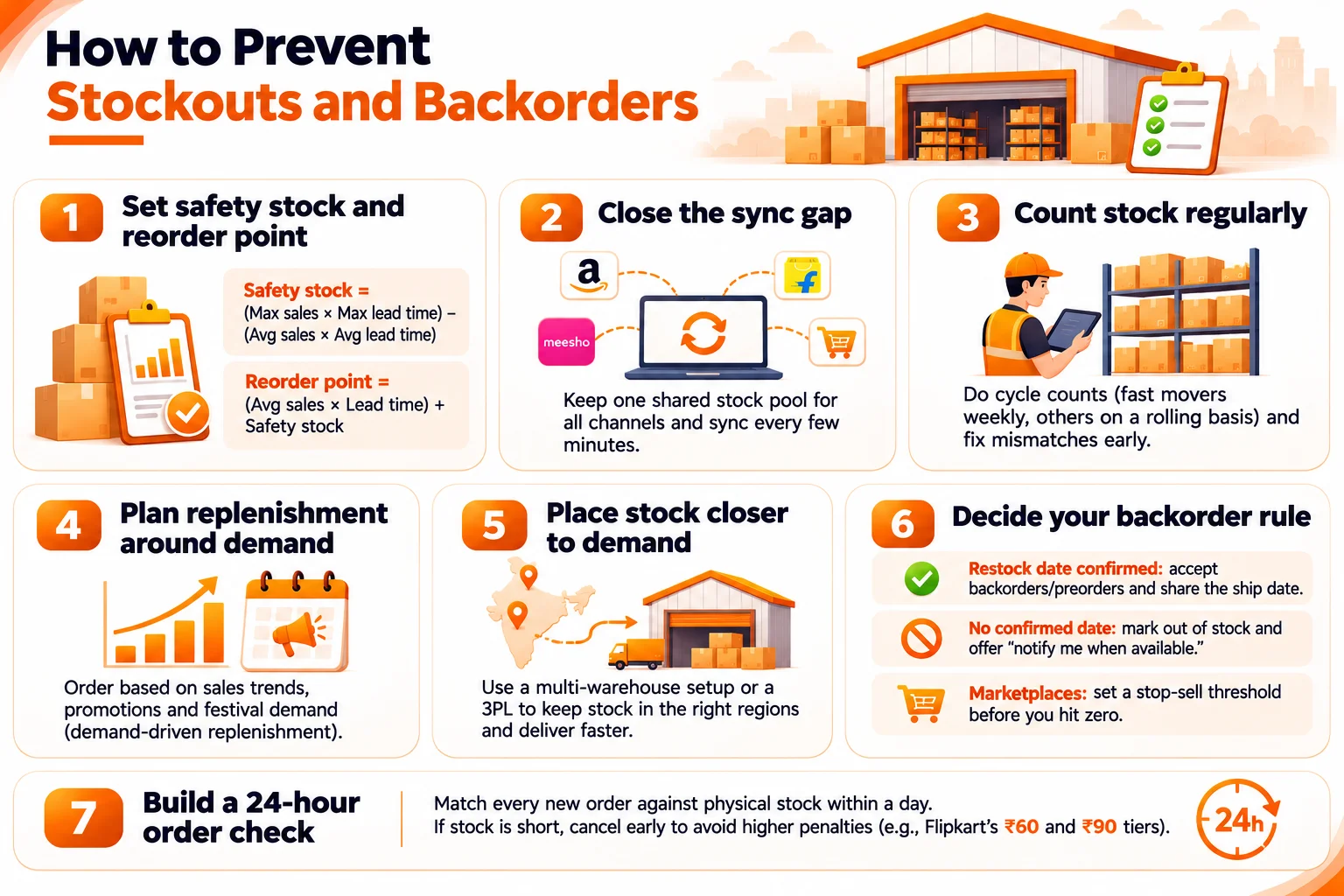
- 1. Set safety stock and a reorder point
Safety stock is your cushion against surprises. The bigger the cushion, the higher your service level, meaning the share of demand you can meet from stock. The reorder point tells you when to place the next order.
Safety stock = (max daily sales × max lead time) − (average daily sales × average lead time)
Reorder point = (average daily sales × lead time) + safety stock
Say you sell 20 units a day on average and 30 on your best day. The supplier takes 10 days on average and 14 at worst.
Safety stock = (30 × 14) − (20 × 10) = 220 units
Reorder point = (20 × 10) + 220 = 420 units
Reorder when stock hits 420. Our guides explain the safety stock formula, the reorder point, and how buffer stock differs from both. Use ABC analysis too, so your top sellers get the thickest cushion. - 2. Close the sync gap
Keep one shared stock pool for Amazon, Flipkart, Meesho, and your D2C site. Sync every few minutes, not every few hours. Hold back a few units on fast movers during flash sales. That small reserve absorbs the lag.
- 3. Count stock regularly
Phantom stock hides behind “system says zero.” Count your fast-moving SKUs weekly and the rest on a rolling cycle. Fix receiving and returns errors at the source.
- 4. Plan replenishment around demand
Order based on recent sales speed, your promotion calendar, and festival dates. This is demand-driven replenishment. AI forecasting tools may help. One source claims 20 to 30% better inventory accuracy, but treat vendor numbers as a claim to test, not a promise. Run a small pilot first.
- 5. Place stock closer to demand
Allocation stockouts happen when stock sits in the wrong place. A multi-warehouse inventory setup lets you split stock by region and ship from the nearest location. A 3PL fulfilment centre can do the same without new leases. Both also shorten delivery to Tier-2 and Tier-3 towns.
- 6. Decide your backorder rule in advance
– Restock date confirmed: accept backorders or preorders on your D2C site, and state the ship date clearly. If the customer agrees, a split shipment sends available items now.
– No confirmed date: mark the item out of stock and add a “notify me when available” button.
– Marketplace listings: set a stop-sell threshold so the listing closes before you hit zero. - 7. Build a 24-hour order check
Match every new order against physical stock within a day. If stock is short, cancel early. Late cancellations cost more, as Flipkart’s ₹60 and ₹90 tiers show.
Numbers to Track Every Week
- Stockout rate = (SKUs out of stock ÷ total SKUs) × 100. If 25 of 500 SKUs are out, your rate is 5%.
- Fill rate: the share of order lines you ship complete on the first attempt.
- Days of inventory: current stock ÷ average daily sales.
- Cancellation rate: track it by reason, such as stock shortage or late dispatch.
- Sell-through rate: how fast new stock sells.
There is no single “good” stockout rate for every seller. Aim for near zero on your top 20% of products, and accept a little more slack on slow movers.
2026 Trends Worth Planning For
Run a festive post-mortem now
Pull your orders from October 9 to November 15. List every SKU that hit zero. Apply the formula above to each one. Then plan your festive season inventory for 2027 while the lessons are fresh.
Quick commerce and dark stores
One report puts quick commerce at about ₹1.08 lakh crore, growing roughly 40% a year. Brands often place only 5 to 15 fast SKUs in each dark store. With so few SKUs, a small buffer miss means an empty shelf.
Penalty-aware planning
Cancellation fees are now tied to order value or charged as flat amounts per order. Your model should treat every oversold order as a direct cost.
Conclusion: Measure It, Then Fix It
A stockout costs more than a missed sale. It adds cancellation penalties, rush freight, and customers who do not come back. A backorder can soften the blow, but only when you have a firm restock date.
Here is the short version:
- Know the difference between a stockout, a backorder, and a preorder.
- Find out which of the five stockout types you actually have.
- Use the four-part formula to put a ₹ figure on every stockout.
- Prevent repeats with safety stock, fast sync, regular counts, and stock placed near your buyers.
Your next step: open a spreadsheet today and run the formula on your top five SKUs from this festive season. If you want real-time stock sync across marketplaces and your D2C store, talk to the Omneelab team about a WMS demo.
FAQs
Safety stock = (max daily sales × max lead time) − (average daily sales × average lead time). Reorder point = (average daily sales × lead time) + safety stock. Reorder when your stock falls to that point.
Use a backorder for items you normally carry that have a confirmed restock date. Use a preorder for new or upcoming products. With either one, show the ship date up front.
Sync stock across channels often, hold back a few units on fast movers, and check orders against physical stock within 24 hours. Dispatch on time too, since Flipkart also penalises missed dispatch-by dates.
A stockout means too little stock to meet demand. Overstock means too much, which ties up cash and can turn into dead stock with carrying costs. Good planning balances both, so protect top sellers first.
On FBA, a listing suppresses when inventory hits zero. One fulfilment source also says longer stockouts can hurt organic ranking, because Amazon’s algorithm uses sales history. Restocking quickly limits the damage.

Kapil Pathak is a Senior Digital Marketing Executive with over six years of experience specializing in the logistics and supply chain industry. His expertise spans digital strategy, search engine optimization (SEO), search engine marketing (SEM), and multi-channel campaign management. He has a proven track record of developing initiatives that increase brand visibility, generate qualified leads, and drive growth for D2C & B2B technology companies.