What if some of your stock never needed a shelf at all?
Think about it. A truck pulls in with 400 cartons. Your team unloads them, scans them, finds a rack, and stores them. Two days later, they pick the same cartons, pack them, and load them onto another truck. That is a lot of handling for goods that were always going to leave.
This is the problem cross docking solves. Instead of storing goods, you move them straight from the inbound dock to the outbound dock, often within a few hours.
In this guide, you will learn:
- What cross docking is, with simple Indian examples
- How a cross dock differs from a regular warehouse (and from transloading)
- The main types of cross docking and the best facility layouts
- How a warehouse management system (WMS) makes it work, step by step
- The pros, the cons, and which Indian industries benefit most
- Whether to run it in-house or use a 3PL, plus 7 best practices to get started
Let’s start with the basics.
What Is Cross Docking?
Cross docking is a logistics method where goods are unloaded from an inbound vehicle, sorted, and loaded onto an outbound vehicle with little or no storage in between. The goods “cross” the dock instead of sitting in it.
Here’s a simple way to picture it. A cross dock works like a railway junction. Passengers get off one train, walk across the platform, and board the next one. Nobody checks into a hotel.
Most cross docks aim to move goods out within 24 hours. Some fast-moving operations do it in under four. Wikipedia’s overview of cross-docking traces the idea back to the US trucking industry, and later to large retailers who used it to cut distribution costs.
A Cross Docking Example from India
Let’s say an FMCG brand ships full truckloads of biscuits, soap, and tea from its factory in Baddi to a hub near Delhi.
- The hub unloads all three products at the inbound dock.
- Staff sort cartons by retail store or distributor.
- Each mixed load goes straight onto a smaller truck heading to Gurugram, Noida, or Faridabad.
The hub never stores a single carton. It simply turns a few big shipments into many small ones.
Quick commerce works in a similar way. Supplier stock lands at a mother hub and is split across dark stores the same day.
Cross Docking vs Traditional Warehousing
So, what’s the actual difference between a warehouse and a cross dock? It comes down to how long goods stay and what the building is designed for.
| Factor | Traditional warehouse | Cross dock facility |
|---|---|---|
| Storage time | Days, weeks, or months | Usually under 24 hours |
| Main process | Receive, put away, store, pick, pack, ship | Receive, sort, stage, ship |
| Layout | Racks and storage zones | Dock doors on both sides, open staging area |
| Inventory carrying cost | Higher | Much lower |
| Planning need | Moderate | High, inbound and outbound must be in sync |
| Best for | Slow movers, safety stock, seasonal buffers | Fast movers, pre-sorted orders, perishables |
In short, a warehouse holds stock. A cross dock moves stock. Many Indian facilities do both under one roof, which is why your WMS needs to handle both flows.
Cross Docking vs Transloading
People often mix these two up, so let’s clear it. Transloading means shifting cargo from one mode of transport to another, such as from a rail wagon or container to a truck. The goods usually stay in the same shipment.
Cross docking, on the other hand, is about re-sorting. Goods from several inbound loads get split, mixed, and rebuilt into new outbound loads by destination. A facility can do both, but the goal is different. Transloading changes the vehicle. Cross docking changes the load.
Types of Cross Docking
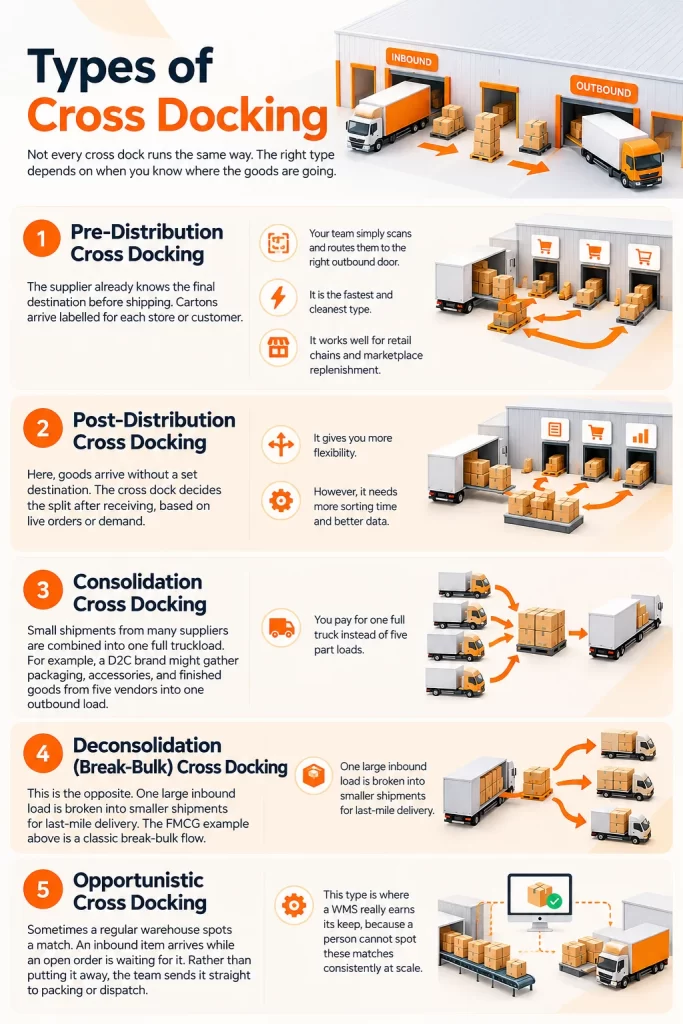
Not every cross dock runs the same way. The right type depends on when you know where the goods are going.
1. Pre-Distribution Cross Docking
The supplier already knows the final destination before shipping. Cartons arrive labelled for each store or customer.
- Your team simply scans and routes them to the right outbound door.
- It is the fastest and cleanest type.
- It works well for retail chains and marketplace replenishment.
2. Post-Distribution Cross Docking
Here, goods arrive without a set destination. The cross dock decides the split after receiving, based on live orders or demand.
- It gives you more flexibility.
- However, it needs more sorting time and better data.
3. Consolidation Cross Docking
Small shipments from many suppliers are combined into one full truckload. For example, a D2C brand might gather packaging, accessories, and finished goods from five vendors into one outbound load. As a result, you pay for one full truck instead of five part loads.
4. Deconsolidation (Break-Bulk) Cross Docking
This is the opposite. One large inbound load is broken into smaller shipments for last-mile delivery. The FMCG example above is a classic break-bulk flow.
5. Opportunistic Cross Docking
Sometimes a regular warehouse spots a match. An inbound item arrives while an open order is waiting for it. Rather than putting it away, the team sends it straight to packing or dispatch.
This type is where a WMS really earns its keep, because a person cannot spot these matches across hundreds of SKUs in real time.
Cross Docking Layout: Which Shape Fits Your Facility?
The building matters more than most people think. A cross dock facility is designed around dock doors and travel distance, not rack space. Here are the four common layouts.
| Layout | How it looks | Best for |
|---|---|---|
| I-shape | Long, narrow building with inbound doors on one side and outbound on the other | Small to mid-size hubs with a modest door count |
| L-shape | Two wings meeting at a corner | Mid-size hubs that need more doors without long walks |
| T-shape | A main wing with a centre arm | Larger hubs with many outbound routes |
| X-shape | Four wings meeting in the middle | Very large networks with heavy, round-the-clock traffic |
Most Indian hubs start with an I-shape because it is simple and cheap to build. As door counts grow, the walk from one corner to the other gets long. That’s when L, T, or X shapes start to pay off, since they keep the centre of the building close to every door.
Whatever the shape, keep three things in mind:
- Staging space: Leave enough open floor near each outbound door for loads being built.
- Clear lanes: Mark aisles so forklifts and pallet jacks never block each other.
- Door assignment: Put your busiest routes on the doors closest to the inbound side.
How a WMS Makes Cross Docking in Warehouse Operations Work
On paper, cross docking sounds simple. Unload, sort, load. In practice, it only works when inbound and outbound are tightly in sync. Miss that, and your “cross dock” turns into a messy pile of cartons near Door 4.
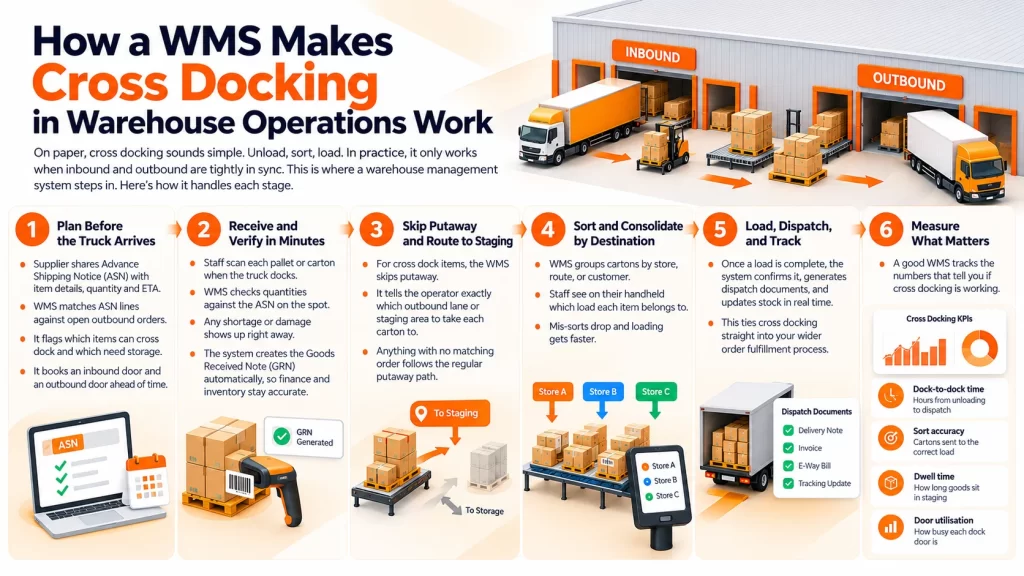
This is where a warehouse management system steps in. Here’s how it handles each stage.
Step 1: Plan Before the Truck Arrives
It all starts with the Advance Shipping Notice (ASN). The supplier shares what is coming, how much, and when.
- The WMS matches ASN lines against open outbound orders.
- It flags which items can cross dock and which need storage.
- It books an inbound door and an outbound door ahead of time.
Step 2: Receive and Verify in Minutes
When the truck docks, staff scan each pallet or carton. With barcode scanning, the WMS checks quantities against the ASN on the spot. Any shortage or damage shows up right away.
The system then creates the Goods Received Note (GRN) automatically, so finance and inventory stay accurate.
Step 3: Skip Putaway and Route to Staging
In a normal flow, received goods go through putaway to a storage location. For cross dock items, the WMS skips that step. Instead, it tells the operator exactly which outbound lane or staging area to take each carton to.
Anything that has no matching order follows the regular putaway path. That way, one facility runs both flows without confusion.
Step 4: Sort and Consolidate by Destination
The WMS groups cartons by store, route, or customer. Staff see on their handheld which load each item belongs to. Consequently, mis-sorts drop and loading gets faster.
Step 5: Load, Dispatch, and Track
Once a load is complete, the system confirms it, generates dispatch documents, and updates stock in real time. This ties cross docking straight into your wider order fulfillment process.
Step 6: Measure What Matters
Finally, a good WMS tracks the numbers that tell you if cross docking is working:
- Dock-to-dock time: hours from unloading to dispatch
- Sort accuracy: cartons sent to the correct load
- Dwell time: how long goods sit in staging
- Door utilisation: how busy each dock door is
You can track these alongside your other warehouse KPIs on one dashboard.
A Cross Docking Example: One Shift at a Hub
To make this real, picture a D2C personal care brand running a hub near Bhiwandi.
- 6:00 am: The WMS receives ASNs from three suppliers and matches most of the lines to open orders for Pune, Nashik, and Surat.
- 8:30 am: Inbound trucks dock at their booked doors. Staff scan cartons, and the GRN posts automatically.
- 9:00 am: Matched cartons go straight to three outbound lanes. The rest follow normal putaway.
- 11:30 am: Each lane’s load is confirmed on the handheld, and dispatch documents print.
- 12:00 noon: All three outbound trucks leave. Stores get stock by evening.
In about six hours, most of the inbound stock has crossed the dock without ever touching a rack. That’s the power of cross docking when the system does the matching for you.
Advantages of Cross Docking
Why do so many brands and 3PLs use cross dock logistics? Here are the main benefits.
- Lower storage costs: Less stock on racks means less space, rent, and handling.
- Faster delivery: Goods reach stores or customers sooner, often the same or next day.
- Fewer touches: Every skipped step is one less chance of damage or loss.
- Fresher products: Perishables and short shelf-life items spend less time sitting idle.
- Better truck use: Consolidation fills trucks and cuts freight cost per unit.
As Investopedia notes, the big win is cutting storage and handling, which are often among the most expensive parts of distribution.
Disadvantages of Cross Docking
Of course, cross docking is not a fix for everything. Be honest about the trade-offs.
- Tight timing: A late inbound truck can hold up several outbound ones.
- Strong supplier discipline: You need accurate ASNs and proper labels every time.
- Upfront setup: You need enough dock doors, staging space, and a capable WMS like Omneelab WMS.
- Less buffer: With little stock on hand, a demand spike can catch you short.
- Not for slow movers: Items with unpredictable demand still need regular storage.
When Does Cross Docking Make Sense in India?
So, should you try it? It usually fits well when:
- You move high volumes of fast-moving SKUs, like FMCG, beverages, or e-commerce bestsellers.
- You serve many stores or dark stores from one hub.
- You handle perishables where every hour counts.
- You run a 3PL hub that consolidates loads for several clients. Our 3PL warehouse management guide covers this in more detail.
- You face festive peaks like Diwali, when storage space runs out and speed matters most.
On the other hand, if your demand is lumpy or your suppliers miss delivery windows often, start with opportunistic cross docking. Run it inside your regular warehouse first, then scale up as your data improves.
Industries That Use Cross Docking in India
Cross docking is not just for big retail chains. Here’s how different sectors put it to work.
FMCG and Retail
FMCG brands ship full loads from plants to regional hubs. From there, goods are split by distributor or store and sent out the same day. This keeps shelves stocked without building up stock in every city.
E-Commerce and Quick Commerce
Marketplace sellers and D2C brands use cross docking to feed fulfilment centres and dark stores. During sale events like Diwali or Big Billion Days, inbound stock is often matched to orders the moment it lands, so it never touches a shelf.
Food, Dairy, and Cold Chain
Perishables lose value with every hour. Cross docking lets fruit, dairy, and frozen goods move from the reefer truck to the delivery van with minimal time outside temperature control.
Pharma
Distributors move fast-selling medicines from manufacturers to chemists and hospitals. Batch and expiry details must still be captured at receiving, so scanning and traceability are a must.
Automotive and Manufacturing
Plants receive parts from many vendors and send them straight to the production line or to assembly units. In this case, cross docking supports just-in-time supply and keeps line-side stock lean.
In-House Cross Docking vs Cross Docking Services from a 3PL
Should you run cross docking yourself or hand it to a logistics partner? Both work. The right choice depends on your volume, network, and control needs.
| Question | In-house | 3PL cross docking services |
|---|---|---|
| Upfront cost | Higher, you need space, doors, staff, and systems | Lower, you pay per pallet, carton, or load |
| Control | Full control over process and priorities | Shared control, governed by an SLA |
| Scale | Grows only as fast as you invest | Can flex quickly during peaks |
| Visibility | Direct, through your own WMS | Depends on the 3PL’s system and reporting |
| Best for | Steady, high volumes on fixed routes | New regions, seasonal peaks, or testing the model |
Many brands mix both. They run a core hub in-house and use a 3PL for new cities or festive overflow. Either way, insist on real-time data. If you can’t see where a carton is, you can’t promise a delivery date.
How to Implement Cross Docking: 7 Best Practices
Thinking of getting started? These steps will help you avoid the usual mistakes.
- Start with the right SKUs. Pick fast movers with steady demand. Leave slow or unpredictable items in regular storage.
- Get suppliers on board. Agree on ASN timing, label formats, and delivery windows before day one.
- Schedule your docks. Give every inbound and outbound truck a time slot so doors never sit idle or jammed.
- Use barcode or RFID labels. Scanning at every handoff keeps sorting accurate and records clean.
- Set a dwell time target. For example, nothing should sit in staging for more than a set number of hours. Then track it daily.
- Train your team. Cross docking is faster paced than storage work. Clear SOPs and handheld guidance reduce errors.
- Run it on a WMS. A system that links ASNs, orders, doors, and dispatch is what keeps everything in sync as volume grows.
Start small. Run one route or one supplier first, measure the results, and then expand.
Conclusion: Move Stock, Don’t Just Store It
Cross docking is a simple idea with a big payoff. Instead of storing goods you already plan to ship, you move them from dock to dock in hours.
Let’s recap:
- Cross docking cuts storage, handling, and delivery time.
- The main types are pre-distribution, post-distribution, consolidation, break-bulk, and opportunistic.
- It suits fast movers, multi-store networks, perishables, and 3PL hubs.
- It only works well when inbound and outbound are in sync, and that takes a WMS.
The good news? You don’t need a brand-new building to start. With the right system, your current warehouse can run cross docking and regular storage side by side.
Omneelab WMS helps Indian businesses plan inbound loads, skip unnecessary putaway, sort by destination, and track every carton in real time.
Ready to see how it would work in your warehouse? Book a free 30-minute demo with our team.
Frequently Asked Questions
Cross docking means unloading goods from one truck and loading them onto another with little or no storage in between. The goods pass through the facility, usually within 24 hours, instead of sitting on racks.
In the supply chain, cross docking is a distribution strategy that links suppliers directly to outbound routes. It shortens lead times, cuts inventory holding, and helps brands serve many stores or customers from one hub.
A warehouse stores goods for days or months before shipping. A cross dock facility moves goods through in hours. Warehouses focus on storage and picking, while cross docks focus on fast sorting and dock door scheduling.
The common types are pre-distribution, post-distribution, consolidation, deconsolidation (break-bulk), and opportunistic cross docking. The right one depends on when you know each item’s destination and how your loads are built.
For small, occasional transfers, you can manage manually. However, once volumes grow, a WMS becomes essential. It matches ASNs to orders, assigns dock doors, guides sorting, and tracks every carton so nothing gets stuck in staging.

Kapil Pathak is a Senior Digital Marketing Executive with over six years of experience specializing in the logistics and supply chain industry. His expertise spans digital strategy, search engine optimization (SEO), search engine marketing (SEM), and multi-channel campaign management. He has a proven track record of developing initiatives that increase brand visibility, generate qualified leads, and drive growth for D2C & B2B technology companies.