Walk into any warehouse in India, from a small Shopify seller’s back room in Jaipur to a massive fulfillment center outside Bhiwandi, and you will hear the same three letters over and over: SKU.
So, what is SKU exactly? The SKU full form is Stock Keeping Unit. It is a unique alphanumeric code that a business assigns to every distinct product it sells, so it can track that product through its entire journey, from the supplier’s truck to the customer’s doorstep.
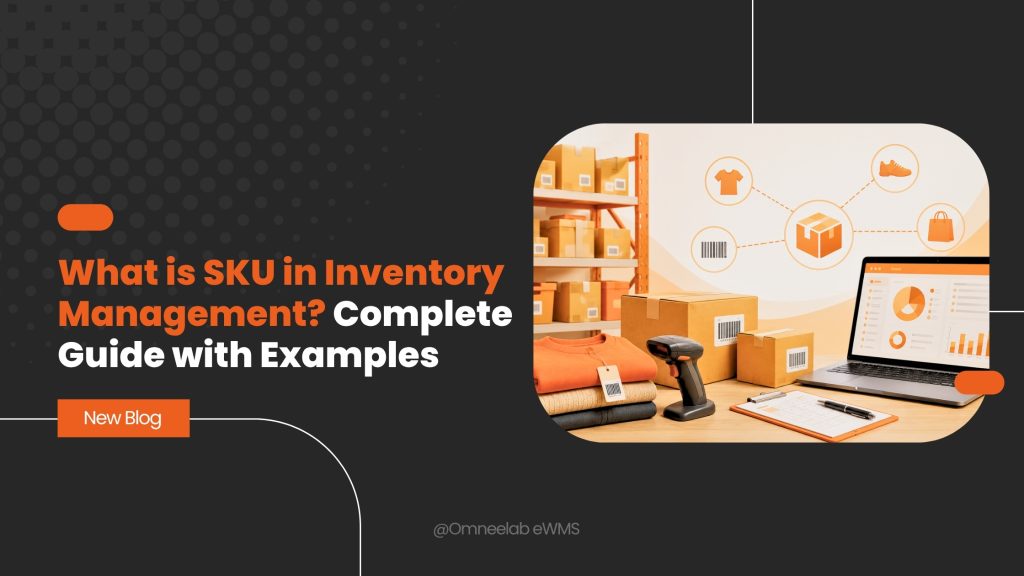
Think of a SKU as a name tag for your inventory. Without name tags at a conference, you would spend all day asking, “Sorry, who are you again?” Without SKUs in your warehouse, your team does the same thing with products. And every one of those little confusions costs you time, money, and sometimes a customer.
In this guide, we will cover the SKU meaning in plain language, show you real SKU number examples, explain how to create SKU numbers for your own catalog, compare SKU vs UPC vs barcode, and walk through SKU management best practices that actually work in Indian warehouses and marketplaces. Let’s get into it.
What is SKU? Meaning and Full Form Explained
A stock keeping unit (SKU) is an internal product identifier. It is a code, usually 8 to 12 characters long, made up of letters and numbers, that represents one specific version of one specific product.
The key word here is specific. A SKU does not just identify a t-shirt. It identifies the blue t-shirt, in size medium, from your summer collection. If the same shirt comes in red, that is a different SKU. If it comes in large, that is another SKU again.
Here is the stock keeping unit definition in one line: a SKU is the smallest unit at which you track inventory.
A quick example
Say you run a footwear brand. You sell one style of running shoe in three colors and five sizes. How many products do you have? From a marketing point of view, one. From an inventory point of view, fifteen. Three colors multiplied by five sizes gives you fifteen SKUs, and each one needs its own code, its own stock count, and its own reorder point.
This is why “SKU count” and “product count” are two very different numbers. A store with 200 products can easily carry 3,000 SKUs once you account for every variant of size, color, style, and pack quantity.
Why is it called a stock keeping unit?
The name is quite literal. It is the unit by which you keep (track and manage) your stock. The term came out of retail operations decades ago, long before e-commerce, when store managers needed a consistent way to count what was on shelves and in back rooms. Today the same concept powers everything from your local kirana store’s billing software to the warehouse management system (WMS) behind a quick commerce dark store.
What Does a SKU Number Look Like? Real Examples
There is no universal format for a SKU number, and that is actually the point. Unlike barcodes issued by a central authority, SKU codes are created by you, for your business. That freedom is powerful, but only if you use a logical structure.
Let’s break down a well-designed SKU number example:
EHGL-097
| Segment | Meaning |
|---|---|
| E | Product category: Earrings |
| H | Style: Hoops |
| G | Material or color: Gold |
| L | Size: Large |
| 097 | Sequential product number |
Anyone on the warehouse floor can read EHGL-097 and know they are looking for large gold hoop earrings, item 97 in that line. No lookup needed. That is what a good SKU architecture does: it turns a code into a description.
Here is another example from apparel:
TSH-BLU-M-S26
| Segment | Meaning |
|---|---|
| TSH | T-shirt |
| BLU | Blue |
| M | Medium |
| S26 | Summer 2026 collection |
Compare that with a lazy SKU like “12345” or, worse, reusing the manufacturer’s part number for everything. When codes carry no meaning, pickers mis-pick, packers mis-pack, and your returns rate quietly climbs.
SKU vs UPC vs Barcode: What’s the Difference?
This is where most beginners get confused, so let’s clear it up. People often use SKU, UPC, and barcode as if they were the same thing. They are not.
| Feature | SKU | UPC | Barcode |
|---|---|---|---|
| Full form | Stock Keeping Unit | Universal Product Code | Not an acronym; a machine-readable symbol |
| Who creates it | Your business | GS1 (a global standards body) | Generated from a SKU, UPC, or any code |
| Format | 8 to 12 alphanumeric characters, flexible | Exactly 12 digits, numbers only | Vertical lines (1D) or squares (2D/QR) |
| Uniqueness | Unique within your business only | Globally unique for that product | Depends on the code behind it |
| Purpose | Internal inventory tracking | External retail identification | Fast scanning of any code |
| Cost | Free, you make it up | Purchased from GS1 | Cost of printing labels |
A few points worth remembering:
- A SKU is your internal language. Two different companies can use the same SKU code for completely different products, and nothing breaks, because SKUs never leave your systems.
- A UPC is the public, standardized identity of a product. If you manufacture goods and sell through external retailers, you buy UPCs from GS1 so that every retailer on the planet scans the same code for your product. In India, GS1 India issues these codes, and you will also encounter the 13-digit EAN (European Article Number), which is the more common standard here. Both fall under the umbrella of GTIN (Global Trade Item Number).
- A barcode is just the machine-readable picture. It is the pattern of lines a scanner reads. You can encode a SKU, a UPC, an EAN, or a batch number into a barcode. If you want to go deeper into scanning technology, we have covered it in our guide to inventory management with barcode technology and our post on QR codes for inventory and warehouse management.
And what about MPN vs SKU? An MPN (Manufacturer Part Number) is assigned by the manufacturer and stays the same no matter who sells the item. Your SKU is yours alone. A reseller might stock one MPN under a SKU like “ELEC-CHRG-045” while another shop codes the same charger as “CH-USB-BLK”.
One more cousin worth mentioning: the serial number. A SKU identifies a type of item, while a serial number identifies one individual unit. All 500 units of the same phone model share one SKU, but each phone has its own serial number. If your products need unit-level tracking, read our guide on inventory serialization in e-commerce.
How to Create SKU Numbers: A Step-by-Step Method
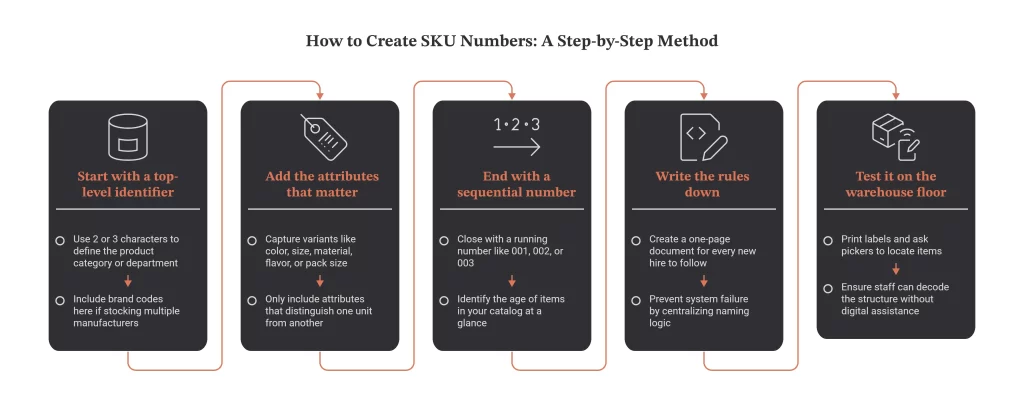
Now for the practical part. How do you create a SKU number? Follow this five-step method and you will end up with a system that scales from 50 SKUs to 50,000.
- Start with a top-level identifier
The first 2 or 3 characters should answer the biggest question about the product: what category or department does it belong to? Examples: TSH for t-shirts, FTW for footwear, ELE for electronics. If you stock multiple brands, the brand code can go here instead.
- Add the attributes that matter
The middle of the code should capture the product variants your business actually tracks: color, size, material, flavor, pack size. Only include attributes that distinguish one sellable unit from another. A candle brand needs fragrance and size in the SKU. It probably does not need the wax supplier’s name.
- End with a sequential number
Close with a running number like 001, 002, 003. This guarantees uniqueness even when two products share every attribute, and it tells you at a glance which items are older in your catalog.
- Write the rules down
Your SKU naming convention should live in a one-page document that every new hire can follow. If the rules live only in the founder’s head, the system falls apart the day someone else creates a product listing.
- Test it on the warehouse floor
Print a few labels, hand them to your pickers, and ask them to find the items. If they can decode the SKU without opening a laptop, your structure works.
Mistakes to avoid when creating SKU codes
- Do not start with zero. Spreadsheets love to strip leading zeros, and “0451” silently becomes “451”.
- Avoid confusing characters. The letter O and the number 0 look identical on a smudged label. Same for I, l, and 1. Skip them.
- Skip special characters. Symbols like /, #, and & break imports into marketplaces and accounting tools. Stick to letters, numbers, and hyphens.
- Never reuse a retired SKU. If you discontinue a product, retire its code forever. Reusing codes corrupts your sales history and makes demand forecasting useless.
- Do not pack in every detail. A 25-character SKU is as unhelpful as a meaningless one. Aim for 8 to 12 characters.
What about SKU generators?
A SKU generator is a tool that builds codes automatically from your product attributes. Many e-commerce platforms include one, and plenty of free SKU generator tools exist online. They are handy for large catalogs, but remember: a generator applies rules, it does not design them. Set your naming convention first, then automate it.
Why SKUs Matter in Inventory Management
So far we have talked about what a SKU is. The bigger question for your business is what a SKU does. Here is why SKU tracking sits at the heart of good inventory control.
Accurate stock levels, in real time
When every unit that enters or leaves your warehouse is scanned against a SKU, your system always knows exactly what you have. No more “let me check and call you back”. No more selling stock you do not actually hold. For multi-channel sellers, this accuracy is the difference between a five-star review and an angry cancellation.
Smarter reordering
SKU-level data tells you how fast each variant sells, which lets you set a sensible reorder point for every item. Maybe blue in medium flies off the shelf while yellow in XL gathers dust. Without SKU-level visibility, you reorder blindly and end up overstocked on slow movers and out of stock on bestsellers. Both outcomes burn cash.
Sharper analysis
SKU data feeds directly into ABC analysis, where you rank items by their contribution to revenue. Your A items (often 20 percent of SKUs driving 80 percent of sales) deserve tighter counting cycles and premium warehouse slotting. Your C items might be candidates for clearance. None of this analysis is possible if your inventory is tracked at the vague level of “shirts”.
Fewer picking errors
A picker holding a pick list that says “TSH-BLU-M-S26, Bin A-14, Qty 2” makes far fewer mistakes than one told to “grab two blue shirts”. Whatever order picking method your warehouse uses, SKU-level pick lists are the foundation of accuracy. Fewer mis-picks mean fewer returns, and fewer returns mean healthier margins.
Less shrinkage
When stock counts drift from reality, SKU-level records show you exactly which items are disappearing and from where. That trail is your first tool against inventory shrinkage, whether the cause is theft, damage, or data entry errors.
Spotting dead stock before it buries you
Every warehouse has products that stopped selling months ago and are quietly eating storage space. SKU-level ageing reports surface this dead stock early, while you can still discount it, bundle it, or return it to the vendor. Stockouts get all the attention, but dead stock is the silent killer of warehouse profitability, and clearing it is one of the fastest ways to improve inventory turnover.
SKU Management Best Practices for Growing Businesses
Creating SKUs is a one-time design decision. Managing them is a habit. Here are the practices that separate tidy operations from chaotic ones.
Keep one source of truth. Your SKU master list should live in one system, ideally your inventory management software or WMS, and every other tool (marketplace listings, accounting, POS system) should sync from it. The moment you maintain separate SKU lists in three spreadsheets, discrepancies creep in.
Audit your catalog regularly. Schedule a quarterly SKU review. Which codes have zero sales? Which have duplicate entries? Which products got listed with a typo in the code? Regular cycle counting keeps physical stock aligned with what the system says.
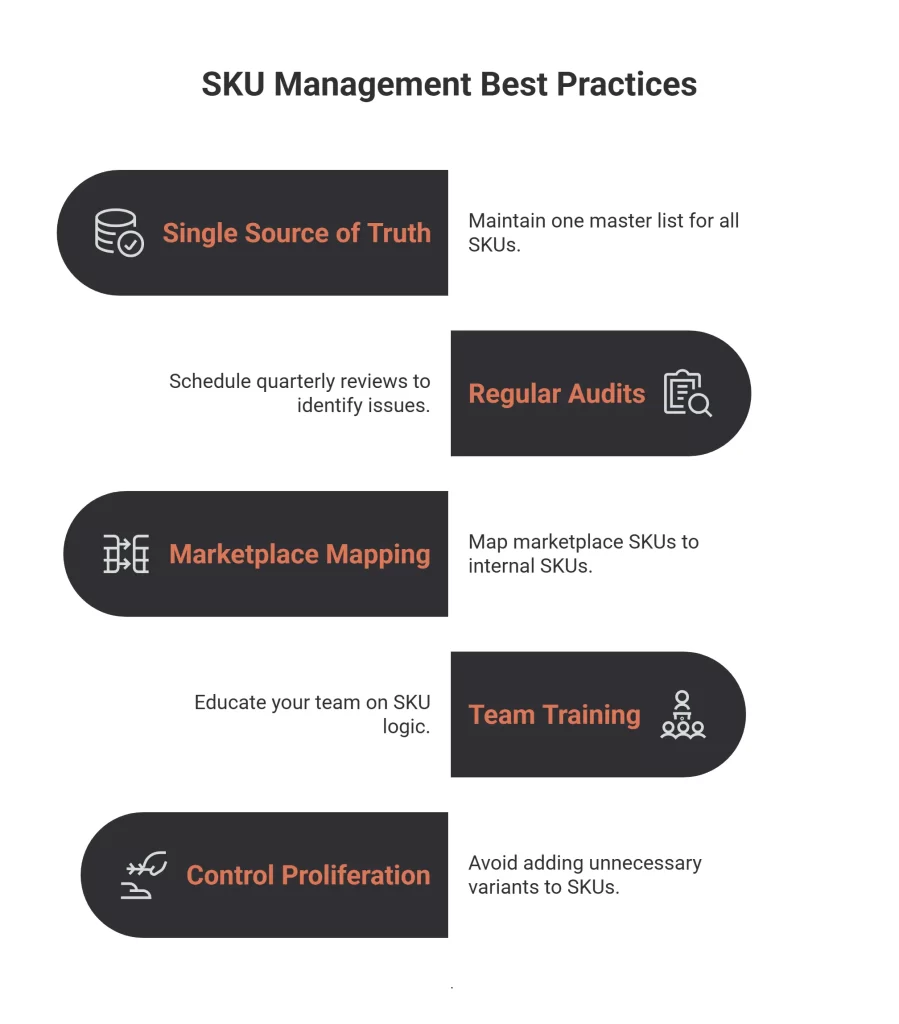
Map marketplace SKUs to internal SKUs. If you sell on multiple channels, each platform may impose its own identifier on top of your codes. Maintain a clean mapping table so that an order for one marketplace listing always decrements the correct internal SKU.
Train your team. Every person who creates listings, receives goods, or picks orders should understand your SKU logic. A ten-minute onboarding session prevents months of cleanup.
Watch out for SKU proliferation. It is tempting to keep adding variants: one more color, one more bundle, one more pack size. Each new SKU adds real cost in storage, counting, listing, and complexity. Which brings us to the next topic.
SKU Rationalization: When Fewer SKUs Mean More Profit
SKU rationalization is the process of reviewing your catalog and deciding which SKUs to keep, which to fix, and which to kill. It sounds harsh, but it is one of the highest-return exercises in inventory management.
Here is the uncomfortable truth most sellers discover during their first rationalization: a large share of SKUs contribute almost nothing to profit. They tie up capital, occupy prime bin locations, complicate purchasing, and slow down picking, all while producing a trickle of sales.
A simple rationalization pass looks like this:
- Pull 12 months of sales, margin, and holding cost data per SKU.
- Rank every SKU by total contribution (not just revenue; a high-selling item with razor-thin margins and heavy returns may still be a loser).
- Flag the bottom performers and ask three questions: Does this SKU attract customers who buy other things? Is it strategically necessary, like a spare part for a bestseller? Is demand seasonal rather than dead?
- Discontinue, discount, or bundle whatever fails all three tests.
Fashion brands managing seasonal inventory and FMCG companies in India often run this exercise before festive season stocking, freeing up warehouse space and working capital exactly when they need it most.
SKU in Amazon, Flipkart, and Indian Marketplaces
If you sell online in India, you juggle several identifiers that all look SKU-like. Here is how they fit together.
Amazon: Seller SKU vs FNSKU vs ASIN
- Seller SKU is the code you assign when you create a listing. Amazon lets you use your internal SKU here, and you absolutely should, because it keeps your channels consistent.
- FNSKU (Fulfillment Network Stock Keeping Unit) is Amazon’s own barcode for units stored in its FBA warehouses. It ties a physical unit to your seller account, so your stock never gets mixed up with another seller’s identical product.
- ASIN is Amazon’s catalog identifier for the product page itself, shared across all sellers of that item.
So one product can carry three codes at once: your internal SKU in your WMS, the seller SKU on the listing (ideally the same), and an FNSKU label on each unit sitting in an Amazon fulfillment center. If you are weighing fulfillment options, our comparison of Amazon FBA vs WMS integration breaks down when to use which.
Flipkart: FSN and Seller SKU
Flipkart works similarly. The FSN (Flipkart Serial Number) identifies the product in Flipkart’s catalog, while your seller SKU connects that listing back to your own inventory system. Sellers managing high order volumes on the platform should read our dedicated guide to WMS for Flipkart sellers in India.
Why this mapping matters for GST and audits
In India there is an extra reason to keep SKU data clean: compliance. Your invoices, e-way bills, and GST filings reference product descriptions and HSN codes. When your SKU master is tidy and every SKU maps to the correct HSN code, tax filing becomes a report you generate, not a puzzle you solve. Auditors love clean SKU-level records, and so will your CA.
SKU Management Software: When Spreadsheets Stop Working
Can you manage SKUs in Excel? Up to a point, yes. Many businesses start with a spreadsheet, and for a catalog of 50 to 100 SKUs on a single sales channel, it works.
Then growth happens. You add a second marketplace. You open a second warehouse. Suddenly you are updating stock in four places, your SKU list has three conflicting versions, and one oversold order on a festival weekend costs you a marketplace rating you spent a year building.
This is the moment to move to dedicated inventory management software or a full warehouse management system. A modern WMS gives you:
- One SKU master synced across every channel and warehouse
- Barcode and QR scanning at receiving, putaway, picking, and dispatch, so every stock movement is recorded against the right SKU automatically
- Real-time stock levels per SKU, per bin, per warehouse
- Automated reorder alerts based on SKU-level velocity
- Batch and expiry tracking layered on top of SKUs, which is essential for FMCG, pharma, and food businesses
- SKU-level reports for ABC analysis, ageing, and rationalization
The rule of thumb: when the time you spend reconciling stock across systems exceeds a few hours a week, software pays for itself. If you are just starting out, see our guide to WMS software for small businesses in India, or compare options in our roundup of the best warehouse management software in India for 2026.
How Many SKUs Should a Store Have?
There is no magic number, but there is a right way to think about it. Your SKU count should be as large as your demand justifies and as small as your operations allow.
A dark store serving 10-minute deliveries might deliberately cap itself at 2,000 to 4,000 fast-moving SKUs, because speed matters more than selection. A marketplace seller in fashion might run 15,000 SKUs across sizes and colors, because selection is the business model. A spare parts distributor might carry 50,000 SKUs with very slow turnover, because availability is what customers pay for.
The warning sign is not a big number. It is a big number without data behind it. If you cannot say which 20 percent of your SKUs drive most of your profit, your catalog is running you, not the other way around.
Track every SKU in real time, across every channel
See how Omneelab WMS automates SKU tracking, barcode scanning and stock accuracy live.
Conclusion: Small Codes, Big Consequences
Let’s recap. A SKU (stock keeping unit) is the unique internal code you assign to every distinct product variant you sell. It is different from a UPC, which is a globally standardized retail code, and from a barcode, which is simply the scannable symbol that can represent either. A good SKU is short, readable, consistent, and designed around a written naming convention. And disciplined SKU management, from creation to rationalization, directly improves stock accuracy, picking speed, reorder timing, and profit.
The businesses that struggle with inventory rarely lack effort. They lack structure. SKUs are that structure, and they cost nothing to get right except a little upfront thought.
Ready to put your SKU system on autopilot? Omneelab’s cloud WMS gives you barcode-driven SKU tracking, real-time stock visibility across warehouses and marketplaces, and the SKU-level reports you need to grow profitably. Book a free demo today and see your inventory the way it was meant to be seen: one accurate SKU at a time.
Frequently Asked Questions
SKU stands for Stock Keeping Unit. Unlike UPC or EAN codes, which are issued by GS1, SKU numbers are created and assigned by your own business. You design the format, you generate the codes (manually or with a SKU generator), and they are unique only within your company.
No. A SKU is the alphanumeric code itself, while a barcode is the machine-readable symbol printed on a label. You can encode your SKU into a barcode or QR code so scanners can read it, but you can also encode a UPC, EAN, or batch number the same way. Think of the SKU as the message and the barcode as the envelope.
Aim for 8 to 12 characters, mixing letters and numbers. Long enough to describe the product’s category, key variants, and a sequential number, short enough to read at a glance. And no, two different products (or two variants of the same product) should never share a SKU. One sellable unit type, one unique code.
Your SKU is your internal identifier. An FNSKU is Amazon’s fulfillment barcode that links units in FBA warehouses to your seller account. An MPN is the manufacturer’s part number, which stays constant no matter who resells the item. A single product in your warehouse can carry all three at once, and good inventory software keeps them mapped correctly.
SKU rationalization is a periodic review of your catalog where you rank every SKU by profit contribution and cut or fix the underperformers. Run it at least once a year, or quarterly in fast-moving categories like fashion and FMCG. It frees working capital, clears warehouse space, reduces dead stock, and simplifies everything from purchasing to cycle counting.

Kapil Pathak is a Senior Digital Marketing Executive with over six years of experience specializing in the logistics and supply chain industry. His expertise spans digital strategy, search engine optimization (SEO), search engine marketing (SEM), and multi-channel campaign management. He has a proven track record of developing initiatives that increase brand visibility, generate qualified leads, and drive growth for D2C & B2B technology companies.