Picture this. Your ops head walks into the Monday review with a vendor deck. Slide four promises a 30% jump in productivity. Slide seven says 99.9% inventory accuracy.
Then the CFO asks one question. Where did these numbers come from?
Silence. Because they came from a vendor’s marketing team, not from your warehouse. And just like that, the project dies.
I have watched this happen more times than I can count. The frustrating part? The WMS was probably a good idea. The business case was just built on sand.
So let’s build one on solid ground instead.
In this guide, you will get real rupee figures for what a warehouse management system costs in India, the four savings that actually drive WMS ROI, a free calculator to run your own numbers, and an honest look at when a WMS simply is not worth it.
Here is the short answer on WMS ROI up front. A WMS in India usually costs ₹30 lakh to ₹45 lakh over three years for a mid sized warehouse running about a dozen licences. It typically pays for itself in 9 to 14 months, provided you have 25 or more warehouse staff. Below that, the maths gets tricky. We will come back to that.
Why most WMS ROI numbers fall apart in the boardroom
Two things kill a WMS ROI case. Both are avoidable.
Problem one: borrowed numbers. Your WMS ROI is only as strong as the weakest number inside it. Vendor benchmarks come from someone else’s warehouse, maybe a large 3PL in Europe. Your CFO knows this, even if nobody says it out loud. The moment you cannot explain where a percentage came from, your credibility goes with it.
Problem two: counting only the subscription. This one is sneakier, and it quietly wrecks WMS ROI.
You budget ₹78,000 a month. That is ₹9.4 lakh a year. Easy to approve, right?
Eighteen months later, actual spend is closer to ₹16 lakh a year. The handhelds, the Shopify connector, two rounds of customisation, the annual support contract. None of it was in the original number.
Now the project is over budget. The WMS gets the blame, when really it was a budgeting miss.
The fix for both problems is the same. Separate what you pay from what you save. Count every line in each column. And use figures you can defend without a vendor in the room.
What a WMS actually costs in India
Every WMS ROI calculation starts with the pay side. That is also where people usually get caught out, so let’s begin there.
Here is a realistic three year bill for a warehouse running 12 licences at ₹6,500 per user per month. Indian mid market WMS cost generally sits in the ₹5,000 to ₹8,000 per user band, so this is a fair middle.
| Line item | Three year total | What it covers |
|---|---|---|
| Subscription | ₹28,08,000 | 12 users x ₹6,500 x 36 months |
| Implementation | ₹2,50,000 | Setup, mapping, testing, go live support |
| Integrations | ₹1,80,000 | 3 channels at roughly ₹60,000 each |
| Hardware | ₹3,60,000 | 15 handheld devices at ₹24,000 each |
| Training | ₹60,000 | Initial plus one refresher round |
| Change requests | ₹2,24,640 | Budget 8% of subscription across three years |
| Total | ₹38,82,640 |
Image alt text: WMS ROI cost breakdown table showing three year warehouse management system cost in India
Notice something? The subscription is only about 72% of the bill. Nearly a third of your spend sits in lines that rarely appear in a first proposal, and every one of them drags on WMS ROI.
The hidden costs that break budgets
Three items quietly sink WMS ROI, so they deserve a closer look.
Hardware is not optional. A WMS without scanning is just a spreadsheet with extra steps. Rugged Android handhelds run ₹18,000 to ₹35,000 each. You will also need label printers at ₹25,000 to ₹60,000.
Then there is Wi-Fi. Does your signal actually reach the top of a 12 metre rack? A proper survey plus access points for a 50,000 sq ft facility can cost ₹1.5 lakh to ₹4 lakh on its own. Many warehouses discover their mezzanine dead zone only after go live, which is a painful week.
Integrations are priced per connection. And you always need more than you think.
Say you sell on your own Shopify store plus Amazon, Flipkart and Myntra. That is four integrations, not one. Want stock and GRN data flowing into Tally or SAP? That is a fifth, and WMS to ERP integration is rarely the cheap one.
Standard marketplace connectors are often bundled. Anything touching your ERP, your 3PL’s system, or a courier aggregator usually is not. Our guide to WMS integration types covers what typically falls on each side.
Change requests are certain, not possible. No warehouse process survives contact with a WMS unchanged. Setting aside 8% of subscription value for changes is realistic. Budgeting zero guarantees an awkward conversation around month seven.
Cloud or on premise: which one costs less?
This depends entirely on how far out you look. In fact, WMS ROI over three years and over five years can point in opposite directions.
With on premise, you pay a perpetual licence up front. Then an annual maintenance contract, which in India usually runs 18% to 22% of licence value each year. A cloud WMS flips that shape entirely. Add server hardware, a database licence, and someone to administer it.
Over three years, on premise often looks cheaper on paper. However, over five years it usually is not. The version upgrade in year four and the infrastructure refresh in year five change the picture completely.
So here is the trap. If your business case only runs 36 months, you are comparing the two options on the timeline that flatters the licence. Run it to five years before you decide.
How Indian WMS vendors price (and why it changes your WMS ROI)
Now for something the global cost guides completely miss. It matters more than any single figure in this article.
Indian WMS vendors and global WMS vendors price on totally different units.
The India born platforms that grew up serving D2C and marketplace sellers mostly price on usage. Think orders processed, shipments handled, sometimes SKUs held. Unicommerce, Increff, EasyEcom, Vinculum’s Vin eRetail, WareIQ and Browntape broadly sit here.
The global enterprise platforms deployed in India price per user, per facility, or on a perpetual licence. That covers SAP EWM, Blue Yonder, Manhattan Associates, Oracle NetSuite and Infor.
Indian enterprise vendors like Ramco, along with warehouse first platforms including Omneelab and LogixGRID, generally sit on the per user side.
Why does this matter so much? Because it decides which vendor is cheap for you, and it can swing your WMS ROI by several lakhs.
| Pricing unit | Cheap when | Expensive when |
|---|---|---|
| Per order or usage | Volumes are modest or seasonal, with many operators and low throughput each | Volume grows, so cost rises with your success and festive spikes hit the invoice |
| Per user or licence | Throughput per operator is high, or volumes are large and growing | You run lots of part time or seasonal staff who each need a login |
| Per facility | You run one or two big warehouses | You run a spread of small dark stores or spokes |
| Perpetual plus AMC | You have capex budget and a five year plus horizon | You need to scale up or down, or want upgrades included |
Image alt text: Warehouse management system ROI comparison of Indian WMS pricing models by operation type
Here is a real world illustration. A quick commerce operator with 40 dark stores and a fashion brand with one 60,000 sq ft facility might ship the same annual volume. Yet they will get wildly different quotes from the same shortlist. The “cheapest” vendor for one is often the priciest for the other.
So before you compare two quotes, normalise them. Convert every proposal to cost per order shipped and cost per operator per month, using your projected year three volume rather than today’s.
A per order platform that looks like a bargain at 20,000 orders a month can turn out to be your most expensive option at 80,000. Miss that, and your WMS ROI model is wrong from day one.
The four savings that drive WMS ROI
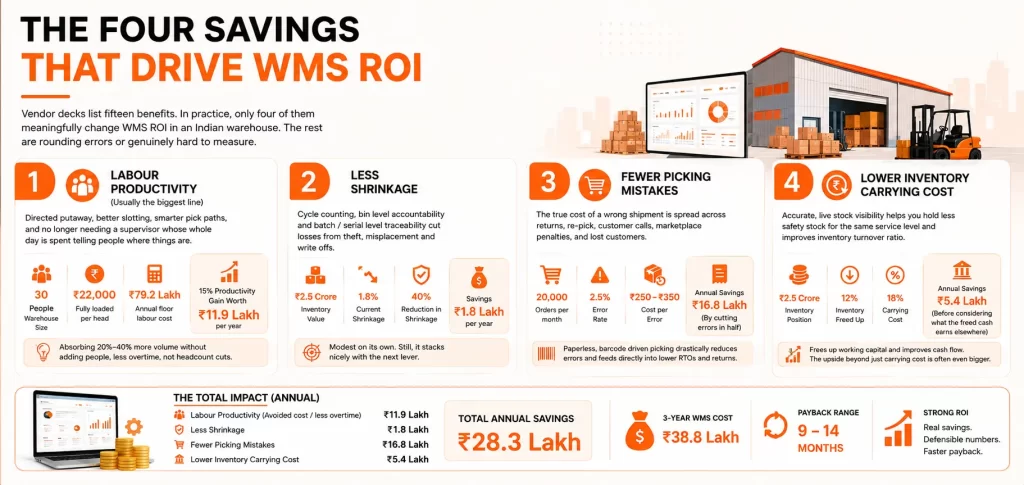
Vendor decks list fifteen benefits. In practice, only four of them meaningfully change WMS ROI in an Indian warehouse. The rest are rounding errors or genuinely hard to measure.
1. Labour productivity (usually the biggest line)
Labour is where most WMS ROI is won. It comes from directed putaway, better slotting, smarter pick paths, and no longer needing a supervisor whose whole day is spent telling people where things are.
A 30 person warehouse at ₹22,000 fully loaded per head spends ₹79.2 lakh a year on floor labour. A 15% productivity gain is worth ₹11.9 lakh a year.
But be careful how you claim it. Unless you plan to actually cut headcount, this saving is avoided hiring and less overtime, not cash removed from payroll.
CFOs spot the difference instantly. A case that blurs the two loses trust fast.
Most Indian warehouses frame it as absorbing 20% to 40% volume growth without adding people. That is real, defensible, and far easier to get approved than a redundancy plan. Our post on warehouse labour productivity breaks down where the hours actually go.
2. Less shrinkage
Cycle counting, bin level accountability and batch or serial level traceability all cut losses from theft, misplacement and write offs.
A warehouse holding ₹2.5 crore of stock at 1.8% shrinkage loses ₹4.5 lakh a year. Cut that by 40% and you get ₹1.8 lakh back.
Modest on its own. Still, it stacks nicely with the next WMS ROI lever. If shrinkage is a live problem for you, our guide on inventory shrinkage and how to prevent it goes deeper.
3. Fewer picking mistakes
People leave this out of WMS ROI models constantly. Why? Because the cost of a wrong shipment is spread across three departments, so nobody ever sees the whole number.
One picking error means return freight, a re pick, a customer service call, often a marketplace penalty, and sometimes a lost customer. Each one also feeds your RTO and returns pile. In Indian D2C, ₹250 to ₹350 per error is a fair all in figure.
Run the maths at 20,000 orders a month with a 2.5% error rate. That is 6,000 errors a year, costing ₹16.8 lakh. Paperless, barcode driven picking routinely cuts that in half. Our barcode vs RFID cost comparison covers which scanning setup makes sense at your scale.
4. Lower inventory carrying cost
Accurate, live stock visibility means you can hold less safety stock for the same service level, which also lifts your inventory turnover ratio.
Free up 12% of a ₹2.5 crore inventory position and you release ₹30 lakh of working capital. At an 18% carrying cost, that is ₹5.4 lakh a year. And that is before counting what the freed cash earns elsewhere in the business, which most WMS ROI models ignore entirely.
Add all four together on these inputs and you get roughly ₹28.3 lakh a year against a three year cost of ₹38.8 lakh. That is where the 9 to 14 month payback range comes from.
Calculate your own WMS ROI
Those figures describe one warehouse. Your WMS ROI will look different.
The assumptions that matter most, like productivity gain, shrinkage and error rate, are the ones only you can set honestly.
Every input in the WMS ROI calculator below is editable. Set the savings percentages to numbers you would happily defend in front of your CFO, not your best case scenario. If the result still works, you have a business case.
WMS ROI & 3-Year TCO Calculator
Built for Indian warehouses. Every assumption below is editable, so change them to match your operation.
Your operation
Fully loaded (salary + PF + ESI)
What it costs
Indian mid market WMS typically lands ₹5,000 to ₹8,000
₹24,000 each assumed
₹60,000 each assumed
What it saves (edit these)
Return freight, re-pick and credit
Your result over 3 years
Cost stack
| Line item | 3-year total |
|---|---|
| Subscription | ₹28,08,000 |
| Implementation | ₹2,50,000 |
| Integrations | ₹1,80,000 |
| Hardware | ₹3,60,000 |
| Training | ₹60,000 |
| Change requests (8%) | ₹2,24,640 |
| Total cost of ownership | ₹38,82,640 |
Benefit stack
| Saving | Per year |
|---|---|
| Labour productivity | ₹11,88,000 |
| Shrinkage reduction | ₹1,80,000 |
| Fewer picking errors | ₹9,24,000 |
| Inventory carrying cost | ₹5,40,000 |
| Annual benefit at full run-rate | ₹28,32,000 |
Cumulative position, month by month
These are planning estimates, not a quote. The savings percentages are editable assumptions, so set them to figures your own operation can defend and the ROI will be one you can take to a CFO.
Image alt text: Free WMS ROI calculator showing payback period and three year TCO for Indian warehouses
Here is a trick worth using. Run it twice.
Once with the numbers you believe. Then again with every savings assumption cut in half.
If the halved version still pays back inside two years, your WMS ROI is solid. If only the optimistic version works, you do not have a business case. You have a hope.
A real world example: a 30 person D2C warehouse
Let's make WMS ROI concrete.
A Bengaluru fashion brand runs one 40,000 sq ft facility. Thirty warehouse staff. Around 20,000 orders a month across its own site plus three marketplaces, all flowing through one order fulfilment process. Roughly ₹2.5 crore of stock on hand. Picking is still paper based, and stock accuracy hovers near 92%.
What they pay. Twelve licences at ₹6,500 comes to ₹78,000 a month. Add implementation at ₹2.5 lakh, fifteen handhelds at ₹3.6 lakh, three integrations at ₹1.8 lakh, and training at ₹60,000. Three year TCO lands at ₹38.8 lakh.
What they save. Labour productivity at 15% gives ₹11.9 lakh a year. Shrinkage down 40% adds ₹1.8 lakh. Errors down 55% brings ₹9.2 lakh. Inventory down 12% at 18% carrying cost contributes ₹5.4 lakh. Annual run rate: ₹28.3 lakh.
When it happens. Benefits do not start on day one. Assume six months to reach full run rate, which is realistic for a first WMS with staff who have never scanned anything.
On that ramp, WMS ROI turns positive at month 10, when cumulative savings overtake cumulative spend. The three year net position comes to roughly ₹39 lakh positive, a 101% return on total cost.
Honestly though, the 101% is not the number that wins the meeting. It is that payback lands inside the first year. That means the investment does not straddle two budget cycles, and finance teams care about that a lot.
When a WMS is not worth it
Here is where WMS ROI breaks down. I am including this section because leaving it out would make everything above less believable.
- Small warehouses. Run the calculator with five staff, two licences and 800 orders a month. Payback stretches past two and a half years. Below roughly 15 to 20 warehouse staff, per user WMS cost struggles to clear its own hurdle and WMS ROI turns negative. A usage priced platform or a well configured inventory module in your existing ERP is often smarter. Our guide to WMS for small businesses in India covers the alternatives.
- Warehouses with no process discipline. A WMS enforces a process. It does not invent one. If goods arrive without a GRN, if bins have no fixed locations, if stock moves unrecorded, software will surface the chaos faster but will not fix it. Sort your inventory SOPs first. That work is cheap, and it is a prerequisite rather than an alternative.
- Projects with no operational owner. The single best predictor of a failed WMS is that nobody on the floor owns it. When the project sits with IT alone, the configuration reflects what IT understood, not how the warehouse runs. Adoption stalls within weeks. Our implementation checklist sets out who needs to own what.
- Very low margin, very high volume operations where labour is already close to optimal and the stock is cheap. The WMS ROI levers are simply too small next to the licence cost.
- 3PLs pricing the wrong way. If you run a third party warehouse, your WMS ROI depends on billing accuracy as much as picking speed. Our 3PL warehouse management guide and the mistakes 3PLs make with WMS cover that separately.
How to build a WMS ROI case your CFO will approve
Four habits separate an approved WMS ROI case from one that quietly dies in a drawer.
Use conservative numbers, and say so. A case built on a 15% productivity gain that delivers 22% makes you credible for the next ask. A case built on 35% that delivers 22% makes you the person who oversold.
Show the cash flow shape, not just the total. The three year WMS ROI figure is a headline. What your CFO actually wants to know is when the cumulative line crosses zero, and how deep the dip is before it does. Show the month by month curve, with the upfront hardware and implementation spend clearly visible.
Name the cost of doing nothing. The alternative is not zero. It is continuing to pay today's shrinkage, today's error rate, and the extra people you will hire to handle next year's volume by hand. Put that figure right next to the investment.
Split committed cost from variable cost. Subscription and AMC are committed. Change requests and extra integrations are variable, and can be phased. Finance approves faster when they can see which parts of the number are controllable.
One more thing, and please do not skip it. Baseline your metrics before you implement. Our warehouse KPI guide sets out what to record. Almost everyone skips this step, then struggles to prove the benefit later.
Wrapping up
So, is a WMS worth it? For most Indian warehouses with 25 or more staff, WMS ROI stacks up. Payback usually lands inside the first year, and three year returns around 100% are realistic rather than optimistic.
Here is what to hold on to:
- Count the full WMS cost, not just the subscription. Hardware, integrations and change requests add roughly 30%.
- Match the pricing model to your operation. Per order and per user quotes are not comparable until you normalise them.
- Four savings do the heavy lifting on WMS ROI: labour productivity, shrinkage, picking accuracy and inventory carrying cost.
- Use conservative assumptions. A case that survives halved numbers is a case that survives the boardroom.
- Baseline before you start, or you will never prove the gain.
Ready to see what WMS ROI looks like for your own warehouse? Run your numbers through the calculator above, then talk to our team for a costed proposal built around your actual volumes, channels and headcount. No generic benchmarks, just your operation.
If you are still shortlisting, our roundup of the best warehouse management software in India is a good next stop. Running more than one site? Start with multi warehouse inventory management instead.
Frequently asked questions
Add up the full three year cost of ownership first. That means subscription, implementation, hardware, integrations, training and a change request allowance. Then total your annual savings across labour productivity, shrinkage reduction, order accuracy and inventory carrying cost.
WMS ROI is net benefit divided by total cost. Your payback period is the month when cumulative savings overtake cumulative spend. Remember to allow three to six months of ramp before benefits reach full run rate.
For warehouses with 25 or more staff, 9 to 14 months is common. Smaller operations often run well past 24 months, because per user licence costs do not scale down as quickly as the savings do.
For a mid sized single warehouse operation running around a dozen licences, ₹30 lakh to ₹45 lakh is a realistic planning band. Roughly 70% of that is subscription. The remaining 30% covers implementation, hardware, integration and change requests.
Often not at per user pricing. Below roughly 15 to 20 warehouse staff, WMS cost is hard to justify against the savings available. Usage based platforms change that calculation considerably, and so does fixing your stock processes first. Many small sellers get further with a well configured inventory module before moving to a full WMS.
Over three years, on premise often looks cheaper because the perpetual licence is a single upfront figure. Over five years it usually is not, once you add AMC at 18% to 22% a year, server infrastructure, database licensing, admin time and the version upgrade in year four. Compare both over the horizon you will genuinely own the system for, not the one that flatters your preferred option.

Kapil Pathak is a Senior Digital Marketing Executive with over six years of experience specializing in the logistics and supply chain industry. His expertise spans digital strategy, search engine optimization (SEO), search engine marketing (SEM), and multi-channel campaign management. He has a proven track record of developing initiatives that increase brand visibility, generate qualified leads, and drive growth for D2C & B2B technology companies.