Walk onto any factory floor and you will see WIP inventory everywhere, even if nobody calls it that. Half-machined castings stacked near a lathe. Stitched shirts waiting for buttons. Bins of parts parked beside the assembly line. None of it is raw material any more, and none of it is ready to sell.
That in-between stock has a name: WIP inventory. It also has a habit of quietly eating cash.
Most plants know their raw material and finished goods numbers well. Ask about WIP, though, and you often get a shrug or a rough guess. That is a problem, because WIP is where lead times stretch, bottlenecks hide, and money sits idle for weeks.
In this guide, we will cover:
- What WIP inventory means, with simple examples
- How it differs from raw materials, semi-finished goods and finished goods
- The WIP formula, with a worked example in rupees
- How to tell if you are carrying too much WIP
- Practical ways to track and reduce WIP on the shop floor
Let’s start with the basics.
What Is WIP Inventory?
WIP inventory is any material that has entered production but is not yet a finished, sellable product. WIP stands for work in process (or work in progress). So if someone asks for the WIP full form in production, that is your answer.
Think of it like cooking dinner. The vegetables in your fridge are raw materials. The plated meal is the finished good. Everything chopped, marinated or simmering on the stove? That is WIP.
In a factory, WIP includes three kinds of cost:
- Raw materials already issued to the floor
- Direct labour spent on the items so far
- Manufacturing overhead, such as power, machine time and supervision
Here are a few examples from Indian plants:
- Auto components: gear housings that are machined but not yet painted
- Garments: shirts that are stitched but not yet washed, checked or packed
- Pharma: granules that are blended but not yet compressed into tablets
- Furniture: frames that are assembled but waiting for polish
What do these have in common? Money has already gone into them, but no customer can buy them yet.
WIP Inventory: Work in Process or Work in Progress?
In day-to-day use, no. Both phrases mean the same thing, and both shorten to WIP.
That said, you will notice a loose pattern:
- Work in process inventory is more common in manufacturing. It usually describes items that move through production quickly, often within days.
- Work in progress is more common in accounting, construction and services. It often describes longer projects, like a building or a software build.
For inventory in a plant, either term is fine. Just pick one and use it consistently in your reports.
WIP Inventory vs Raw Materials, Semi-Finished Goods and Finished Goods
Every manufacturer holds stock in stages. Your bill of materials tells you what goes in. Your inventory stages tell you where that material sits right now.
| Stage | What it is | Example (auto parts plant) | Can you sell it? |
|---|---|---|---|
| Raw materials | Inputs not yet issued to production | Aluminium ingots, bolts, paint | No (unless you resell the material) |
| Work in process (WIP) | Material being worked on right now | A housing on the CNC line | No |
| Semi-finished goods (SFG) | A completed stage, stored before the next one | Machined housings waiting in a buffer store | Sometimes |
| Finished goods | Fully made, checked and packed | Painted, inspected housings in boxes | Yes |
Semi-Finished Goods vs WIP Inventory
This one confuses a lot of people, especially in India, where “SFG” is common ERP language.
Here is a simple way to separate them:
- WIP is moving. It is on a machine, on a conveyor or waiting at a workstation in the middle of an operation.
- SFG is parked. One stage is complete, the item has its own code, and it sits in a store until the next stage pulls it.
For example, a pharma plant might store coated tablets as SFG before packing. A garment unit might store cut fabric panels as SFG before stitching.
On the balance sheet, both usually sit under “work in progress” as part of inventory. On the shop floor, though, the difference matters. SFG needs a location, a label and a stock count. WIP needs stage-by-stage visibility.
The WIP Inventory Formula (With a Worked Example)
You don’t need advanced maths to value WIP. You need three numbers and one simple formula.
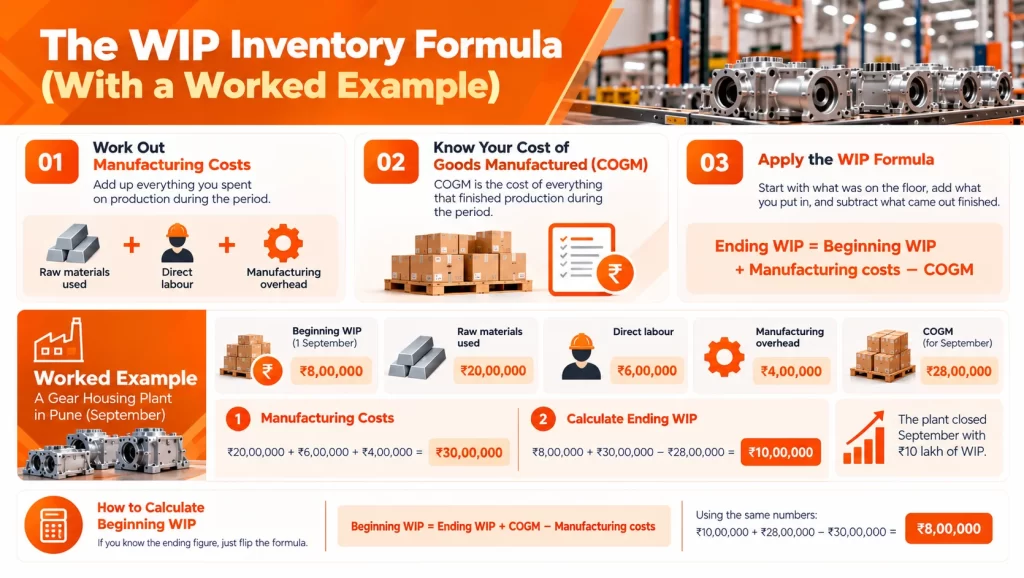
Step 1: Work Out Manufacturing Costs
First, add up everything you spent on production during the period.
Manufacturing costs = Raw materials used + Direct labour + Manufacturing overhead
Step 2: Know Your Cost of Goods Manufactured (COGM)
COGM is the cost of everything that finished production during the period. Your costing or ERP report usually gives you this figure.
Step 3: Apply the WIP Inventory Formula
Ending WIP = Beginning WIP + Manufacturing costs − COGM
In plain words: start with what was on the floor, add what you put in, and subtract what came out finished. Whatever is left is still in process.
Worked Example: A Gear Housing Plant in Pune
Let’s say a mid-sized auto parts plant is closing its books for September.
- Beginning WIP on 1 September: ₹8,00,000
- Raw materials used: ₹20,00,000
- Direct labour: ₹6,00,000
- Manufacturing overhead: ₹4,00,000
- COGM for September: ₹28,00,000
First, find manufacturing costs:
₹20,00,000 + ₹6,00,000 + ₹4,00,000 = ₹30,00,000
Next, plug everything into the formula:
₹8,00,000 + ₹30,00,000 − ₹28,00,000 = ₹10,00,000 ending WIP
So the plant closed September with ₹10 lakh of half-made housings on the floor. That is ₹2 lakh more than it started with. Is that a warning sign? Maybe. We will look at how to judge that in a moment.
How to Calculate Beginning Work in Process Inventory
Sometimes you know the ending figure but need the opening one. Just flip the formula around:
Beginning WIP = Ending WIP + COGM − Manufacturing costs
Using the same numbers: ₹10,00,000 + ₹28,00,000 − ₹30,00,000 = ₹8,00,000. It checks out.
Quick tip: The formula is only as good as the data behind it. If material issues, labour bookings or production receipts are entered late, your WIP number will be wrong, even if the maths is right.
Is WIP Inventory an Asset? Where It Shows Up in Your Books
Yes. WIP is a current asset. In Indian financial statements, it appears under Inventories, alongside raw materials and finished goods.
How should you value it? Under Ind AS 2, inventory (WIP included) is carried at the lower of cost or net realisable value (NRV). NRV is roughly what you expect to sell it for, minus the costs to finish and sell.
Why does this matter? Suppose a batch of WIP is damaged, or the product it was meant for is discontinued. Its value may drop below what you spent on it. In that case, you write it down.
In practice, WIP moves through your books in three steps:
- Material issued to production: raw materials go down, WIP goes up.
- Labour and overhead applied: WIP goes up again.
- Production completed: WIP goes down, finished goods go up.
What Does Negative WIP Mean?
Now and then, a system report shows WIP below zero. That is impossible in real life, so it is always a data problem.
Usually, it happens because finished output was booked before the matching material issue. Backflushing setups and late entries on the shop floor are common causes. Treat negative WIP as a red flag that your transactions are out of sync.
How Much WIP Inventory Is Too Much?
Some WIP is normal. You can’t make anything without it. The real question is whether you are carrying more than the process needs.
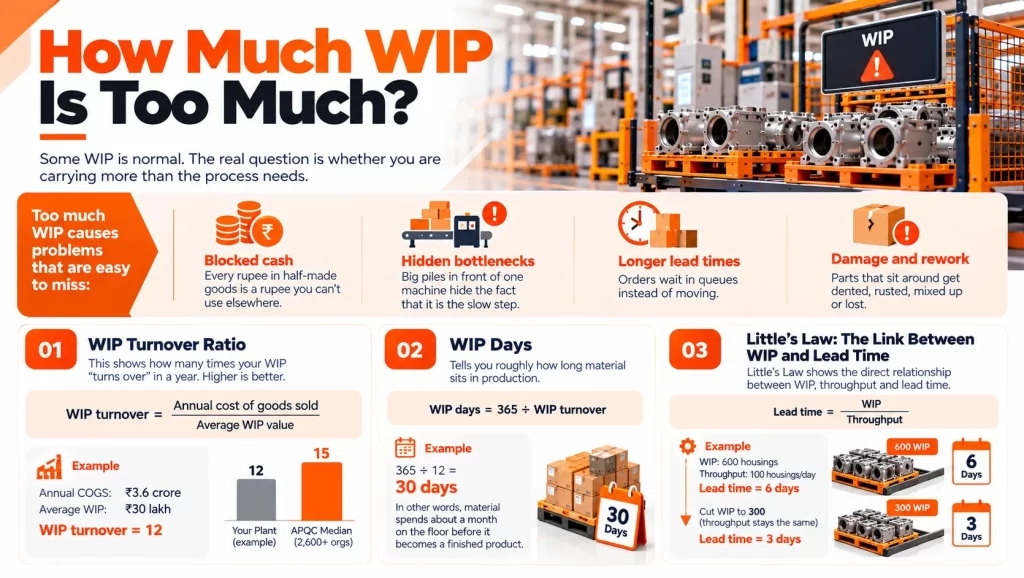
Too much WIP causes problems that are easy to miss:
- Blocked cash: every rupee in half-made goods is a rupee you can’t use elsewhere.
- Hidden bottlenecks: big piles in front of one machine hide the fact that it is the slow step.
- Longer lead times: orders wait in queues instead of moving.
- Damage and rework: parts that sit around get dented, rusted, mixed up or lost.
So how do you measure it? Three simple metrics will tell you most of what you need.
1. WIP Turnover Ratio
This shows how many times your WIP “turns over” in a year. Higher is better.
WIP turnover = Annual cost of goods sold ÷ Average WIP value
For example, a plant with annual COGS of ₹3.6 crore and average WIP of ₹30 lakh has a WIP turnover of 12.
How does that compare? APQC, a benchmarking body, reports a median of 15 WIP inventory turns across more than 2,600 organisations. So our example plant has room to improve. (It works just like your overall inventory turnover ratio, but for WIP only.)
2. WIP Days
Work in Progress (WIP) days tells you roughly how long material sits in production.
WIP days = 365 ÷ WIP turnover
In our example, 365 ÷ 12 = about 30 days. In other words, material spends about a month on the floor before it becomes a finished product. For a simple machined part, that is far too long.
3. Little’s Law: The Link Between WIP and Lead Time
This is the one most plant managers wish they had learned earlier. Little’s Law says:
Lead time = WIP ÷ Throughput
Imagine a line with 600 housings in WIP that finishes 100 housings a day. Lead time is 600 ÷ 100 = 6 days.
Now cut WIP to 300 without changing anything else. Lead time drops to 3 days. You get no extra machines and no overtime, just less material waiting in queues.
That is why reducing WIP is often the fastest way to improve your lead time.
How to Track WIP Inventory on the Shop Floor
The formula tells you how much WIP you have in rupees. It doesn’t tell you where it is, which stage it is at or how long it has been waiting. For that, you need tracking.
Most plants use one of three methods. Let’s look at each honestly.
Manual Registers and Excel Sheets
This is where most small units start. Supervisors note down quantities at each stage, and someone types them into a spreadsheet at the end of the shift.
It works when volumes are low. However, it breaks down quickly:
- Entries are late, so the data is always a few hours (or days) old
- Typing errors creep in, and nobody notices until the month-end count
- You can see totals, but not which batch is stuck at which machine
ERP Backflushing
Many ERPs use backflushing. When finished goods are reported, the system automatically deducts the components the BOM says were used.
This keeps the costing simple. But there is a catch. Material only leaves WIP after the product is finished, so the system has no idea what is happening in between. Scrap, rework and substitutions are also missed, which is a common source of negative WIP.
Barcode or RFID Scanning at Each Stage
This is where WIP tracking software, usually a warehouse management system (WMS) linked to your ERP, makes a real difference. Every movement becomes a quick scan instead of a manual entry.
A typical stage-wise flow looks like this:
- Material issue: raw material is scanned out of the store against a work order.
- Line-side staging: material lands at the line and is scanned into a line-side location.
- Operation scans: each workstation scans the batch in and out, so you know exactly where it is.
- Quality check: QC passes or rejects the batch, and rejects are moved to a rework or scrap bin.
- Finished goods receipt: completed goods are scanned into the FG store, and WIP closes out.
The result? You can open a dashboard and see that 240 housings are waiting at painting, and that they have been there for two days. That is information you can act on today, not at month end.
Wondering whether to use barcodes or RFID? Barcodes are cheaper and fine for most plants. RFID makes sense for high-value or fast-moving items. Our guide on barcode vs RFID costs covers the trade-offs in detail.
Don’t Forget WIP Sent to Job Workers
Many Indian manufacturers send WIP outside for plating, heat treatment or embroidery. That stock is still yours, even though it is not in your building.
Under GST, these movements are reported in Form ITC-04. Inputs sent to a job worker generally need to come back within one year. Larger businesses (turnover above ₹5 crore) file half-yearly, and others file once a year. This ClearTax guide on GST for job work explains the rules well.
A good tracking system treats each job worker as a virtual location. That way, you can see what is out, with whom and for how long.
How to Reduce WIP in Manufacturing
Once you can see your WIP, reducing it gets much easier. Here are six steps that work in most plants, with or without a big budget.
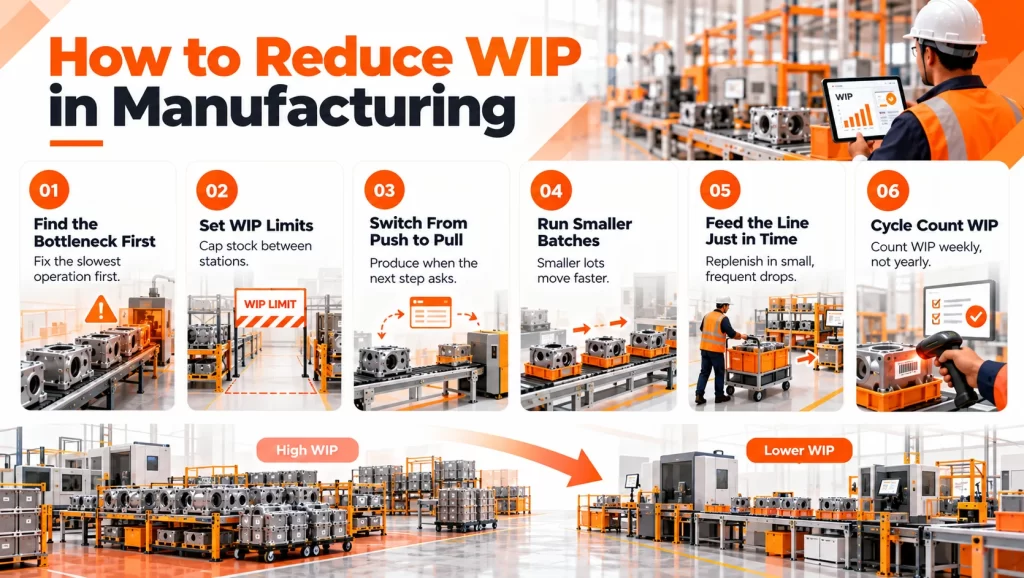
1. Find the Bottleneck First
Look for the biggest pile. It usually sits right in front of your slowest operation. Speeding up any other step will only make that pile bigger, so fix the slow step first.
2. Set WIP Limits
Decide the maximum quantity allowed between two stations, and stick to it. When the limit is reached, the upstream station stops and helps elsewhere. It feels odd at first. However, it is one of the quickest ways to shorten lead time.
3. Switch From Push to Pull
Instead of making parts because a schedule says so, make them when the next step asks for them. A kanban replenishment system does exactly this, using cards or digital signals to trigger production.
4. Run Smaller Batches
Big batches look efficient on paper. In reality, they create huge queues at every stage. Smaller batches move faster and show quality problems sooner.
5. Feed the Line Just in Time
Don’t dump a full shift’s material at the line. Instead, replenish line-side stock in small, frequent drops. That keeps the floor clear and makes WIP easier to count.
6. Cycle Count WIP, Not Just the Store
Most plants count the warehouse regularly but leave WIP until the annual audit. Count a few WIP locations every week. You will catch stuck batches, missing scans and negative WIP long before they reach your P&L.
None of these steps needs new machines. They mostly need visibility and a bit of discipline, and good WIP tracking gives you both.
Conclusion: Make Your WIP Inventory Visible, Then Make It Smaller
WIP inventory is the most overlooked stock in most factories. It holds your money, hides your bottlenecks and stretches your lead times, often without anyone noticing.
Here is a quick recap:
- WIP is anything in production that is not finished yet. Work in process and work in progress mean the same thing.
- The formula is simple: Ending WIP = Beginning WIP + Manufacturing costs − COGM.
- Measure it with WIP turnover, WIP days and Little’s Law, not just the rupee value.
- Track it stage by stage with barcode scans, not end-of-shift registers.
- Reduce it by fixing the bottleneck, setting WIP limits and moving to pull-based replenishment.
The hardest part is usually the first step: seeing where WIP actually sits. Once you can see it, the savings tend to follow.
Want to see how that works in a real plant? Read how a leading heavy manufacturer improved its inventory accuracy with Omneelab. When you’re ready, book a free demo of Omneelab WMS and we’ll show you stage-wise WIP tracking on your own product flow.
Frequently Asked Questions
In production, WIP stands for work in process or work in progress. It means materials and parts that have entered manufacturing but are not yet finished goods. It includes the cost of raw materials, direct labour and overhead already spent on them.
Use this formula: Ending WIP = Beginning WIP + Manufacturing costs − Cost of goods manufactured (COGM). Manufacturing costs are raw materials used plus direct labour plus overhead. For example, ₹8 lakh + ₹30 lakh − ₹28 lakh gives ending WIP of ₹10 lakh.
WIP is material actively being worked on at a machine or station. Semi-finished goods have completed one full stage and are stored with their own item code until the next stage pulls them. Both are usually reported under inventories in the balance sheet.
Yes. WIP is a current asset and is reported under inventories, along with raw materials and finished goods. Under Ind AS 2, it is valued at the lower of cost and net realisable value. If WIP is damaged or becomes obsolete, it should be written down.
The most reliable method is stage-wise barcode or RFID scanning through WIP tracking software, such as a WMS linked to your ERP. Each issue, operation, quality check and finished-goods receipt is scanned in real time. This shows exactly where each batch sits and how long it has been waiting.

Kapil Pathak is a Senior Digital Marketing Executive with over six years of experience specializing in the logistics and supply chain industry. His expertise spans digital strategy, search engine optimization (SEO), search engine marketing (SEM), and multi-channel campaign management. He has a proven track record of developing initiatives that increase brand visibility, generate qualified leads, and drive growth for D2C & B2B technology companies.