Picture this. You pack an order, hand it to the courier, and mentally tick it off as revenue. Ten days later, that same parcel is back at your door. Unsold. Unpaid. And now it has cost you twice. That, in one sentence, is RTO in ecommerce, and if you sell online in India, it is quietly eating your margins right now.
Most guides tell you how to reduce RTO at checkout. Verify the address, push prepaid, nudge the buyer. All useful. But here is the half nobody talks about: once that parcel starts its journey back, the fight moves into your warehouse. And that is exactly where a good WMS (Warehouse Management System) helps you claw back money others simply write off.
In this guide, we will cover what RTO actually means, why it happens, what it really costs, and how the right warehouse setup helps you reduce return to origin losses across India. Let us get into it.
What is RTO in Ecommerce?
RTO in ecommerce is when a shipped order fails to reach the customer and gets sent back to the seller’s warehouse. The courier tries to deliver, cannot, and after a few attempts, routes the package home.
It is not a customer clicking “return” after using a product. It is an order that never even landed in their hands.
For Indian sellers, RTO is one of the most expensive words in the business. Every returned parcel means you paid for forward shipping, you now pay for reverse shipping, and you earn nothing on either leg.
What is the Full Form of RTO?
The full form of RTO in ecommerce is Return to Origin. Simple as that. The “origin” is your warehouse or pickup location, and the parcel is returning there after a failed delivery.
You will see the same term across every Indian marketplace and courier, including Delhivery, Ekart, Xpressbees, Shadowfax, and Blue Dart. The label might shift slightly on your dashboard, but the meaning stays the same.
RTO vs Return: What’s the Difference?
People mix these up all the time, so let us clear it up.
- RTO (Return to Origin): The order never reached the buyer. It bounced back after a failed delivery. The customer never touched it.
- Return (customer return or refund): The order was delivered, the buyer received it, and then chose to send it back.
Why does the difference matter? Because the cause is different, and so is the fix. An RTO is usually an address, communication, or COD problem. A customer return is usually a product, sizing, or expectation problem. You cannot solve one with the tactics meant for the other.
Why Do RTO Orders Happen?
RTO is rarely random. It follows clear patterns, and most of them are preventable. Here are the usual suspects:
- Wrong or incomplete addresses. Missing flat numbers, wrong PIN codes, or vague landmarks. Indian addresses are messy, and the delivery agent often gives up.
- Unreachable customers. Phone switched off, wrong number, or nobody picking up when the agent calls.
- Buyer refusal. The classic COD problem. The customer changes their mind, finds a cheaper option, or simply forgets they ordered.
- Fake or impulse orders. Someone places a COD order with zero intention of paying at the door.
- Late deliveries. By the time the parcel arrives, the buyer has lost interest.
- Poor courier service. Rude agents, single delivery attempts, or areas with weak last-mile coverage.
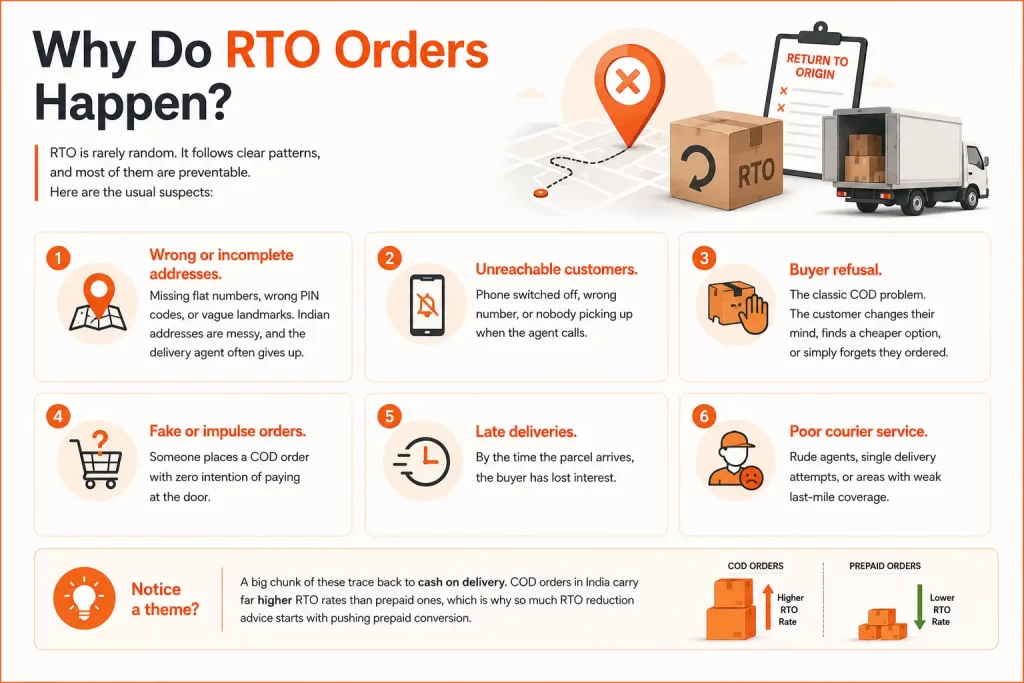
Notice a theme? A big chunk of these trace back to cash on delivery. COD orders in India carry far higher RTO rates than prepaid ones, which is why so much RTO reduction advice starts with pushing prepaid conversion.
What a Single RTO Actually Costs
Here is where it stings. An RTO is not one charge. It is a pile of small costs stacked on top of each other, and most sellers only notice them one at a time.
A single return to origin usually includes:
- Forward shipping you already paid to send it out
- Reverse shipping to bring it back, often 60 to 80% of the forward charge
- Packaging consumed the moment it left your warehouse
- Labour for picking, packing, and now receiving it again
- Quality inspection and repackaging once it lands back
- Blocked inventory sitting in transit for days, unsellable
- Working capital stuck, since COD settlements and RTO recovery take time
Add it up and you get a number that hurts. Across the industry, a single RTO typically costs an Indian seller somewhere around 150 to 300 rupees per order, and more for heavier or bulkier items.
How is RTO Rate Calculated?
You cannot fix what you do not measure. The RTO rate formula is straightforward:
RTO Rate (%) = (Total RTO Orders / Total Shipped Orders) × 100
Say you ship 1,000 orders in a month and 220 come back undelivered. Your RTO rate is 22%. If that number sits above your category average, you are bleeding margin faster than your competitors.
Some sellers track RTO only on COD orders, since that is where most of the damage happens. Both views are useful. Track total RTO for the big picture, and COD RTO rate to see where the real leak is.
How Much Does an RTO Cost a Seller?
Beyond the per-order figure, think about scale. Ship 5,000 orders a month at a 20% RTO rate and that is 1,000 parcels boomeranging back every single month. Multiply that by even 200 rupees each and you are staring at a serious hole in your profit and loss statement.
This is why RTO is not a small operational nuisance. For thin-margin D2C brands and marketplace sellers, it can be the difference between growth and quietly going under.
What is a Good RTO Rate for Ecommerce?
Fair question. There is no single magic number, because it depends on your category, your payment mix, and where you ship.
As a rough guide for India:
- Prepaid-heavy stores: often manage 8 to 12%
- Typical COD-driven sellers: land in the 20 to 30% range
- Fashion and apparel: can climb toward 40%, the highest of any category
Fashion tops the list because sizing doubts, impulse buys, and COD all collide there. If you sell kurtis or footwear, treat anything under 20% as a genuine win.
The Part Everyone Ignores: When the Parcel Comes Back
Here is the gap in most RTO advice. Every blog stops at prevention. Verify the address, push prepaid, done.
But prevention only handles the orders that have not shipped yet. What about the parcels already on their way back? For a busy seller, that could be hundreds of units a week. And that is a warehouse problem, not a checkout problem.
This is exactly where a WMS earns its keep. Because the speed and accuracy of how you handle returned stock decides whether that RTO becomes a partial recovery or a total write-off.
Think of it like a cricket match. Checkout tools are your batting lineup, trying to score. But your warehouse is the fielding side. Drop catches and even a good total slips away.
How a WMS Cuts RTO Losses
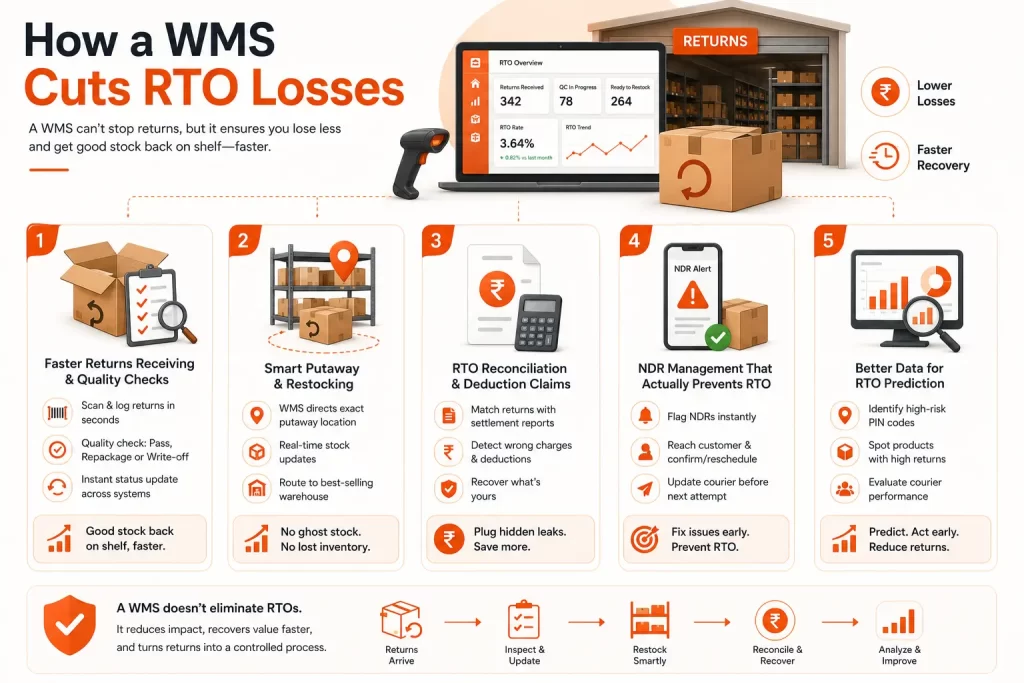
A warehouse management system does not stop a customer from refusing a parcel. What it does is make sure that once the parcel returns, you lose as little as possible and get that stock back on the shelf, ready to sell again, fast.
Here is how that plays out on the ground.
Faster Returns Receiving and Quality Checks
When an RTO parcel lands back, the clock starts. Every hour it sits unprocessed is an hour of blocked inventory and stuck capital.
A WMS speeds this up with:
- Barcode or RFID scanning at the receiving dock, so returned units are logged in seconds, not hours
- Guided quality inspection with clear pass, repackage, or write-off outcomes
- Instant status updates so the item shows as “returned, in QC” across your systems right away
The faster the quality check on returns happens, the faster good stock rejoins your sellable inventory. That single step recovers more money than any checkout tweak.
Smart Putaway and Restocking
A returned unit is worthless if it gets lost in your warehouse. That happens more than you think in manual setups.
A WMS directs putaway. It tells the picker exactly where the returned item belongs, updates stock counts in real time, and keeps your inventory accurate. No ghost stock. No “we have it somewhere but cannot find it” moments.
For sellers running multiple warehouses, this matters even more. The system can route the returned unit to the location where it is most likely to sell next, cutting down on wasted movement.
RTO Reconciliation and Deduction Claims
Here is a hidden leak most sellers never plug. Couriers and marketplaces make mistakes on RTO charges all the time. Wrong weight slabs, wrong lane rates, or charging you for an RTO that never physically came back.
A WMS keeps a clean, timestamped record of what actually returned to your dock. Match that against your settlement report and the wrong deductions jump out. That is real money you can claim back, month after month, that would otherwise vanish silently.
NDR Management That Actually Prevents RTO
Before a parcel becomes an RTO, it becomes an NDR.
NDR stands for Non-Delivery Report. It is the status a courier raises when a delivery attempt fails. Think of it as an early warning. You usually have a narrow window, often 24 to 48 hours, to fix the issue before the courier gives up and starts the return.
Handle that NDR resolution window well and you convert a failed attempt into a successful delivery. Ignore it, and it slides into RTO.
A WMS connected to your order and courier data helps by:
- Flagging NDRs the moment they appear
- Triggering customer outreach to confirm address or reschedule
- Passing updated details back to the courier before the next attempt
Sellers who run tight NDR workflows routinely cut their RTO meaningfully, because they rescue orders that would otherwise bounce.
Better Data for RTO Prediction
Over time, your WMS builds a history. Which PIN codes fail most. Which products get refused. Which courier partners drop the ball in which zones.
That data feeds RTO prediction and risk scoring. You can then flag risky orders before dispatch, limit COD in high-risk pincodes, or nudge those buyers toward prepaid. In short, your warehouse data makes your checkout smarter.
RTO Reduction Strategies That Work
Cutting RTO takes a two-sided approach. Stop the ones you can before they ship, and recover fast on the ones you cannot. Here is a practical playbook.
Before dispatch (prevention):
- Verify addresses at checkout with pincode serviceability checks
- Push prepaid with small discounts or free shipping to drive COD to prepaid conversion
- Confirm risky COD orders by call or WhatsApp before packing
- Flag high-risk pincodes using past RTO data and limit COD there
- Set delivery expectations clearly so buyers do not lose patience
After an NDR is raised (rescue):
- Act inside the resolution window, ideally within 24 hours
- Reach the customer to fix the address or reschedule
- Feed updated info to the courier before the second attempt
Once the parcel returns (recovery):
- Receive and inspect fast with barcode-driven QC
- Restock quickly so good units resell without delay
- Reconcile charges against settlement reports and claim wrong deductions
Prevention protects revenue. Recovery protects margin. You need both, and a WMS ties the recovery half together.
Marketplace RTO: Meesho and Flipkart
If you sell on marketplaces, RTO shows up directly in your settlements, so it pays to know the ground rules.
Meesho RTO Charges
Meesho is famous for its low commission model, but reverse logistics is where margins actually get tested. For genuine RTO where delivery never happened, many sellers report no return shipping fee, though policies shift by category. Either way, forward shipping is already gone, and Meesho’s tier-2 COD-heavy buyer base tends to push RTO rates on the higher side.
Always cross-check your settlement report for line items like reverse shipping or RTO charges. If something looks off, raise a supplier ticket the same day with screenshots. A clean WMS record makes those disputes far easier to win. If you sell there, our WMS guide for Meesho sellers goes deeper.
Flipkart RTO Charges
Flipkart typically charges reverse shipping on customer returns, and apparel categories see high return and RTO rates. The seller usually bears the logistics cost, so tracking every returned unit against what you were charged is essential. Our WMS setup for Flipkart sellers covers how to keep those numbers clean.
Across both platforms, the lesson is the same. The seller carries most of the RTO cost, so accurate warehouse records are your best defence.
Who Bears the RTO Charges, Seller or Platform?
In most cases, the seller. Whether you sell on your own store or a marketplace, you generally absorb the forward shipping and, depending on the platform, some or all of the reverse cost too.
A few programs soften this. Meesho, for instance, has run RTO assurance style offerings that cap losses for eligible sellers who opt in. But these are the exception, not the rule. The safe assumption is that RTO costs land on you, which is exactly why managing them well is not optional.
Must Know: Why Unreconciled RTO Stock Quietly Wrecks Your Margins
Most sellers watch their RTO rate closely but never check what happens to the parcels after they land back. That blind spot causes more silent damage than the returns themselves.
Here are the gaps that trip businesses up:
- Returned units never make it back to sellable stock. A parcel comes home, gets dumped in a corner, and sits there for weeks. On paper you have inventory. In reality you have blocked capital and stock you cannot sell because nobody scanned it back in.
- Wrong courier deductions go unclaimed. Couriers and marketplaces misfire on RTO charges all the time, wrong weight slabs, wrong lane rates, or a fee for an RTO that never physically returned. If you have no clean record of what actually reached your dock, you pay these silently, month after month.
- Stock adjustments never hit your inventory ledger. If a returned item is damaged and written off physically but that write-off does not update your system, your recorded inventory value and your real warehouse value drift apart. Nobody notices until a physical count forces the issue.
- Multi-warehouse sellers feel it worse. When returned stock is not routed and costed consistently across locations, your location-wise profitability reports lie to you, even when the consolidated numbers look fine.
Why this matters for how you run RTO:
Tracking your RTO rate accurately but not tying every returned parcel into an automatic inventory and accounting update is not real RTO management. It is just two systems that talk to each other now and then. A WMS that logs every returned unit on scan, updates stock instantly, and creates a clean, timestamped record for reconciliation closes this gap. Anything relying on manual sync leaves room for your inventory value, your claims, and your true margin to quietly slip out of line.
Turn returned parcels back into sellable stock, fast
See how Omneelab WMS speeds up RTO processing, restocks good units on scan, and reconciles wrong courier deductions so you stop writing off returns.
Bringing It All Together
Let us recap the big picture.
- RTO in ecommerce means Return to Origin, an order that bounced back before reaching the buyer.
- Indian RTO rates typically run 20 to 30%, and up to 40% in fashion.
- Every RTO costs roughly 150 to 300 rupees, thanks to double shipping plus handling and blocked stock.
- Most advice stops at checkout, but the warehouse is where you recover the money others write off.
- A WMS cuts RTO losses through fast returns processing, accurate restocking, sharp reconciliation, and tight NDR workflows.
Reducing RTO is not one clever trick. It is a system. Prevent what you can, rescue what you catch in time, and recover fast on the rest. The sellers who win at this are not the ones with the fanciest checkout. They are the ones whose warehouse turns a returned parcel back into sellable stock before it drags down the month.
Ready to stop writing off returned inventory? See how Omneelab’s WMS handles reverse logistics and RTO recovery for Indian ecommerce sellers, and turn your warehouse into your margin’s best friend.
Frequently Asked Questions
RTO stands for Return to Origin. It happens when a shipped order fails to reach the customer and is sent back to the seller’s warehouse after failed delivery attempts. It is different from a customer return, where the buyer actually received the product first. RTO is one of the biggest hidden costs in Indian ecommerce, especially for cash on delivery orders.
Use this formula: RTO Rate (%) = (Total RTO Orders / Total Shipped Orders) × 100. So 220 returns out of 1,000 shipments means a 22% RTO rate. In India, prepaid-heavy sellers often hit 8 to 12%, COD-driven sellers see 20 to 30%, and fashion can touch 40%. Anything below your category average is a good sign.
NDR stands for Non-Delivery Report. It is the status a courier raises when a delivery attempt fails, whether due to a wrong address, an unreachable customer, or a refusal. An NDR is not final. You usually have a 24 to 48 hour resolution window to fix the issue before it turns into an RTO. Strong NDR management, often powered by a WMS, converts many failed attempts into successful deliveries and reduces returns.
A WMS does not stop a customer from refusing a parcel, but it minimises what you lose once it returns. It speeds up returns receiving with barcode scanning, guides quality inspection and restocking, keeps inventory accurate across warehouses, and creates clean records to reconcile wrong courier deductions. It also flags NDRs early and feeds RTO prediction data back to your checkout, so risky orders get caught before dispatch.
Usually, yes, though it varies. On Meesho, genuine RTO often has no reverse shipping fee, but forward shipping is still lost and policies change by category. Flipkart typically applies reverse shipping charges, and apparel sees high RTO rates. In both cases the seller carries most of the cost. Always check your settlement report for RTO or reverse shipping line items, and dispute anything that looks wrong with proper records to back you up.

Kapil Pathak is a Senior Digital Marketing Executive with over six years of experience specializing in the logistics and supply chain industry. His expertise spans digital strategy, search engine optimization (SEO), search engine marketing (SEM), and multi-channel campaign management. He has a proven track record of developing initiatives that increase brand visibility, generate qualified leads, and drive growth for D2C & B2B technology companies.