Picture this: It’s March 31st, and your entire warehouse has come to a grinding halt. Forklifts are parked, orders are on hold, and your team is scrambling through every aisle with clipboards. If you’ve ever wondered about cycle counting vs physical inventory and which method actually works better for Indian warehouses, you’re not alone. This is the most common dilemma warehouse managers face when trying to maintain stock accuracy without killing productivity.
In this comprehensive guide, we’ll break down cycle counting vs physical inventory in detail, explore the best practices for Indian warehouses, and help you decide which approach (or combination) works best for your business. Whether you run an ecommerce fulfillment center in Mumbai or a manufacturing warehouse in Chennai, this article has you covered.
What is Physical Inventory? Understanding the Traditional Approach
Let’s start with the basics. A physical inventory count (also called a wall-to-wall inventory count) is exactly what it sounds like. You count every single item in your warehouse at one time.
This is the traditional approach that most Indian businesses follow, typically done once or twice a year. During a physical inventory count process, warehouse operations are completely paused. No picking, no packing, no shipping. Everything stops so your team can verify that what’s physically on the shelves matches what’s recorded in your system.
Here’s how the physical stock verification process typically works:
- Choose a date (usually year-end or quarter-end)
- Halt all warehouse operations
- Assign counting teams to specific zones
- Count every SKU in every bin location
- Record findings and compare with system data
- Investigate and resolve discrepancies
- Update inventory records
For many Indian businesses, this process is tied to GST stock audit compliance and the physical stock verification requirements under the Companies Act. It’s a legal necessity in many cases, not just a best practice.
What is Cycle Counting in Warehouse Management?
Now, let’s talk about the modern alternative. Cycle counting is a method where you count a small portion of your inventory on a regular, rotating basis (daily, weekly, or monthly) rather than counting everything at once.
Think of it like going to the dentist for regular checkups instead of waiting until you need a root canal. You’re catching problems early, in small doses, without disrupting your entire operation.
With inventory cycle counting in India gaining popularity, more warehouses are adopting this approach because it offers continuous inventory accuracy without the massive operational disruption of a full physical count.
The cycle counting process looks like this:
- Select a subset of items to count (based on a chosen method)
- Count those items during normal working hours
- Compare results with system records immediately
- Investigate variances and correct errors on the spot
- Move to the next subset the following day or week
- Over time, all inventory gets counted multiple times per year
The beauty of cycle counting? Your warehouse never stops. Orders keep flowing, customers stay happy, and you still maintain high inventory accuracy. If you’re already tracking warehouse KPIs and metrics, adding cycle count accuracy to your dashboard is a natural next step.
Cycle Counting vs Physical Inventory: Key Differences Explained
When comparing cycle counting vs physical inventory, the differences go far beyond just frequency. Let’s put these two methods side by side so you can clearly see how they stack up:
| Factor | Cycle Counting | Physical Inventory |
|---|---|---|
| Frequency | Daily/Weekly/Monthly | Once or twice per year |
| Scope | Small portion at a time | Entire warehouse |
| Operations Impact | No disruption | Complete shutdown required |
| Labor Requirement | Small dedicated team | All hands on deck |
| Error Detection | Immediate, ongoing | Delayed (found only during count) |
| Cost | Lower ongoing cost | High concentrated cost |
| Accuracy Over Time | Consistently high | Degrades between counts |
| Compliance | May not satisfy all legal requirements alone | Meets GST and Companies Act requirements |
| Technology Dependence | Works best with WMS | Can be done manually |
| Best For | High-volume, fast-moving warehouses | Regulatory compliance, annual audits |
Understanding these differences in cycle count vs physical count helps you make an informed decision based on your warehouse size, industry, and compliance needs.
Types of Cycle Counting Methods for Indian Warehouses
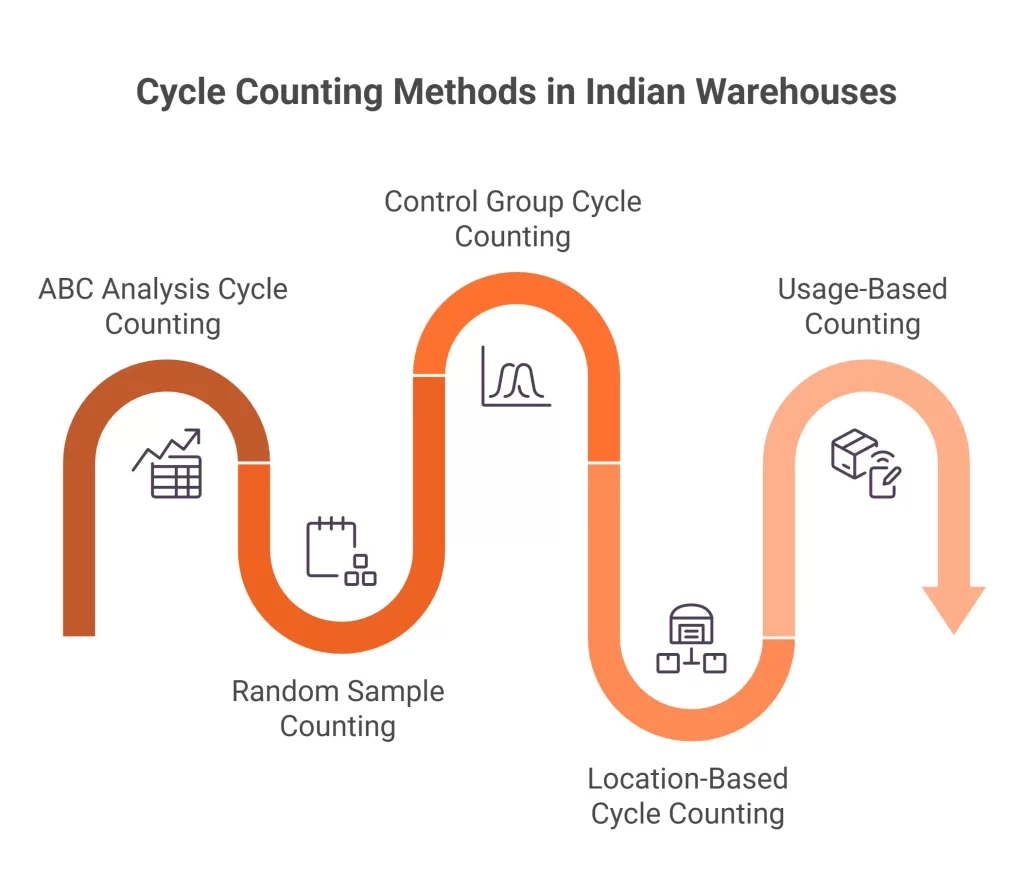
Not all cycle counting approaches are the same. Here are the most common inventory cycle count methods used in Indian warehouses:
ABC Analysis Cycle Counting
This is the most popular method, and it’s based on the Pareto principle (the 80/20 rule). You categorize your inventory into three groups:
- A items (high value, ~20% of SKUs, ~80% of revenue) counted most frequently (weekly or monthly)
- B items (moderate value) counted quarterly
- C items (low value, high quantity) counted once or twice a year
ABC analysis inventory counting ensures you’re spending the most time and attention on the items that matter most to your bottom line.
Random Sample Counting
With this method, you randomly select a set number of SKUs to count each day. It’s simple, unbiased, and works well for warehouses with relatively uniform inventory value.
For example, if you have 10,000 SKUs, you might count 50 random items per day. Over 200 working days, you’d cover your entire inventory at least once.
Control Group Cycle Counting
This is a lesser-known but highly effective method. You select a small “control group” of items and count them repeatedly over a short period. The goal isn’t to verify those specific items. It’s to test and refine your counting process itself.
If your control group keeps showing discrepancies, you know there’s a problem with your counting procedure, not necessarily with your inventory.
Location-Based Cycle Counting
Instead of selecting items, you select specific bin locations to count. This works well for warehouses organized by zones and helps with bin location verification. You might count one aisle per day, rotating through the entire warehouse over a set period. This method pairs well with proper warehouse slotting and storage optimization strategies.
Usage-Based (Transaction-Based) Counting
Items that are picked, received, or moved most frequently are counted more often. The logic is simple. The more an item is touched, the more likely errors will occur. This method is particularly effective for ecommerce warehouses with high order volumes.
Cycle Counting vs Physical Inventory: Best Practices for Indian Warehouses
Now that you understand the methods, let’s dive into the cycle counting best practices that work specifically for the Indian warehouse environment. These tips apply whether you’re choosing cycle counting, physical inventory, or a hybrid of both.
1. Start with ABC Analysis
For most Indian businesses, ABC analysis is the ideal starting point. It aligns well with how Indian warehouses typically operate. High-value items get more attention, and you can demonstrate ROI quickly to management.
2. Set Clear Accuracy Thresholds
Define what “accurate” means for your operation. Most warehouses aim for:
- A items: 99.5% accuracy or higher
- B items: 97% accuracy
- C items: 95% accuracy
Your cycle count tolerance percentage should be documented in your SOP and communicated to all counting staff. If you haven’t already built one, our guide on how to create SOPs for inventory walks you through the process step by step.
3. Count at the Right Time
Schedule cycle counts during low-activity periods. Early morning before picking starts, or during shift changes. This minimizes interference with live operations and reduces counting errors caused by items being in transit within the warehouse.
4. Use Blind Counts
In a blind cycle count, the counter doesn’t see the expected system quantity before counting. This eliminates bias. They can’t just “confirm” what the system says. They count what’s physically there, and discrepancies are flagged automatically.
This is far more accurate than an open cycle count where the counter knows the expected quantity.
5. Leverage Barcode Scanning Technology
Manual counting with pen and paper introduces errors. Using barcode scanning for cycle counts dramatically improves accuracy and speed. Even small businesses can implement affordable barcode solutions that integrate with their inventory system. If you’re weighing your options, our comparison of barcode vs RFID for warehouse management can help you choose the right technology.
6. Investigate Root Causes, Not Just Variances
When you find a discrepancy, don’t just adjust the number and move on. Ask why:
- Was it a receiving error?
- A picking mistake?
- Theft or damage?
- A system entry error?
Inventory discrepancy resolution should always include root cause analysis. Otherwise, you’re just treating symptoms. Many of these issues trace back to common inventory management challenges that have well-documented solutions.
7. Document Everything in an SOP
Create a detailed cycle counting procedure SOP that covers:
- Who counts (dedicated team vs. rotating staff)
- When counts happen (time of day, frequency)
- What method is used (ABC, random, location-based)
- How variances are investigated
- Who approves adjustments
- How results are reported
8. Track KPIs Religiously
Monitor these cycle counting KPIs and metrics to measure effectiveness:
- Inventory Record Accuracy (IRA): Percentage of items counted that match system records
- Variance rate: Percentage of counts showing discrepancies
- Adjustment value: Total rupee value of inventory adjustments
- Count completion rate: Are you completing planned counts on schedule?
- Time per count: Efficiency of your counting process
When Physical Inventory Wins Over Cycle Counting
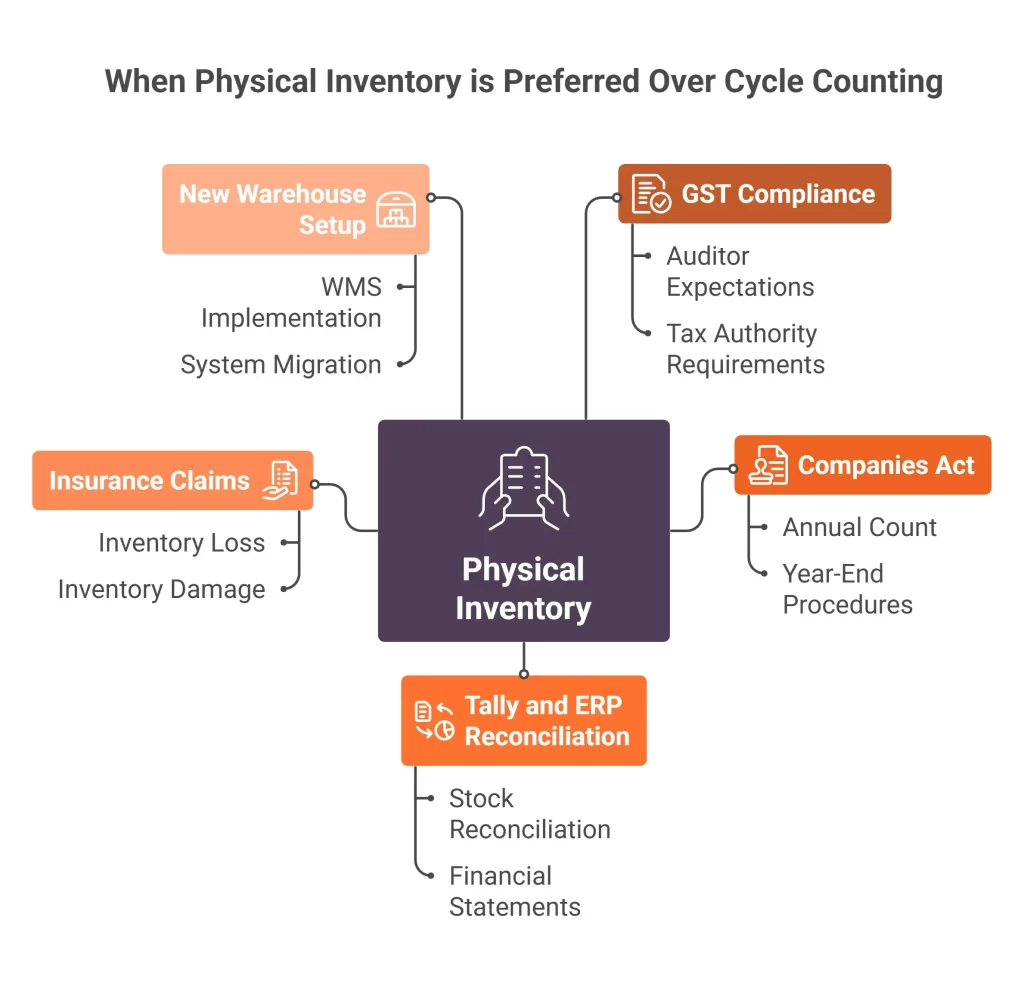
In the cycle counting vs physical inventory debate, there are clear situations where a full physical count remains the better choice for Indian businesses:
GST Compliance Requirements
Under GST regulations, businesses must maintain accurate stock records. While cycle counting helps maintain ongoing accuracy, many auditors and tax authorities still expect periodic physical stock verification to validate your books.
Companies Act Obligations
The Companies Act requires physical verification of inventory at reasonable intervals. For most businesses, this means at least one annual physical count. Your auditors will likely require it as part of their year-end procedures.
Tally and ERP Reconciliation
Many Indian businesses still use Tally for accounting. Year-end stock reconciliation in Tally often requires a complete physical count to ensure your financial statements accurately reflect actual inventory.
Insurance Claims
If you ever need to file an insurance claim for inventory loss or damage, having documented physical inventory records strengthens your case significantly.
New Warehouse Setup or System Migration
When you’re moving to a new warehouse, implementing a new WMS, or migrating from manual to automated systems, a complete physical count establishes your baseline.
The Hybrid Approach: Combining Cycle Counting and Physical Inventory
Here’s what smart Indian warehouses are doing in 2026. They’re not choosing between cycle counting vs physical inventory. They’re combining both methods strategically:
Throughout the year: Regular cycle counting maintains high accuracy, catches errors early, and keeps operations running smoothly.
Once a year: A focused physical inventory count satisfies compliance requirements, validates your cycle counting program’s effectiveness, and gives you a clean slate for financial reporting.
This hybrid approach gives you warehouse operations continuity for 364 days while still meeting your legal and financial obligations.
How WMS Enables Effective Cycle Counting
Implementing WMS-driven cycle counting transforms the entire process. Here’s how a warehouse management system makes cycle counting dramatically more effective:
- Automated count scheduling: The WMS automatically generates daily count lists based on your chosen method (ABC, random, location-based)
- Real-time inventory visibility: See current stock levels, last count dates, and variance history at a glance
- Barcode/RFID integration: Scanners connect directly to the WMS for error-free data capture
- Variance alerts: Automatic notifications when counts exceed tolerance thresholds
- Audit trails: Complete documentation of who counted what, when, and what adjustments were made
- Analytics and reporting: Track inventory record accuracy trends over time
For Indian warehouses looking to implement cycle counting software, a modern WMS eliminates the complexity of managing count schedules manually and ensures nothing falls through the cracks. If you’re evaluating options, our guide to the best warehouse management software in India covers what to look for.
How to Implement Cycle Counting Without a WMS
Not every warehouse has a WMS, and that’s okay. Here’s how smaller Indian businesses can start cycle counting with basic tools:
- Create an Excel-based schedule. List all SKUs, assign counting frequency based on ABC classification, and create a daily count calendar.
- Use a simple inventory counting app. Several affordable mobile apps allow barcode scanning and count recording.
- Assign a dedicated counter. Even one person spending 1-2 hours daily on cycle counts makes a difference.
- Maintain a variance log. Track all discrepancies in a spreadsheet with date, item, expected vs. actual, and root cause.
- Review weekly. Hold a brief weekly meeting to discuss findings and corrective actions.
You don’t need expensive technology to start. You need discipline and consistency.
Cycle Counting vs Physical Inventory for Specific Indian Industries
Different industries have unique requirements when choosing between cycle counting vs physical inventory:
FMCG and Food & Beverage
Focus on batch and expiry tracking during cycle counts. Count items approaching expiry more frequently to prevent dead stock accumulation and write-offs. Our detailed guide on batch and expiry tracking in FMCG covers the specific workflows you’ll need.
Pharmaceutical Warehouses
Regulatory requirements demand extremely high accuracy. Implement daily cycle counts for controlled substances and high-value medications. Unit-level traceability is non-negotiable.
Ecommerce Fulfillment Centers
High transaction volumes mean more opportunities for errors. Usage-based cycle counting works best here. Count your fastest-moving SKUs daily and slower movers weekly.
Automotive Parts Warehouses
With thousands of similar-looking parts, bin location verification becomes critical during cycle counts. Ensure parts haven’t been placed in wrong locations.
Common Mistakes to Avoid in Cycle Counting and Physical Inventory
Even with the best intentions, warehouses often stumble with their counting programs. Here are pitfalls to watch for:
- Counting during peak hours. This leads to inaccurate counts and frustrated pickers.
- Not investigating variances. Adjusting numbers without understanding why creates recurring problems.
- Inconsistent scheduling. Skipping counts when things get busy defeats the purpose.
- Counting without training. Untrained staff make more errors than they find.
- Ignoring C items entirely. Low-value items can still cause order fulfillment issues.
- Not measuring results. If you’re not tracking IRA, you don’t know if your program is working.
These mistakes often contribute to inventory shrinkage that silently eats into your profits over time.
How Many Items Should You Count Per Day?
This depends on your warehouse size, team capacity, and chosen method. Here’s a general guideline for Indian warehouses:
- Small warehouse (under 1,000 SKUs): 20-30 items per day
- Medium warehouse (1,000-10,000 SKUs): 50-100 items per day
- Large warehouse (10,000+ SKUs): 100-200 items per day
The goal is to count your entire inventory at least once per year through cycle counting, with A items counted 4-12 times per year.
Measuring Success: The Inventory Accuracy Formula
To know if your counting program is working, calculate your Inventory Record Accuracy (IRA):
IRA = (Number of Accurate Counts / Total Number of Counts) × 100
For example, if you counted 100 SKUs today and 94 matched your system records perfectly, your IRA is 94%.
Target benchmarks for Indian warehouses:
- Below 90%: Serious problems. Investigate immediately.
- 90-95%: Average. Room for improvement.
- 95-97%: Good. Your program is working.
- 97-99%: Excellent. You’re among the best.
- 99%+: World-class accuracy.
Conclusion
The debate between cycle counting vs physical inventory isn’t really about choosing one over the other. It’s about finding the right balance for your specific warehouse operation.
For most Indian warehouses in 2026, the winning strategy is clear: implement regular cycle counting to maintain day-to-day accuracy and operational efficiency, while conducting annual physical inventory counts to satisfy GST compliance, auditor requirements, and financial reporting needs.
Start small if you need to. Even basic ABC cycle counting with a spreadsheet and a dedicated team member will dramatically improve your inventory accuracy over time. As you grow, invest in a WMS that automates the process and gives you real-time visibility into your stock levels.
The warehouses that thrive aren’t the ones that count everything once a year and hope for the best. They’re the ones that count a little every day and catch problems before they become expensive disasters.
Ready to implement cycle counting in your warehouse? Explore how Omneelab’s WMS can automate your cycle counting schedule, integrate barcode scanning, and deliver real-time inventory accuracy dashboards tailored for Indian businesses.
Frequently Asked Questions (FAQs)
In most cases, no. Indian businesses still need periodic physical inventory for GST compliance and Companies Act requirements. However, a strong cycle counting program can significantly reduce the scope and duration of your annual physical count.
For ecommerce fulfillment centers with high transaction volumes, daily cycle counting is recommended. Use a usage-based or ABC analysis approach where fast-moving SKUs are counted weekly, moderate movers monthly, and slow movers quarterly. This ensures your highest-risk items (those touched most often) are verified frequently, reducing order cancellations and shipping errors.
In a blind cycle count, the person counting doesn’t see the expected system quantity beforehand. They simply count what’s physically present. In an open cycle count, they can see the expected number. Blind counts are significantly more accurate because they eliminate confirmation bias. The counter can’t unconsciously “find” the expected quantity. For best results, always use blind counts for your A items.
Most Indian warehouses should target 95-97% IRA, with pharmaceutical operations aiming for 99%+. The key is consistent improvement. If you’re at 85% today, set 90% as your first milestone and keep raising the bar.
Classify inventory using ABC analysis in a spreadsheet, assign one team member for 1-2 hours of daily counting, use an affordable barcode scanning app, and maintain a variance log in Excel. Most businesses see noticeable accuracy improvements within 60-90 days.

Kapil Pathak is a Senior Digital Marketing Executive with over six years of experience specializing in the logistics and supply chain industry. His expertise spans digital strategy, search engine optimization (SEO), search engine marketing (SEM), and multi-channel campaign management. He has a proven track record of developing initiatives that increase brand visibility, generate qualified leads, and drive growth for D2C & B2B technology companies.