Picture this. It is Day 1 of Flipkart Big Billion Days. Orders are pouring in at five times your normal rate. Your team is scrambling to pick, pack, and dispatch. Then someone notices a problem — 200 units sold on the platform, but only 140 are actually on the shelf. Somewhere between your last manual stock count and now, the numbers went wrong.
This is not a rare horror story. It is the daily reality for thousands of Flipkart sellers who are still managing their warehouse operations manually or through basic spreadsheets. And in a marketplace where your seller rating lives and dies by dispatch speed, accuracy, and return rates, this kind of slip can cost you the Flipkart Assured badge or, worse, your account health.
That is exactly why WMS for Flipkart sellers in India has become one of the most important topics for Indian ecommerce operators in 2026. A Warehouse Management System (WMS) is no longer just for large enterprises with massive logistics budgets. Today, even mid-sized D2C brands and SME sellers are adopting WMS platforms to automate inventory tracking, sync orders in real time, and reduce the painful cost of Return to Origin (RTO).
This guide walks you through everything — what a WMS is, how it connects with Flipkart, what features matter most, and how to choose the right one for your business.
What Is a WMS and Why Does It Matter for Flipkart Sellers?
A Warehouse Management System (WMS) is software that controls and tracks every movement of goods inside your warehouse — from inbound receiving to dispatch and returns. To understand the fundamentals of warehouse workflows and concepts, you can also refer to this detailed guide on the introduction to warehouse management.
Now, why does this matter specifically if you are selling on Flipkart?
Flipkart serves hundreds of millions of registered users and commands a large share of India’s ecommerce market. It processes millions of orders every single day. That means you are operating in one of the fastest, most competitive marketplaces in the world. Without a system that automates your warehouse operations, you are always a step behind — reactive instead of proactive.
A Flipkart seller warehouse management system bridges that gap. It keeps your stock levels accurate, your orders moving fast, and your returns under control. Think of it as the operating system for your warehouse — quietly running everything in the background so your team can focus on growth instead of firefighting.
If you are already struggling with stock mismatches, overselling, or write-offs, it also helps to understand broader operational issues highlighted in this article on common inventory management challenges.
How Flipkart Fulfillment Models Work (And Where WMS Fits In)
Before understanding how WMS helps, it is important to know how Flipkart’s fulfillment actually works. There are three main models:
1. Standard Fulfillment
Flipkart manages logistics end-to-end. You prepare the order, and their delivery partner picks it up. You are responsible for having accurate stock ready and dispatching on time.
2. Flipkart Seller Flex (Smart Fulfillment)
Under Seller Flex, you store inventory in your own warehouse but operate under Flipkart’s quality standards. Your facility effectively becomes a Flipkart-approved fulfillment node. This model qualifies you for the Flipkart Assured badge, which can boost listing visibility and buyer trust.
3. Self-Ship Fulfillment
You manage everything — packing, dispatch, delivery, and returns. This is typically used for large or bulky products like furniture or appliances.
A WMS Flipkart integration India is most valuable in the Seller Flex and Self-Ship models, where you are directly accountable for operational accuracy. Any picking error, any delay in dispatch, or any inventory mismatch immediately impacts your seller rating. That is where automation stops being optional and starts being essential.
For a more strategic view of technology’s role in warehousing, you can also explore the article on technologies in warehousing and logistics in India.
Flipkart Seller Flex and WMS: A Natural Partnership
Flipkart Seller Flex warehouse management is a hot topic among growing Indian sellers — and for good reason. Seller Flex gives you greater control over your inventory while still leveraging Flipkart’s logistics network and customer trust.
However, Seller Flex comes with strict operating requirements:
- Near-zero order cancellation rates
- Same-day or next-day dispatch timelines
- Real-time inventory visibility at all times
- Accurate pick, pack, and ship operations with minimal errors
A WMS helps you meet these benchmarks. It auto-generates pick lists, guides warehouse staff to the exact shelf location using barcode scanning, and updates inventory the moment a unit leaves the rack. When your Flipkart seller hub inventory sync is live with your WMS, the stock numbers on the platform always match what is physically in your warehouse. This alone eliminates two of the biggest problems Flipkart sellers face: overselling and phantom stockouts.
If you want to explore the broader business case for implementing WMS in your organization, this article on the business need of a warehouse management system provides a useful framework.
Key Features to Look for in Flipkart Inventory Management Software India
Not all WMS platforms are created equal. Here are the specific features that matter most when you are evaluating Flipkart inventory management software India.
Real-Time Inventory Sync
This is the foundation. Your WMS must connect with Flipkart’s API and push stock updates in real time. Every time an order is placed, confirmed, cancelled, or returned, the inventory count must adjust instantly — with no manual intervention required. This is what prevents the Big Billion Days nightmare we described at the start.
For a deeper understanding of how visibility ties into performance, you can refer to the article on inventory visibility in 2025.
Flipkart API Integration for Order Automation
A strong Flipkart API integration warehouse management setup means your WMS pulls new orders from Flipkart automatically, creates pick lists, assigns them to the right pickers, and marks orders as ready for dispatch — all without anyone touching a spreadsheet. This is what order automation for Flipkart sellers looks like in practice.
To understand how integrations in general impact your tech stack, the piece on top WMS integration types and benefits is particularly helpful.
SKU Management and Multi-Location Tracking
Good SKU management for Flipkart sellers means every product variant — size, color, bundle — has a unique identifier tracked across every shelf and bin in your warehouse. If you operate multiple warehouses or dark stores, the WMS shows you exactly where each SKU is and how much is available at each location.
When you start handling more complex catalogs and multiple nodes, you’ll also find this guide on stock management for ecommerce in India 2026 valuable.
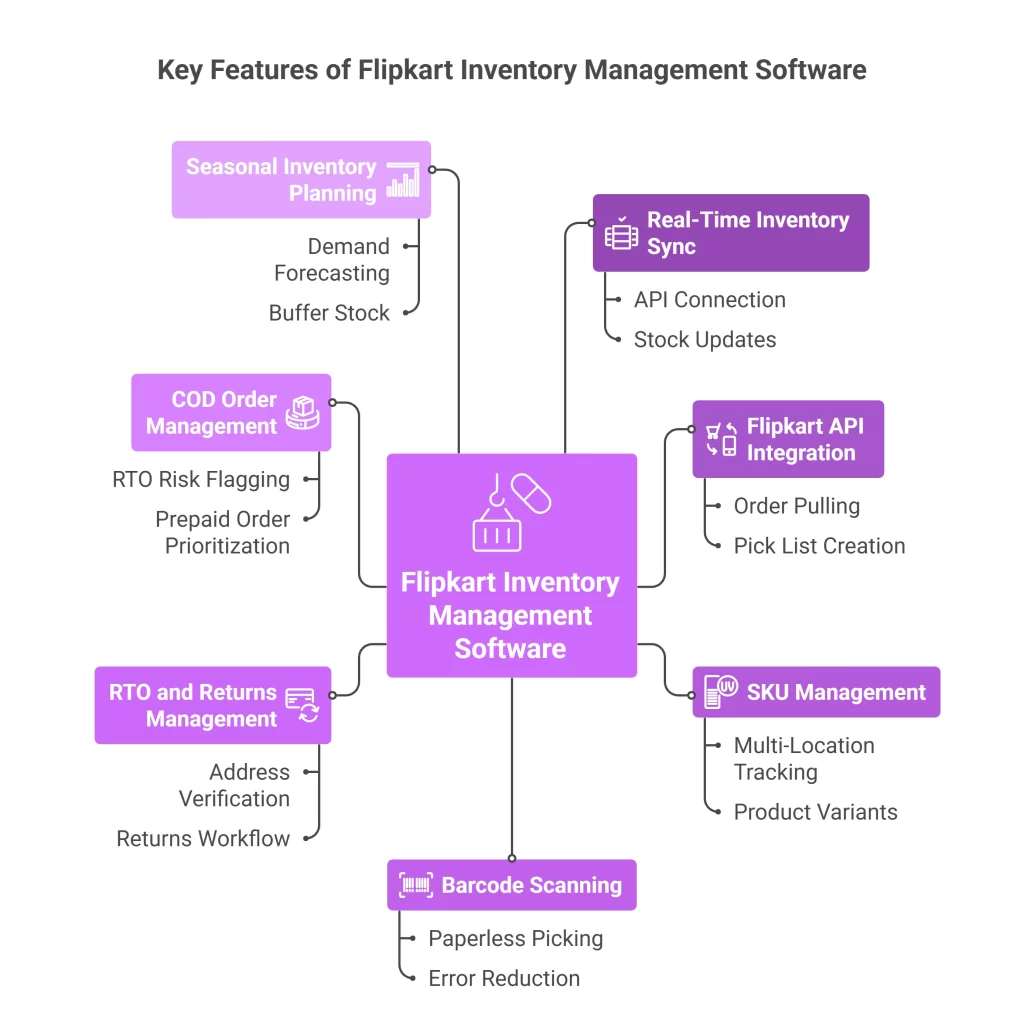
Barcode Scanning and Paperless Picking
Manual picking is slow and error-prone. A WMS that supports barcode scanning in Flipkart warehouse India lets pickers scan each item before packing, which drastically reduces wrong-item errors. Combined with a paperless picking system, this can cut your average order processing time significantly.
If you are still on manual lists, it is worth exploring how warehouse barcode scanning for 3PLs and this paperless picking guide for modern warehouses can transform day-to-day operations.
You can also explore barcode as a technology in more depth via the article on inventory management with barcode technology.
RTO and Returns Management
Flipkart RTO management WMS is one of the most important focus areas. RTO (Return to Origin) happens when a Flipkart order cannot be delivered and is sent back to the seller. Every RTO costs you shipping fees in both directions.
A WMS reduces RTO by automating address verification at packing, ensuring the right product ships in the right condition, and streamlining the returns workflow when RTOs do happen. For a more detailed India-focused view, you can also read the article on reverse logistics and returns management using WMS in India.
COD Order Management
In India, Cash-on-Delivery (COD) still accounts for a large share of ecommerce orders, especially in Tier 2 and Tier 3 cities. Flipkart COD order management through a WMS means you can flag high-RTO-risk COD orders, prioritize prepaid orders for faster dispatch, and maintain separate workflows for COD returns — all automatically.
Seasonal and Demand-Based Inventory Planning
During Flipkart Big Billion Days inventory planning, a WMS with demand forecasting helps you pre-position stock across warehouses based on historical sales data. Instead of reacting to a stockout, you are prepared for it weeks in advance.
A smarter way is to use data-driven buffer levels and replenishment rules. You can dive deeper into these concepts in your guides on what is buffer stock and how to calculate it and demand-driven replenishment.
How to Automate Flipkart Orders: Step-by-Step Workflow
Here is what order automation for Flipkart sellers looks like inside a WMS on a typical order processing day:
- Order received – The WMS pulls new Flipkart orders automatically via API, every few minutes or in real time.
- Order routed – The system identifies the nearest warehouse with available stock and routes the order to that location.
- Pick list generated – A digital pick list is sent to the picker’s handheld device, showing the exact bin location of each item. You can also learn more about efficient picking patterns in this guide to warehouse order picking process, methods, and types.
- Picking confirmed – The picker scans the item barcode to confirm the right SKU is picked.
- Packing verified – At the packing station, the system cross-checks packed items against the order before sealing.
- Label generated – A shipping label (with Flipkart’s courier partner details) is auto-generated and printed.
- Dispatch marked – Once the courier scans the package, the WMS marks the order as dispatched and updates Flipkart Seller Hub automatically.
- Inventory updated – Stock levels adjust across all connected sales channels in real time.
This entire flow — from order receipt to dispatch confirmation — can happen in minutes for a well-configured warehouse, compared to far longer with manual processes.
WMS for Flipkart Multichannel Sellers: Managing More Than One Marketplace
If you are selling on Flipkart and Amazon, Meesho, Myntra, or your own website, you already know the chaos of managing separate inventory pools for each platform. Flipkart multichannel inventory management through a unified WMS solves this by maintaining one master inventory pool that automatically allocates stock across all your sales channels.
When an item sells on one marketplace, your stock updates everywhere. This approach eliminates the need to reserve separate stock buffers for each marketplace, which improves your inventory turnover rate and reduces dead stock.
If you are particularly interested in how WMS compares with platform-led fulfillment models, your detailed piece on Amazon FBA vs WMS integration is a useful companion to this Flipkart-focused guide.
For a broad overview of integration across multiple sales channels and ERPs, revisit top WMS integration types and benefits, and for India-specific ecommerce context, see WMS for Shopify ecommerce fulfillment in India.
Cloud WMS vs On-Premise: What Works for Indian Sellers?
Most Indian Flipkart sellers — especially SMEs and D2C brands — are better off with a cloud WMS for Indian ecommerce rather than an on-premise solution.
For a more SME-focused perspective, this article on WMS software for small business in India explains the benefits and trade-offs very clearly.
Cloud WMS vs On-Premise – Quick Comparison
| Factor | Cloud WMS | On-Premise WMS |
|---|---|---|
| Setup Cost | Subscription-based | High upfront investment |
| Implementation Time | Days to weeks | Weeks to months |
| Scalability | Easy to scale | Requires physical upgrades |
| Remote Access | Accessible from anywhere | Limited to local network |
| Flipkart API Updates | Managed by vendor | Often manual |
| Best For | SMEs, D2C, growing sellers | Very large enterprises |
How a WMS Improves Your Flipkart Seller Rating
Your Flipkart seller rating affects how your listings rank, whether you qualify for Flipkart Assured, and even whether you get access to priority logistics slots during peak season.
A WMS improves your seller rating across key metrics:
- Lower cancellation rate – Real-time inventory sync prevents you from accepting orders you cannot fulfill.
- Faster dispatch – Automated pick-pack-ship workflows cut dispatch time significantly.
- Fewer wrong items – Barcode scanning at picking and packing eliminates incorrect shipments.
- Reduced RTO – Better packing quality and address verification reduce delivery failures.
- Faster returns processing – Automated returns workflows get your stock back on the shelf faster.
You can also look at your article on 11 costly inventory management mistakes that hurt profits to see how operational errors directly impact profitability and ratings.
Expanding to Tier 2 and Tier 3 Cities with WMS Support
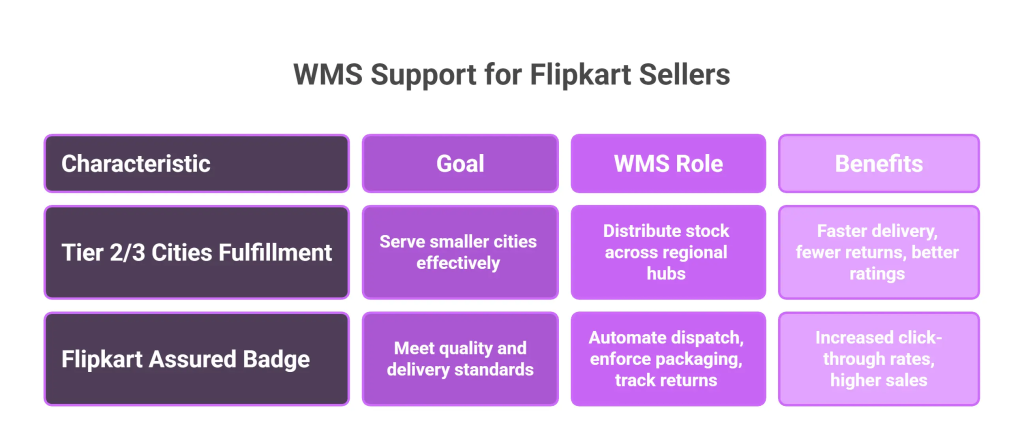
One of the biggest growth opportunities for Flipkart sellers in India is Flipkart Tier 2 and Tier 3 cities fulfillment. Cities like Indore, Lucknow, Coimbatore, Rajkot, and Bhopal now have millions of active online shoppers, and competition is often lower than in metros.
Serving these markets well requires fast, reliable fulfillment from strategically located warehouses. A multi-warehouse WMS lets you distribute stock across regional hubs so that orders in smaller cities are fulfilled locally, cutting delivery time from several days down to one or two days. Faster delivery means fewer return requests and better ratings.
To understand how WMS helps with downstream logistics, you can read about integrating WMS with last-mile delivery in India and WMS optimizing last-mile delivery stations in India.
WMS and the Flipkart Assured Badge: What You Need to Know
The Flipkart Assured badge is given to sellers who meet Flipkart’s quality, packaging, and delivery standards. It is displayed prominently on listings and can increase click-through rates.
To qualify and maintain Flipkart Assured status, you need:
- Consistent on-time dispatch, usually above a defined threshold
- Quality packaging verified at the warehouse level
- Low return rates linked to product or packing defects
- Accurate product descriptions matching what is shipped
A WMS supports all four of these requirements. It automates dispatch timelines, enforces packaging checklists at the packing station, tracks return reasons to identify recurring product issues, and ensures the right SKU ships against the right order description every time.
For a wider supply chain context on how visibility supports these goals, see your articles on why visibility in the supply chain is important and visibility in supply chain digitization.
Choosing the Best WMS for Flipkart Sellers in India (2026)
When evaluating the best WMS for ecommerce sellers India 2026, ask these questions:
- Does it have a native Flipkart API integration?
- How frequently does inventory sync with Flipkart Seller Hub?
- Does it support Seller Flex operational requirements?
- Can it handle COD orders and RTO use cases?
- Does it support multi-marketplace selling (Amazon, Meesho, Myntra, etc.)?
- Is it cloud-based with mobile access for warehouse staff?
- Does it offer demand forecasting for seasonal planning?
- What is the implementation timeline and onboarding support?
Omneelab’s content library already explains broader WMS evaluation angles. For example, you can revisit choosing the right warehouse management solution for a decision-making checklist and role of cloud retail WMS in the supply chain for technology benefits.
Is a WMS Worth It for Your Flipkart Business?
If you are processing fewer than 50 orders a day and selling on one platform, you might manage without a WMS for now. But if you are crossing 200 to 300 orders daily, selling across multiple platforms, or planning to scale during Big Billion Days, then the cost of not having a WMS is almost always higher than the cost of getting one.
A single RTO costs you twice in logistics. If you have dozens of RTOs per week, this quickly adds up. A WMS that reduces your RTO rate, improves inventory accuracy, and speeds up dispatch can often pay for itself in a short period.
Conclusion
The Indian ecommerce market is moving at a pace that rewards the organized and punishes the reactive. WMS for Flipkart sellers in India is no longer a luxury reserved for large logistics companies. It is the operational foundation that lets you grow your Flipkart business with confidence — whether you are managing a few hundred orders a day from one warehouse or thousands of orders across multiple fulfillment centers.
Start by identifying your biggest pain point. Is it RTO? Inventory mismatch? Slow dispatch? A WMS can address all three. As your next step, explore more in-depth resources like the comprehensive guide to inventory management systems and manual and automated inventory management to align your warehouse strategy with your Flipkart growth goals.
Frequently Asked Questions (FAQs)
Use WMS with Flipkart API integration for real-time stock updates. Add SOPs (create SOP for inventory) and barcode counting to avoid overselling.
RTO costs double logistics when deliveries fail. WMS validates addresses and tracks returns (reverse logistics WMS India).
Seller Flex fulfills from your warehouse under Flipkart standards. WMS ensures fast dispatch and accuracy for Flipkart Assured (WMS for Myntra).
Yes, multi-channel WMS syncs inventory across all platforms. Reduces overselling (Amazon FBA vs WMS).
Fewer cancellations, faster dispatch, accurate picking lift ratings. See operational impact (11 inventory mistakes).

Kapil Pathak is a Senior Digital Marketing Executive with over four years of experience specializing in the logistics and supply chain industry. His expertise spans digital strategy, search engine optimization (SEO), search engine marketing (SEM), and multi-channel campaign management. He has a proven track record of developing initiatives that increase brand visibility, generate qualified leads, and drive growth for D2C & B2B technology companies.