India loses nearly ₹92,000 crore worth of food annually due to inadequate cold chain infrastructure. That’s not just a statistic. It’s a massive problem that affects farmers, distributors, retailers, and ultimately consumers who receive compromised products.
From dairy products traveling across states to life-saving vaccines reaching remote villages, temperature-controlled warehousing plays a critical role in keeping goods safe and fresh. However, managing a cold storage warehouse with spreadsheets or basic tools is like trying to keep ice cream frozen with a desk fan. It simply doesn’t work.
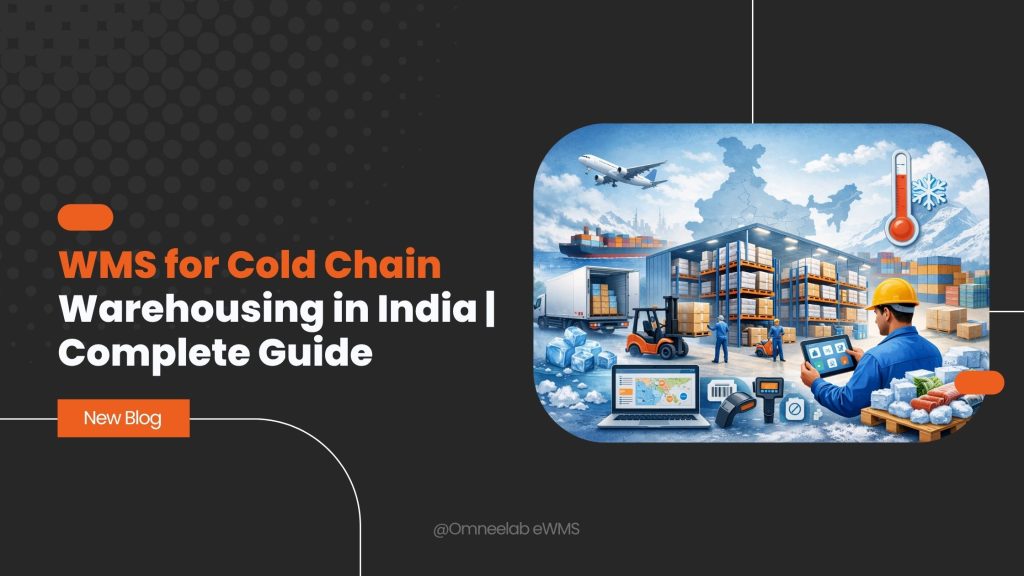
That’s where a WMS for cold chain warehousing comes in. A dedicated warehouse management system built for cold chain operations doesn’t just track inventory. It monitors temperatures, enforces expiry-based picking, ensures regulatory compliance, and ultimately saves businesses from costly spoilage. Whether you run a pharmaceutical cold storage facility, a frozen food warehouse, or a quick commerce dark store, the right WMS for cold chain warehousing can completely transform how you operate.
In this guide, we’ll walk you through everything you need to know about temperature-controlled warehouse management in India. From the core challenges businesses face to the must-have features, compliance requirements, and how to pick the right solution. Let’s dive in.
What Is Cold Chain Warehouse Management?
Cold chain warehouse management refers to the process of storing, handling, and distributing temperature-sensitive products within a controlled environment. Unlike regular warehousing, cold storage operations require constant temperature monitoring, specialized equipment, and strict adherence to safety protocols. If you’re new to the broader concept, our introduction to warehouse management covers the fundamentals in detail.
A WMS for cold chain warehousing is software specifically designed to handle these complexities. It integrates with IoT temperature sensors, automates stock rotation based on expiry dates, and provides real-time visibility into every corner of your refrigerated warehouse.
Think of it this way: a standard WMS manages what is in your warehouse and where it is. A WMS built for cold chain warehousing adds a third critical dimension, how it’s being stored. That “how” can mean the difference between a shipment of fresh produce reaching customers in perfect condition or ending up in a landfill.
Key Takeaway: Cold chain WMS = Standard WMS + Temperature Control + Expiry Management + Compliance Automation
What Is the Difference Between Cold Storage and Regular Warehousing?
Before we go further, let’s clear up a common question. Regular warehousing operates at ambient temperatures and focuses primarily on space optimization and inventory accuracy. Cold storage warehousing, on the other hand, is a completely different beast:
| Parameter | Regular Warehousing | Cold Chain Warehousing |
|---|---|---|
| Temperature | Ambient (no control needed) | Multi-zone: Frozen (-18°C to -25°C), Chilled (2°C to 8°C), Cool (10°C to 15°C) |
| Energy Costs | Standard | 3-5x higher due to refrigeration |
| Handling Speed | Flexible | Time-critical (products degrade fast) |
| Compliance | Basic safety standards | FSSAI, HACCP, pharma GDP, WHO guidelines |
| Risk Level | Moderate | Very high (a few degrees = total batch loss) |
This is exactly why generic warehouse management software falls short for cold storage operations. Businesses need a purpose-built WMS for cold chain warehousing that understands these unique demands. For a deeper look at how to evaluate your options, check out our guide on choosing the right warehouse management solution.
Why Generic WMS Fails in Cold Chain Operations
This is something most businesses learn the hard way. A standard WMS can manage locations, orders, and inventory counts. But here’s what it cannot do for cold chain:
- No temperature zone mapping — It doesn’t know that Zone A is frozen and Zone B is chilled
- No FEFO logic — It picks based on location, not expiry date
- No excursion alerts — If a freezer fails at 2 AM, nobody knows until morning
- No compliance automation — FSSAI and HACCP audit trails require manual effort
- No energy-aware scheduling — Dock doors stay open longer than necessary, spiking refrigeration costs
The bottom line: Using a generic WMS for cold storage is like using a regular car for an ambulance. It moves, but it’s not built for the job.
That’s precisely why a dedicated WMS for cold chain warehousing exists. It fills every gap listed above.
Why Is a WMS for Cold Chain Warehousing Important?
If you’re running a cold storage facility in India, you already know the headaches. Power outages, inconsistent temperatures across zones, manual record-keeping that nobody trusts, and the constant fear of a compliance audit. A WMS for cold chain warehousing built for Indian operations addresses all of these pain points.
Here’s what a dedicated cold chain WMS brings to the table:
- Real-time temperature monitoring: Integration with IoT temperature sensors gives you live dashboards showing conditions across every zone, rack, and cold room
- Automated FEFO picking: The system enforces First Expiry First Out (FEFO) logic, ensuring products closest to expiration ship first
- Batch and expiry tracking: Every SKU is tracked at the batch level with complete lot tracking for perishable inventory. Our detailed article on batch and expiry tracking in FMCG explains how this works in practice.
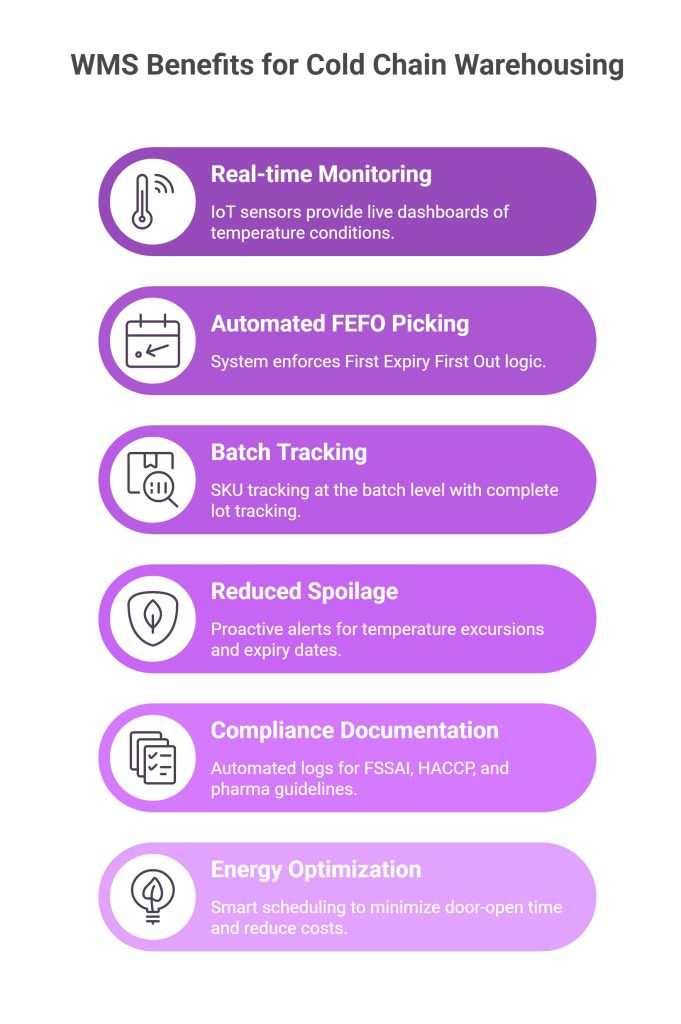
- Reduced spoilage: With proactive alerts for temperature excursions and expiry dates, you catch problems before they become losses
- Compliance documentation: Automated logs for FSSAI cold chain compliance, HACCP warehouse management, and pharma cold chain GDP guidelines
- Energy optimization: Smart scheduling of inbound and outbound activities to minimize door-open time and reduce refrigeration costs
Real Impact: Businesses implementing a cold chain WMS typically see 20-40% reduction in spoilage and 30% faster compliance audits within the first year.
What Are the Challenges of Cold Chain Warehousing in India?
India’s cold chain infrastructure has come a long way, but significant challenges remain. Understanding these is key to appreciating why the right WMS for cold chain warehousing matters so much.
Fragmented Infrastructure
India’s cold chain infrastructure in 2026 is still unevenly distributed. While major metros have modern facilities, Tier 2 and Tier 3 cities often rely on outdated cold rooms with limited automation. This makes consistent cold chain supply chain management across India incredibly difficult.
High Energy Costs
Running energy-efficient refrigeration systems is expensive. Power outages, especially in rural areas, add another layer of risk. Without a WMS that tracks temperature deviations in real time, businesses often discover spoilage after it’s too late.
Compliance Complexity
Between FSSAI food safety warehouse standards, pharmaceutical GDP guidelines, and state-level regulations, staying compliant is a full-time job. Manual documentation is error-prone and nearly impossible to audit efficiently.
Workforce Challenges
Cold warehouse workers operate in harsh conditions. Shifts need to be shorter, and efficiency per hour matters more than in ambient warehouses. A WMS for cold chain warehousing with barcode scanning capabilities and mobile-friendly interfaces reduces the time workers spend in freezing environments. If you’re considering barcode-based solutions, our comparison of barcode vs RFID for warehouse management can help you decide.
Product Diversity
A single cold storage facility might handle dairy, frozen foods, pharmaceuticals, and fresh produce, each with different temperature requirements and shelf life management protocols. Managing this diversity without a robust cold storage inventory tracking system leads to cross-contamination risks and compliance violations.
Key Features to Look for in a WMS for Cold Chain Warehousing
Not all warehouse management systems are created equal. When evaluating a WMS for cold chain warehousing in India, look for these essential features:
Real-Time Temperature Monitoring and Alerts
The system should integrate with IoT temperature sensors placed throughout the warehouse. When a zone drifts outside its acceptable range, the WMS should trigger instant alerts via SMS, email, or dashboard notifications. This is your first line of defense against temperature excursion management failures.
FEFO and FIFO Inventory Logic
For perishable goods logistics, FEFO (First Expiry First Out) is non-negotiable. The WMS should automatically direct pickers to the batch closest to expiration. For products where expiry isn’t the primary concern, FIFO inventory management in cold storage ensures proper stock rotation for perishable goods. Learn more about managing shelf life effectively in our guide on managing perishable inventory.
Batch-Level Traceability
Complete product traceability across the cold chain is essential for recalls, audits, and quality control. Every item should be traceable from receipt to dispatch, with full batch and expiry tracking at every stage. For a deeper understanding of unit-level vs batch-level approaches, read our article on unit-level vs batch-level traceability.
Zone-Based Inventory Management
A cold room warehouse layout typically includes multiple temperature zones. Your WMS for cold chain warehousing should support zone-based storage rules, ensuring that frozen items never accidentally end up in a chilled zone and vice versa.
Compliance and Audit Trails
Automated logging of temperature data, handling times, and storage conditions creates a digital paper trail for FSSAI cold chain compliance and HACCP audits. This alone can save dozens of hours during regulatory inspections.
Integration Capabilities
The best cold chain logistics software in India doesn’t work in isolation. Look for ERP integration capabilities, marketplace connectivity, and compatibility with RFID in cold storage and barcode hardware. Our guide on WMS-ERP integration explains how these systems work together seamlessly.
Cloud-Based Accessibility
Can a cloud-based WMS handle temperature-controlled warehousing? Absolutely. A cloud-based WMS for cold chain warehousing offers remote monitoring, automatic updates, and scalability without heavy upfront infrastructure costs. This is especially valuable for businesses managing multiple facilities.
How Does IoT Enhance a WMS for Cold CHow IoT Transforms a WMS for Cold Chain Warehousing
IoT is arguably the most impactful technology in cold chain automation. When paired with a WMS for cold chain warehousing, it creates a powerful combination:Here’s the flow:
Wireless Sensors → Real-Time Data → WMS Dashboard → Automated Alerts → Corrective Action
- Wireless sensors in storage zones, vehicles, and pallets continuously transmit temperature and humidity data
- The WMS receives this data and maps it against predefined thresholds for each product category
- Automated alerts fire when conditions deviate, allowing corrective action within minutes
- Historical data logs provide complete audit trails and help identify patterns
Example: A WMS detects that Zone 3 consistently runs 2°C warmer between 2-4 PM daily. Instead of discovering spoilage, the operations team adjusts airflow scheduling proactively.
To explore how AI is further enhancing these capabilities, check out our article on AI in warehouse management in India.
What FSSAI Regulations Apply to Cold Chain Warehouses in India?
FSSAI (Food Safety and Standards Authority of India) has specific guidelines for cold chain operations that every food-related cold storage facility must follow:
- Temperature maintenance records must be documented and available for inspection
- Storage conditions must match the requirements specified for each food category
- Hygiene and sanitation protocols must be followed in all storage and handling areas
- Traceability systems must be in place to track products from source to consumer
- Pest control and contamination prevention measures are mandatory
For pharmaceutical cold storage management, additional GDP (Good Distribution Practice) guidelines apply, particularly for vaccine cold chain management in India. Our detailed guide on pharmaceutical warehouse management systems covers pharma-specific compliance in depth.
Key Takeaway: A WMS for cold chain warehousing with built-in compliance features automates 80%+ of this documentation, reducing human error and making audits significantly less stressful.
Industries That Need a WMS for Cold Chain Warehousing in India
The demand for temperature-controlled warehousing solutions spans multiple sectors. Here are the industries that benefit most from implementing a WMS for cold chain warehousing:
- Dairy cold chain India: Milk, curd, cheese, and butter require unbroken cold chains from production to retail
- Pharmaceutical cold storage management: Vaccines, biologics, and certain medications need precise temperature control
- Frozen food warehousing India: Ready-to-eat meals, ice cream, and frozen vegetables are a rapidly growing segment
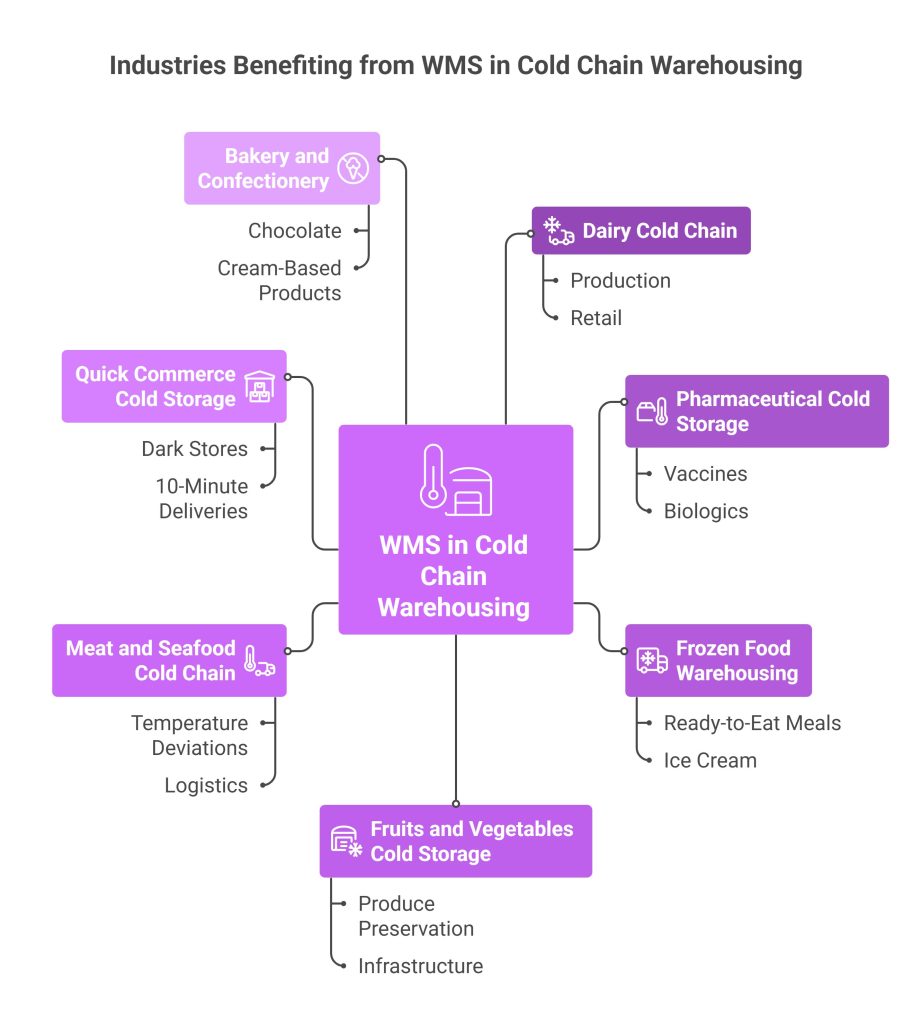
- Fruits and vegetables cold storage: India loses an estimated 15-20% of its produce due to inadequate cold chain infrastructure
- Meat and seafood cold chain logistics: These products have zero tolerance for temperature deviations
- Quick commerce cold storage: Companies like Blinkit and Zepto rely on dark store cold storage management for 10-minute deliveries
- Bakery and confectionery: Chocolate, cream-based products, and dough require controlled environments
Each of these industries has unique requirements, but they all share one common need: a reliable WMS for cold chain warehousing.
How to Choose the Best WMS for Cold Chain Warehousing
Selecting the right WMS for cold chain warehousing requires careful evaluation. Here’s a practical framework:
1. Assess your temperature zone requirements. How many zones do you operate? Do you need multi-temperature support within a single facility?
2. Evaluate integration needs. Does the WMS integrate with your existing ERP, accounting software, and marketplace channels? Seamless ERP integration prevents data silos.
3. Check IoT compatibility. Can the system connect with your existing temperature sensors, or does it require proprietary hardware?
4. Look for India-specific compliance features. FSSAI, GST, and e-way bill support should be built in, not bolted on.
5. Consider scalability. If you plan to expand to multiple facilities, a cloud-based WMS for cold chain warehousing is typically more flexible than on-premise solutions.
6. Evaluate the vendor’s domain expertise. A WMS vendor with experience in warehouse management for perishable goods in India will understand nuances that a generic software provider might miss.
7. Request a pilot or demo. Nothing beats seeing the system in action with your actual workflows and product categories.
WMS vs ERP for Cold Storage: Which Do You Need?
This is a question that comes up frequently. An ERP system handles broad business functions like finance, procurement, and HR. A WMS for cold chain warehousing focuses specifically on warehouse operations. For cold chain businesses, the answer is usually both, working together.
Your ERP manages purchase orders, vendor payments, and financial reporting. Your WMS handles the operational details: where to store a pallet, which batch to pick, whether the temperature in Zone 3 is within range, and how to optimize your cold chain throughput.
The magic happens when these systems talk to each other through tight integration. Orders flow from ERP to WMS, fulfillment data flows back, and everyone works from a single source of truth.
How Does a WMS for Cold Chain Warehousing Reduce Spoilage?
Spoilage is the silent profit killer. Here’s how a WMS for cold chain warehousing fights back:
| Spoilage Cause | How WMS Prevents It |
|---|---|
| Products expiring on shelf | FEFO enforcement picks nearest-expiry first |
| Freezer failure overnight | Real-time excursion alerts via SMS/email |
| Wrong zone placement | Zone-based rules prevent cross-zone errors |
| Damaged goods received | Inbound quality checks flag issues at receiving |
| Inventory inaccuracy | Barcode/RFID scanning eliminates manual errors |
| Slow stock rotation | Shelf life dashboards highlight at-risk inventory |
Real Impact: Businesses typically see 20-40% spoilage reduction and 95%+ inventory accuracy after implementing a cold chain WMS.
Cold Chain Warehouse Lifecycle: How WMS Manages Every Stage
Understanding the end-to-end flow helps visualize where a WMS for cold chain warehousing adds value:
- Stage 1: Inbound Receiving → Temperature check at dock → GRN with batch/expiry capture → Quality inspection
- Stage 2: Putaway → Zone-based allocation (frozen/chilled/cool) → Location assignment → Sensor validation
- Stage 3: Storage → Continuous temperature monitoring → FEFO queue management → Expiry alerts
- Stage 4: Picking & Packing → FEFO-driven pick lists → Barcode/RFID verification → Cold-pack compliance
- Stage 5: Dispatch → Dock scheduling (minimize door-open time) → Reefer vehicle temperature check → Dispatch confirmation
At every stage, the WMS creates an audit trail that satisfies FSSAI, HACCP, and pharma GDP requirements automatically.
Cold Chain Warehouse KPIs and Metrics to Track
Once your WMS for cold chain warehousing is in place, monitor these key performance indicators. For a broader look at warehouse performance tracking, our guide on warehouse KPIs, metrics, and dashboard is a helpful resource.
| KPI | What It Measures |
|---|---|
| Temperature compliance rate | Percentage of time all zones stay within range |
| Spoilage/shrinkage rate | Value of goods lost to temperature damage or expiry |
| FEFO adherence rate | Percentage of orders picked following FEFO logic |
| Order accuracy | Correct items, quantities, and conditions shipped |
| Dock-to-stock time | How quickly inbound goods move from receiving to cold storage |
| Energy cost per pallet | Refrigeration cost efficiency |
| Inventory turnover | How quickly stock moves through the facility |
A good WMS for cold chain warehousing provides dashboards and reports for all of these metrics, giving you the visibility needed to continuously improve operations.
Wrapping Up
Cold chain warehousing in India is at an inflection point. Consumer demand for fresh, safe, and high-quality products is rising. Regulatory requirements are tightening. And the cost of getting it wrong, whether through spoilage, compliance failures, or customer complaints, is higher than ever.
A purpose-built WMS for cold chain warehousing isn’t a luxury anymore. It’s the foundation of efficient, compliant, and profitable temperature-controlled operations. From real-time temperature monitoring and FEFO automation to FSSAI compliance and IoT integration, the right system pays for itself many times over.
Omneelab offers a comprehensive, India-ready WMS designed specifically for the complexities of cold chain warehousing. With built-in support for multi-zone temperature tracking, batch-level traceability, FSSAI compliance, and seamless ERP and marketplace integrations, OmneeLab empowers businesses to reduce spoilage, streamline operations, and scale with confidence. Whether you’re managing a single cold storage facility or a multi-warehouse network across India, OmneeLab’s cloud-based platform is built to grow with you.
Ready to take control of your cold chain operations? Book a free demo with Omneelab today.
Frequently Asked Questions
Generally, cloud-based solutions start from ₹15,000 to ₹50,000 per month for small to mid-sized operations. However, enterprise implementations with custom integrations can cost more. As a result, most businesses see ROI from reduced spoilage within 6 to 12 months.
In essence, FIFO dispatches stock based on arrival order, whereas FEFO dispatches based on expiration date regardless of when it arrived. Therefore, a WMS for cold chain warehousing enforces FEFO automatically, ensuring that products closest to expiry always ship first and spoilage stays minimal.
Simply put, a temperature excursion happens when products are exposed to temperatures outside their safe storage range. To prevent this, a WMS integrates with real-time sensors and triggers instant alerts on deviations. Additionally, it enforces SOPs like maximum dock time and door-open duration limits.
Yes, absolutely. Modern WMS solutions support multiple temperature zones within one facility. More specifically, the system assigns products to the correct zone, prevents cross-zone placement errors, and simultaneously tracks conditions for frozen, chilled, and cool sections independently.
Notably, quick commerce players like Blinkit and Zepto need rapid fulfillment of temperature-sensitive products. Consequently, a cold chain WMS enables fast pick-pack workflows while maintaining FEFO compliance at high speed. Furthermore, it integrates with last-mile delivery systems for seamless end-to-end operations.

Kapil Pathak is a Senior Digital Marketing Executive with over four years of experience specializing in the logistics and supply chain industry. His expertise spans digital strategy, search engine optimization (SEO), search engine marketing (SEM), and multi-channel campaign management. He has a proven track record of developing initiatives that increase brand visibility, generate qualified leads, and drive growth for D2C & B2B technology companies.