Picture this: You’re running a growing D2C brand out of Mumbai. Orders are pouring in from Delhi, Bangalore, and Chennai. But your single warehouse in Bhiwandi is struggling to keep up. Shipping costs are climbing, delivery times are stretching, and customers are starting to complain. Sound familiar?
![Multi-Warehouse Inventory Management in India [2026 Guide]](https://omneelab.com/wp-content/uploads/2026/03/Multi-Warehouse-Inventory-Management-in-India-2026-Guide-1024x576.jpg)
This is the exact moment when businesses realize they need multi-warehouse inventory management. And in a country as vast and diverse as India, managing inventory across multiple locations isn’t just a nice-to-have. It’s a survival strategy.
Whether you’re an e-commerce seller shipping through Flipkart and Amazon, a D2C brand scaling nationally, or a 3PL provider handling multiple clients, this guide walks you through everything you need to know about setting up and running a multi-location inventory management system in India. Let’s dive in.
What Is Multi-Warehouse Inventory Management?
At its core, multi-warehouse inventory management is the process of monitoring, managing, and transferring inventory between two or more storage locations. These locations could be distribution centers, retail stores, dark stores, or traditional warehouses spread across different cities or regions.
Instead of relying on a single warehouse to fulfill all orders, businesses distribute their stock across multiple locations. This brings products closer to customers, reduces shipping times, and lowers last-mile delivery costs.
But here’s the catch: managing inventory across multiple warehouses is significantly more complex than running a single location. You need real-time inventory tracking, seamless stock level synchronization, and a robust system that gives you complete inventory visibility across warehouses from a single dashboard.
If you’re new to the concept of inventory visibility and why it matters, Omneelab’s detailed guide on why visibility in supply chain is important is a great starting point.
Without the right tools and processes, you’ll end up with stockouts in one warehouse and overstocking in another. And that’s a recipe for lost revenue and frustrated customers.
Why Indian Businesses Need Multi-Location Inventory Management
India’s logistics landscape is unique. The country spans over 3.2 million square kilometers, with customers spread across tier-1, tier-2, and even tier-3 cities. Here’s why multi-warehouse management in India has become essential:
- Faster delivery expectations: With quick commerce platforms like Blinkit and Zepto setting 10-minute delivery benchmarks, customers now expect speed from every brand. Distributing inventory across locations helps you meet these expectations.
- Rising shipping costs: Shipping a package from Mumbai to Guwahati costs significantly more than shipping it from a warehouse in Kolkata. A distributed warehouse network in India helps you cut transportation expenses dramatically.
- Marketplace requirements: If you sell on Flipkart, Amazon, or Meesho, you likely need to stock inventory at multiple fulfillment centers. Managing this without a centralized system is a nightmare.
- GST and compliance: Inter-state stock transfers in India require proper documentation, including e-way bills and GST-compliant invoicing. A proper system ensures you stay compliant without manual headaches.
- Seasonal demand variations: Demand patterns vary by region. A winter clothing brand might see high demand in Delhi but low demand in Chennai during the same period. Inventory allocation strategy by location helps you stock smarter.
Simply put, if your business ships to customers across India, operating from a single warehouse is holding you back.
Centralized vs. Decentralized Inventory: Which Model to Choose?
Before setting up multiple warehouses, you need to decide on your inventory model. There are two primary approaches:
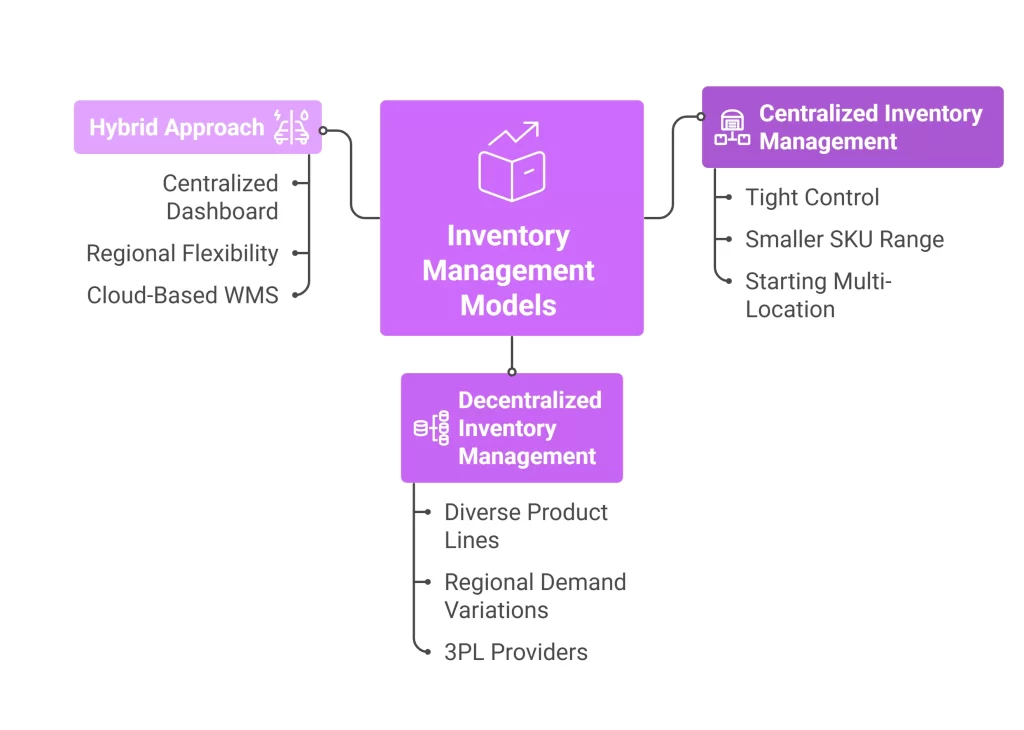
Centralized Inventory Management
In this model, all inventory decisions are made from a single point of control. You might have multiple warehouses, but one central system (and often one central team) manages stock allocation, replenishment, and transfers.
Best for: Businesses that want tight control over inventory, have a smaller SKU range, or are just starting with multi-location operations.
Decentralized Inventory Management
Here, each warehouse operates semi-independently. Local teams make decisions about stock levels, reordering, and fulfillment based on regional demand.
Best for: Large enterprises with diverse product lines, regional variations in demand, or 3PL providers managing multiple clients.
The sweet spot for most Indian businesses? A hybrid approach. Use a centralized inventory management dashboard for visibility and control, but allow regional warehouses some flexibility in day-to-day operations. A cloud-based WMS makes this possible by giving every location access to the same real-time data. To understand how cloud-based systems fit into this picture, check out Omneelab’s post on the role of cloud retail WMS in supply chain.
Step-by-Step Guide to Setting Up Multi-Warehouse Management
Now let’s get practical. Here’s how to actually set up multiple warehouse inventory management for your business in India:
Step 1: Warehouse Network Design and Location Strategy
Your first decision is where to place your warehouses. This isn’t just about picking cities on a map. Consider:
- Customer concentration: Where are most of your orders coming from? Analyze your order data by pin code to identify demand clusters.
- Proximity to suppliers: If your raw materials come from Gujarat, having a warehouse nearby reduces inbound logistics costs.
- Infrastructure and connectivity: Look for locations with good road, rail, and air connectivity. Cities like Bhiwandi (Mumbai), Hosur (Bangalore), and Manesar (Delhi NCR) are popular warehouse hubs for a reason.
- Warehouse capacity planning: Don’t over-invest upfront. Start with 2-3 strategic locations and expand based on data.
A common approach for Indian e-commerce businesses is the hub-and-spoke warehouse model. You maintain a large central hub (say, in Delhi NCR) and smaller spoke warehouses in key demand zones (Bangalore, Hyderabad, Kolkata). The hub handles bulk storage and replenishment, while spokes handle fast fulfillment. If you’re exploring the dark store model for quick commerce, Omneelab’s guide on dark store WMS for quick commerce in India covers this in detail.
Step 2: Choosing the Right Multi-Warehouse WMS
This is arguably the most critical step. Your warehouse management system (WMS) is the backbone of your entire multi-location operation. Without it, you’re essentially flying blind.
Look for a multi-warehouse management system that offers:
- Centralized dashboard with real-time visibility into all locations
- Warehouse bin and zone management for organized storage
- Inter-warehouse stock transfer capabilities with full audit trails
- Barcode scanning and automation for accurate data capture
- API-based marketplace integration with platforms like Flipkart, Amazon, Shopify, and Meesho
- Cloud-based architecture so your team can access data from anywhere
- GST-compliant documentation for inter-state transfers
Not sure what to look for in a WMS? Omneelab’s guide on choosing the right warehouse management solution breaks down the evaluation criteria step by step.
Omneelab’s cloud-based WMS is purpose-built for Indian businesses managing multiple warehouse locations. With built-in marketplace integrations, barcode scanning, inter-warehouse transfer management, and GST-compliant documentation, it eliminates the complexity of multi-location operations. Whether you’re running 2 warehouses or 20+, Omneelab scales with you. Explore Omneelab WMS features here.
Step 3: Inventory Synchronization and Real-Time Tracking
One of the biggest challenges in managing inventory across multiple warehouses is keeping stock levels accurate and synchronized. When a customer places an order on your website, your system needs to instantly know which warehouse has the item in stock and can fulfill it fastest.
This requires:
- Real-time inventory tracking across all locations
- Automated inventory updates whenever stock moves (receiving, picking, shipping, or transferring)
- Stock level synchronization between your WMS, e-commerce platforms, and ERP system
- Barcode or RFID inventory tracking at the item or batch level for accuracy
If you’re weighing the pros and cons of different tracking technologies, Omneelab’s comparison of barcode vs. RFID for warehouse management will help you make the right choice.
Without synchronization, you risk selling products that are already out of stock at the nearest warehouse, leading to cancellations, delays, and unhappy customers.
Step 4: Inter-Warehouse Stock Transfer and GST Compliance
Moving stock between warehouses is a routine part of multi-location operations. But in India, it comes with regulatory requirements you can’t ignore.
Key considerations for inter-warehouse stock transfers:
- E-way bill generation: For goods valued above ₹50,000 being moved between states (or within some states), you need to generate an e-way bill under GST rules.
- Stock transfer documentation: Maintain proper delivery challans and goods received notes (GRN) for every transfer. If you need a refresher on GRN processes, Omneelab’s guide on goods received notes covers everything.
- Tax implications: Inter-state stock transfers between your own warehouses are treated as supply under GST and require proper invoicing.
- Transfer lead times: Factor in transit times when planning replenishment. A transfer from Delhi to Bangalore might take 3-5 days by road.
Your WMS should automate much of this documentation, reducing manual errors and ensuring GST-compliant inter-warehouse transfers every time.
Step 5: Multi-Channel Integration (Flipkart, Amazon, Shopify, and More)
If you sell on multiple platforms, your inventory system needs to talk to all of them. This is where multi-channel inventory management becomes critical.
When a sale happens on Flipkart, your inventory should automatically update on Amazon, Shopify, and every other channel. Otherwise, you’ll end up overselling and dealing with cancellations.
A robust multi-warehouse inventory management system integrates with:
- Marketplaces: Flipkart, Amazon, Meesho, Myntra, AJIO, JioMart, ONDC
- E-commerce platforms: Shopify, WooCommerce, Magento, BigCommerce
- Shipping and logistics partners: For automated order routing and last-mile delivery
- ERP systems: Tally, SAP, Zoho, or custom ERPs for financial and operational sync
For a deeper understanding of how WMS and ERP systems work together, read Omneelab’s detailed guide on WMS-ERP integration.
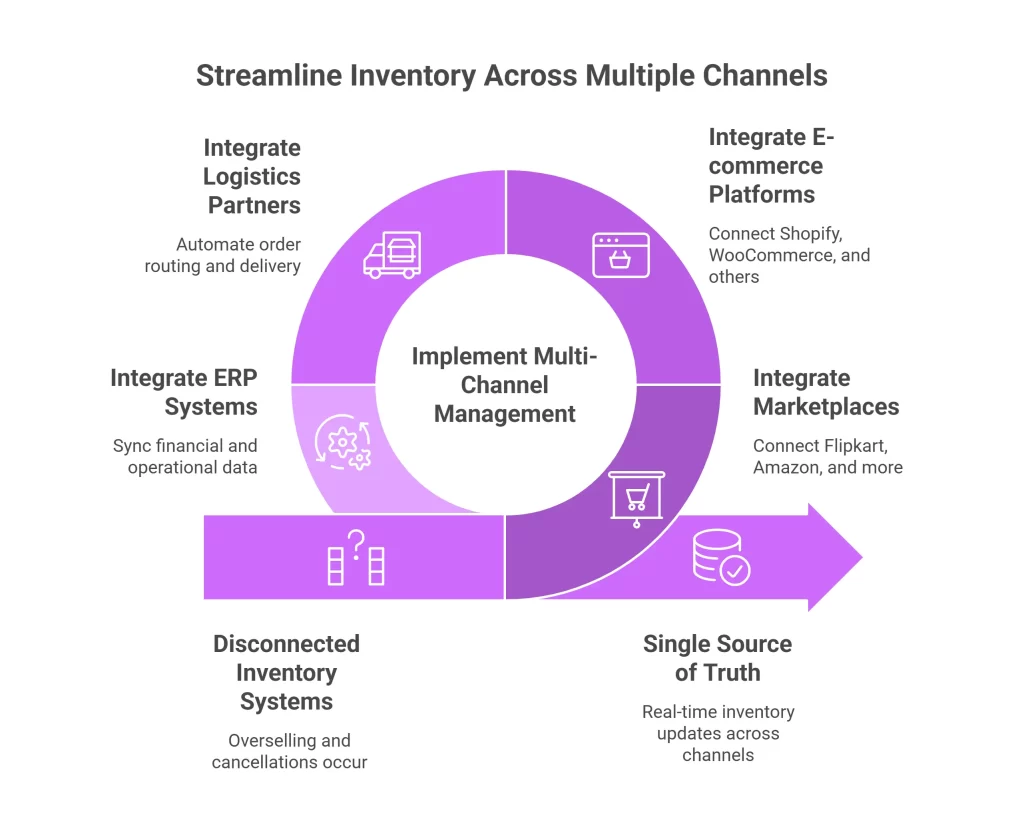
The goal is a single source of truth for your inventory, no matter where the sale happens or which warehouse fulfills it.
Step 6: Demand Forecasting and Inventory Allocation
Once your multi-warehouse setup is running, the next challenge is stocking the right products at the right locations. This is where demand forecasting per location and smart inventory allocation strategy come into play.
Here’s how to approach it:
- Analyze historical sales data by region and warehouse to identify demand patterns
- Set inventory reorder points by warehouse based on local demand velocity and transfer lead times
- Allocate safety stock strategically. High-demand warehouses need more buffer stock than low-volume ones
- Use demand-driven replenishment to automatically trigger stock transfers or purchase orders when levels drop below thresholds
- Plan for seasonality. Festive seasons like Diwali and regional events create demand spikes that vary by location
The smarter your allocation, the lower your inventory carrying costs and the fewer stockouts you’ll experience. Omneelab’s article on demand-driven replenishment dives deeper into these strategies.
Key Features to Look for in Multi-Warehouse Management Software
Not all inventory software is built for multi-location operations. When evaluating multiple warehouse management software in India, prioritize these features:
| Feature | Why It Matters |
|---|---|
| Real-time multi-location dashboard | See stock levels across all warehouses at a glance |
| Inter-warehouse transfer management | Move stock between locations with proper documentation |
| Automated reorder points per location | Prevent stockouts without manual monitoring |
| Barcode/RFID scanning support | Ensure accuracy during receiving, picking, and transfers |
| Marketplace and e-commerce integrations | Sync inventory across all sales channels automatically |
| Order routing and splitting | Route orders to the nearest or best-stocked warehouse |
| GST and e-way bill compliance | Stay compliant with Indian tax regulations |
| Role-based access control | Give each warehouse team access only to their location’s data |
| Reporting and analytics | Track performance metrics like inventory turnover by location |
| Cloud-based access | Manage operations from anywhere, on any device |
Common Challenges in Multi-Warehouse Management (And How to Solve Them)
Let’s be honest. Running multiple warehouses isn’t easy. Here are the most common challenges and practical solutions:
1. Inventory Discrepancies Across Locations When stock counts don’t match between your system and physical shelves, chaos follows. Solution: Implement cycle counting at each location and use barcode scanning for every inventory movement to maintain accuracy.
2. Stockouts at One Location, Overstocking at Another This is the classic imbalance problem. Solution: Use a WMS with automated inventory updates and demand-based allocation to distribute stock proportionally across locations.
3. Slow Inter-Warehouse Transfers Moving stock between warehouses takes time, and delays can mean missed sales. Solution: Set up proactive replenishment triggers based on inventory reorder points by warehouse rather than waiting until stock runs out.
4. GST Compliance Complexity Managing e-way bills, delivery challans, and tax invoices for every stock transfer is tedious. Solution: Choose a WMS that automates GST documentation for inter-warehouse movements.
5. Lack of Visibility If you can’t see what’s happening across all locations in real time, you can’t make good decisions. Solution: Invest in a centralized inventory management platform with a unified dashboard and real-time sync.
6. Coordination Between Teams Different warehouse teams may follow different processes, leading to inconsistencies. Solution: Create standardized SOPs for inventory management and ensure all locations use the same WMS with consistent workflows.
Multi-Warehouse Management for E-Commerce Sellers in India
For e-commerce sellers, multi-warehouse order fulfillment in India is practically a requirement for scaling. Here’s why:
- Amazon FBA and Flipkart Fulfillment require you to send inventory to multiple fulfillment centers across India. Without a system to track what’s where, you’ll lose control fast.
- D2C brands selling through their own Shopify or WooCommerce stores need to route orders to the nearest warehouse for faster delivery and lower shipping costs.
- Omnichannel sellers managing both online and offline channels need inventory synchronization across warehouses to prevent overselling.
The key to success? A multi-warehouse WMS that integrates with every platform you sell on and every logistics partner you ship with. This gives you a single view of inventory across all channels and locations, enabling smarter order routing and splitting based on stock availability and customer proximity.
How Omneelab WMS Simplifies Multi-Warehouse Inventory Management
If you’ve been nodding along to the challenges described above, you’re not alone. This is exactly why Omneelab built its WMS with multi-warehouse operations at its core.
Here’s what makes Omneelab different:
- Unified dashboard for real-time visibility across all your warehouse locations
- Seamless inter-warehouse transfers with automated documentation and GST compliance
- Deep marketplace integrations with Flipkart, Amazon, Meesho, Myntra, Shopify, WooCommerce, and more
- Barcode and RFID support for accurate, paperless warehouse operations
- Smart order routing that automatically assigns orders to the optimal warehouse
- Demand-driven replenishment alerts to keep every location properly stocked
- Cloud-based architecture so your team can manage operations from anywhere in India
Whether you’re a growing D2C brand, a marketplace seller, or a 3PL provider, Omneelab’s WMS gives you the tools to manage inventory across locations without the complexity.
Ready to simplify your multi-warehouse operations? Book a free demo with Omneelab and see how our WMS can transform your inventory management.
Frequently Asked Questions (FAQs)
Multi-warehouse inventory management is the process of tracking and transferring stock across two or more warehouse locations. For Indian businesses, it reduces shipping costs, enables faster regional deliveries, and helps meet marketplace fulfillment requirements across India’s vast geography.
A WMS provides a centralized dashboard to view stock levels at every location in real time, automates inventory synchronization, and manages inter-warehouse transfers with proper documentation. It integrates with e-commerce platforms to eliminate guesswork from multi-location operations.
Yes. When goods valued above ₹50,000 are moved between warehouses across state borders, an e-way bill must be generated under GST regulations. Even transfers between your own warehouses require proper invoicing, and a good WMS automates this compliance process.
In centralized management, all stock decisions are controlled from a single unified system, providing visibility across locations. In decentralized management, each warehouse operates independently. Most Indian businesses benefit from a hybrid approach using a cloud-based WMS.
Cloud-based WMS solutions like Omneelab offer subscription-based pricing and quick implementation, making multi-warehouse management accessible without heavy upfront investment. You can start with two locations and scale as you grow, paying only for what you use.

Kapil Pathak is a Senior Digital Marketing Executive with over four years of experience specializing in the logistics and supply chain industry. His expertise spans digital strategy, search engine optimization (SEO), search engine marketing (SEM), and multi-channel campaign management. He has a proven track record of developing initiatives that increase brand visibility, generate qualified leads, and drive growth for D2C & B2B technology companies.