India’s quick commerce revolution isn’t slowing down anytime soon. What started as a bold experiment in 10-minute grocery delivery has now become one of the fastest-growing segments in Indian retail. Platforms like Blinkit, Zepto, and Swiggy Instamart are racing to open hundreds of dark stores across metros and tier-2 cities. And at the heart of this hyper-speed fulfillment model lies dark store management with WMS in India, the combination that’s making ultra-fast delivery possible at scale.
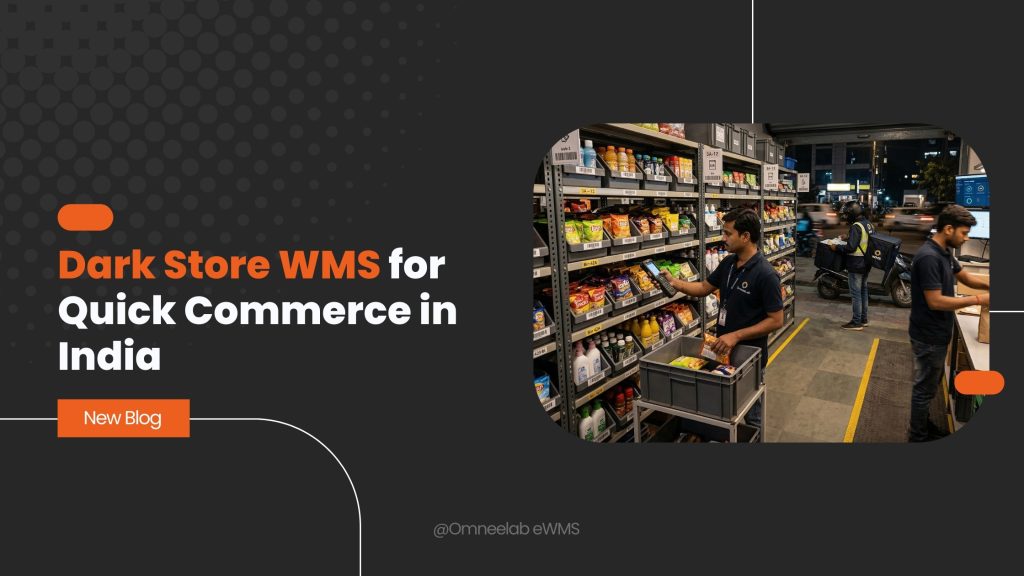
If you’re a logistics operator, D2C brand, or quick commerce seller trying to figure out how dark store management with WMS in India actually works, you’re in the right place. This playbook breaks down everything from what dark stores are, to how a WMS transforms their operations, to the challenges you’ll face and the tech stack you’ll need. Let’s dive in.
What Is a Dark Store and How Does It Work in Quick Commerce?
A dark store is essentially a mini-warehouse designed exclusively for online order fulfillment. Unlike a regular retail store, no customers walk in. There are no display shelves, no billing counters, and no window shoppers. Instead, every square foot is optimized for one thing: getting orders picked, packed, and dispatched as fast as humanly (and technologically) possible.
Think of it as an urban micro-warehouse strategically placed close to residential clusters. The typical dark store in India ranges from 2,000 to 4,000 square feet and stocks anywhere between 2,000 to 5,000 SKUs, mostly everyday essentials like groceries, personal care items, snacks, and beverages.Here’s how dark store management with WMS in India typically flows:
- A customer places an order on a q-commerce app.
- The WMS routes the order to the nearest dark store using AI-powered order routing optimization.
- A picker inside the dark store receives a WMS-generated pick list and locates items rapidly.
- The order is packed and handed to a delivery rider.
- The rider delivers it to the customer’s doorstep, often within 10 to 20 minutes.
The entire process, from tap to doorstep, relies heavily on real-time inventory visibility and a WMS that keeps every moving part synchronized.
The Quick Commerce Landscape in India (2026)
Quick commerce in India has evolved from a niche convenience into a mainstream shopping habit. The market has grown exponentially, with major players aggressively expanding their hyperlocal fulfillment networks. This growth is exactly why dark store management with WMS in India has become a top priority for logistics leaders.
Here’s a snapshot of the key players and their dark store strategies:
- Blinkit (by Zomato): Operating over 600 dark stores across Indian cities, Blinkit has been the most aggressive in scaling its network.
- Zepto: Known for its 10-minute delivery promise, Zepto has expanded rapidly with a strong focus on demand forecasting and warehouse efficiency.
- Swiggy Instamart: Leveraging Swiggy’s existing delivery fleet, Instamart has built a dense network of dark stores in major metros.
- Flipkart Minutes: Flipkart has entered the quick commerce race by launching dark stores dedicated to ultra-fast delivery.
- Reliance Retail: With its massive retail footprint, Reliance is converting existing store locations into dark store hubs for quick commerce.
- BigBasket (by Tata): A pioneer in online grocery, BigBasket continues to refine its dark store model for faster fulfillment.
What’s particularly interesting is the push into tier-2 city quick commerce. Cities like Jaipur, Lucknow, Chandigarh, and Coimbatore are now seeing dark store openings, signaling that this isn’t just a metro phenomenon anymore.
The bottom line? If you’re in the supply chain or e-commerce space in India, understanding quick commerce dark store operations isn’t optional. It’s essential.
Dark Store vs. Traditional Warehouse: What’s Different?
Before we get into the WMS side of things, it helps to understand why dark stores can’t simply run on traditional warehouse processes.
| Parameter | Traditional Warehouse | Dark Store |
|---|---|---|
| Size | 10,000–100,000+ sq. ft. | 2,000–4,000 sq. ft. |
| SKU Count | 10,000–50,000+ | 2,000–5,000 |
| Location | Industrial areas, outskirts | Residential neighborhoods, city centers |
| Order Volume | Bulk/B2B shipments | High-frequency, small-basket B2C orders |
| Delivery SLA | 1–7 days | 10–30 minutes |
| Picking Method | Wave/batch picking | Single-order rapid picking |
| Customer Access | None | None (both are closed to public) |
The key takeaway? Dark stores operate under extreme time pressure with very little margin for error. A traditional WMS designed for bulk fulfillment simply won’t cut it. You need a system built for speed, precision, and real-time decision-making.
How Does a WMS Help Manage Dark Store Operations?
This is where things get exciting. A quick commerce warehouse management system isn’t just a digital inventory ledger. It’s the brain of the entire dark store operation. Here’s how:6 Ways WMS Powers Dark Store Management in India
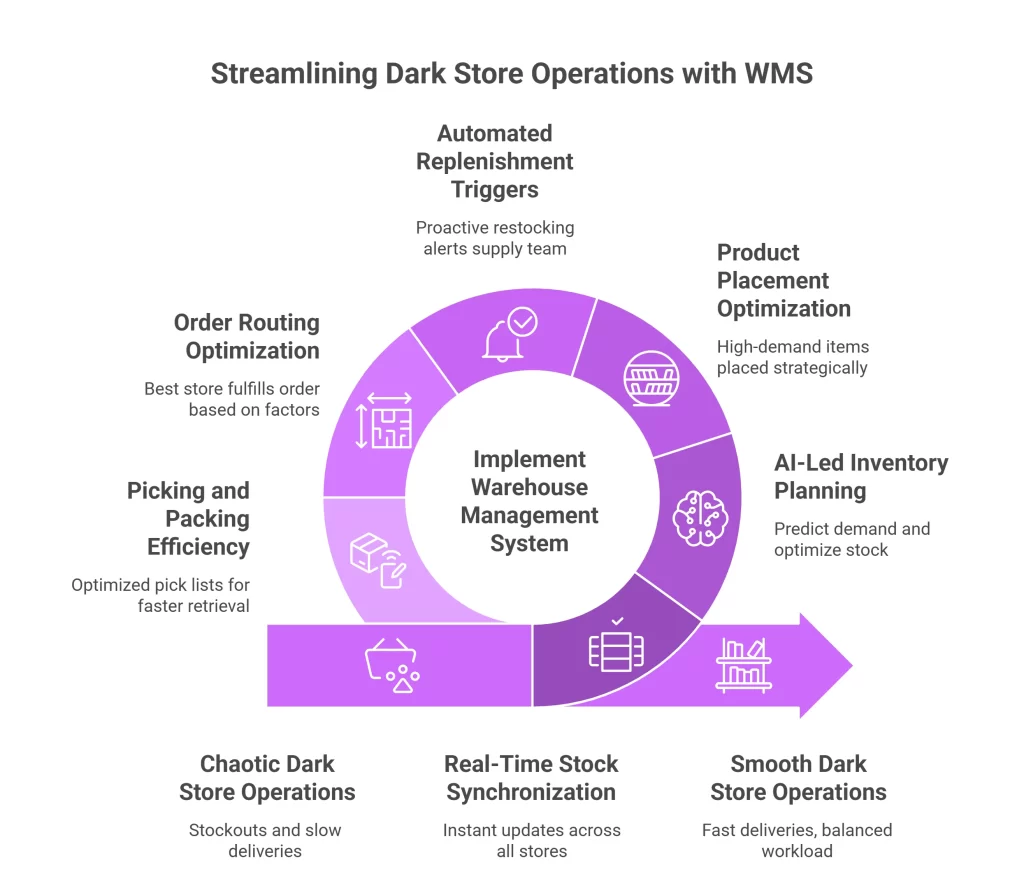
This is where things get exciting. A quick commerce warehouse management system isn’t just a digital inventory ledger. It’s the brain of the entire dark store operation. Here’s how WMS transforms dark store management in India across six critical areas:
1. Real-Time Inventory Tracking and Visibility
In a dark store, you can’t afford to have a customer order something that’s already out of stock. A WMS provides real-time stock synchronization across every dark store in your network. The moment an item is picked, the inventory count updates instantly. This level of real-time inventory visibility is what separates a smooth operation from a chaotic one.
2. AI-Led Inventory Planning and Demand Forecasting
Smart WMS platforms use AI-led inventory planning to predict what products will sell, when, and in which locations. For example, demand for ice cream spikes on hot afternoons in Mumbai, while instant noodle sales surge during late-night hours in Bangalore. Demand forecasting in dark stores helps maintain optimal stock levels and can reduce stockout risk by up to 35%.
3. Product Placement and Slotting Optimization
In a 3,000 sq. ft. dark store, every second counts during picking. A WMS tracks the rate of sale for each product and optimizes its placement within the store. High-demand items are placed at eye level and near the packing station. This product placement optimization directly impacts picking speed and delivery time.
4. Automated Replenishment Triggers
Running out of stock in a dark store is a revenue killer. A WMS sets up automated replenishment triggers that alert the supply team when inventory for a specific SKU drops below a predefined threshold. This ensures restocking cycles are proactive rather than reactive.
5. Order Routing and Fulfillment
When a customer places an order, the WMS determines which dark store is best positioned to fulfill it based on proximity, stock availability, and current workload. This order routing optimization ensures faster delivery and balanced load distribution across the network.
6. Picking and Packing Efficiency
The dark store picking and packing process is fundamentally different from traditional warehousing. Orders are small (typically 3 to 8 items), and pickers need to locate and collect items within 60 to 90 seconds. A WMS generates optimized pick lists, often displayed on handheld devices, guiding pickers through the most efficient route inside the store. For more on this, check out our guide on paperless picking in modern warehouses.
Key Challenges of Managing Dark Stores in India
Running a dark store sounds straightforward on paper, but the reality is far more complex. Even with a solid WMS, here are the biggest hurdles that dark store management in India presents:
Stockouts and Overstocking
With limited storage space and high order velocity, getting SKU management in dark stores right is a constant balancing act. Too much stock wastes precious space. Too little means lost orders and unhappy customers. This is where stockout prevention through WMS-driven forecasting becomes non-negotiable.
Space Constraints
Dark stores operate in compact urban locations where real estate is expensive. Every shelf, every bin, and every aisle needs to be utilized with surgical precision. A WMS helps maximize storage density through intelligent slotting and layout recommendations.
Demand Variability
Consumer demand in quick commerce is wildly unpredictable. A viral social media post can spike demand for a specific product overnight. Festivals, weather changes, and even cricket matches influence buying patterns. Without robust quick commerce inventory tracking, operators are essentially flying blind.
Perishable Inventory Management
A significant portion of dark store inventory consists of perishable goods like fruits, vegetables, dairy, and bakery items. Managing shelf life, ensuring FIFO (First In, First Out) compliance, and minimizing waste requires specialized WMS capabilities. Our detailed guide on managing perishable inventory covers this in depth.
Returns and RTO Management
While return rates in quick commerce are lower than in fashion e-commerce, they still exist. Damaged items, wrong deliveries, and customer refusals all contribute to return to origin (RTO) volumes. A WMS integrated with reverse logistics and returns management workflows helps process returns efficiently without disrupting ongoing operations.
Delivery SLA Compliance
The entire value proposition of quick commerce rests on speed. Missing a 10-minute delivery window even occasionally can erode customer trust. Effective dark store management with WMS in India ensures that the warehouse side of the equation, picking, packing, and dispatch, happens within the allocated time, typically under 3 minutes.
The Technology Stack Behind WMS-Powered Dark Store Management in India
A dark store isn’t just shelves and delivery riders. It’s a technology-driven operation where the WMS sits at the center. Here’s the typical tech stack enabling efficient dark store management in India:
- Warehouse Management System (WMS): The central nervous system managing inventory, orders, picking, and dispatch.
- Barcode and RFID Scanning: For rapid item identification and inventory tracking using barcode technology. Learn more about barcode vs. RFID for warehouse management.
- AI and Machine Learning: Powers demand forecasting, dynamic slotting, and order routing.
- IoT Sensors: Monitor temperature for cold chain items, track equipment usage, and ensure environmental compliance.
- Delivery Fleet Management Software: Coordinates rider allocation, route optimization, and real-time tracking.
- Real-Time Dashboards: Provide KPIs and performance metrics for store managers to monitor throughput, accuracy, and SLA compliance.
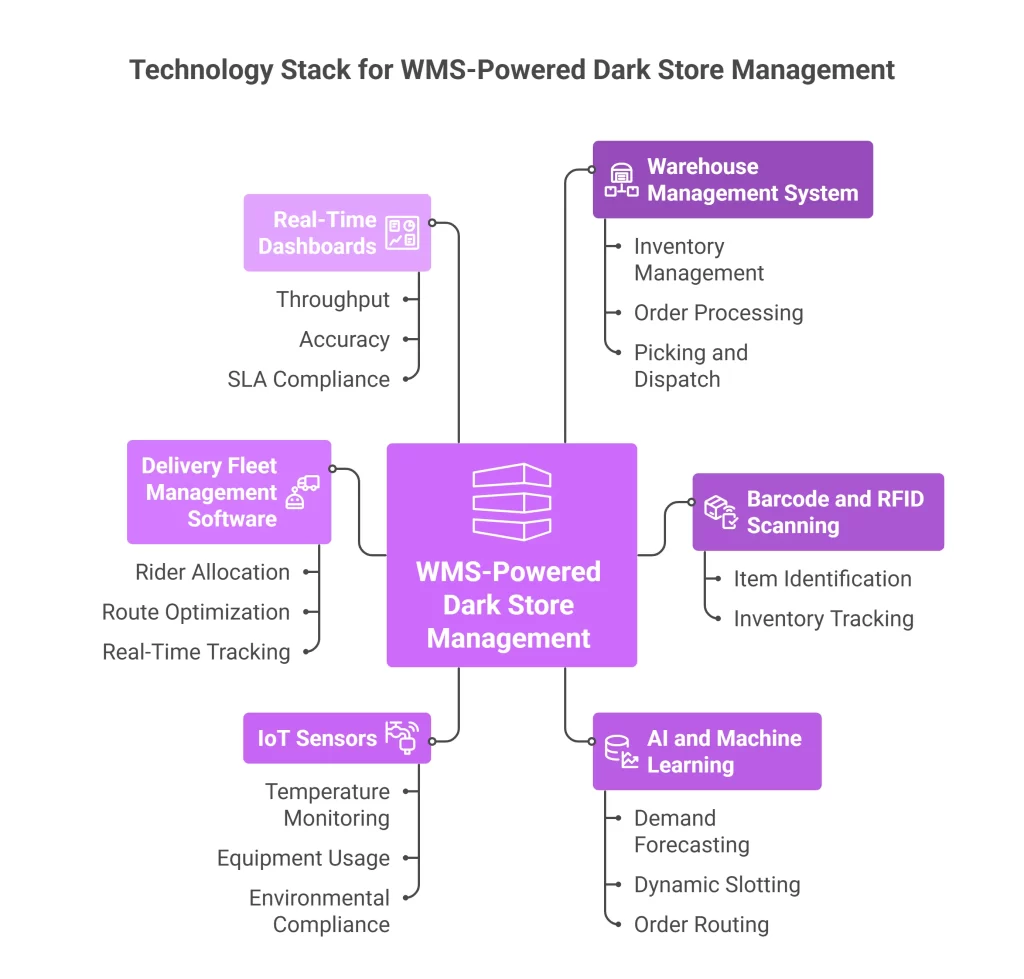
The integration between these systems is what enables the seemingly magical experience of ordering something and having it at your door before your coffee gets cold.
Can Small Businesses Adopt Dark Store Management with WMS in India?
Absolutely. You don’t need to be Blinkit or Zepto to benefit from the dark store approach. Many D2C brands and regional sellers are setting up micro-fulfillment centers in key cities to offer same-day or next-hour delivery.The key enabler? An affordable, cloud-based WMS for quick commerce sellers in India that doesn’t require massive upfront investment. Modern WMS platforms like OmneeLab are designed to be scalable for small businesses, offering features like real-time inventory sync, barcode scanning, automated replenishment, and marketplace integrations, all without the complexity of enterprise-grade systems.If you’re selling on platforms like Flipkart, Meesho, or even ONDC, a WMS-powered dark store (or even a dark-store-style back room) can dramatically improve your fulfillment speed and customer satisfaction.
The Future of Dark Store Management with WMS in India
Quick commerce is no longer an experiment. It’s becoming one of the key pillars in India’s evolving retail landscape. Here’s what the future holds for dark store management with WMS in India:
- Expansion beyond groceries: Categories like electronics, beauty, pharmacy, and pet care are increasingly being fulfilled through dark stores.
- Tier-2 and tier-3 city penetration: As infrastructure improves and consumer habits shift, dark stores will spread well beyond metros.
- Smarter WMS platforms: Expect deeper AI integration, predictive analytics, and autonomous decision-making within WMS systems.
- Sustainability focus: Optimized routing, reduced waste through better forecasting, and eco-friendly packaging will become competitive differentiators.
- Consolidation and partnerships: Smaller players may partner with established WMS providers to compete with well-funded platforms, making scalable quick commerce operations accessible to all.
The businesses that invest in the right technology stack today, especially a capable dark store operations management software, will be the ones leading this space tomorrow.
Ready to Power Your Dark Store with Smart WMS?
The quick commerce wave in India is only getting bigger, and the businesses that thrive will be the ones with the smartest warehouse operations. Whether you’re running a single dark store or managing a network across multiple cities, OmneeLab’s AI-powered WMS gives you the real-time visibility, automated workflows, and intelligent insights you need to stay ahead.
Explore Omneelab’s WMS Solutions → and discover how you can transform your dark store operations from reactive to predictive.
Frequently Asked Questions (FAQs)
A dark store is a standalone facility built only for online order fulfillment, while a micro-fulfillment center can operate within an existing retail store. Both enable hyperlocal delivery, but dark stores are purpose-built for quick commerce speed.
A WMS analyzes historical sales data, seasonal trends, and local events to predict SKU demand and set automated replenishment triggers. This approach can reduce stockout risk by up to 35%, ensuring consistent delivery SLA compliance.
Barcode and RFID scanning enable rapid, error-free item identification during picking and packing. Connected to the WMS, handheld scanners ensure real-time stock synchronization and reduce returns caused by wrong items.
It combines strategic dark store placement near residential areas, AI-powered order routing, and WMS-optimized pick paths. The warehouse process from order receipt to dispatch typically takes under 3 minutes, leaving the rest for last-mile delivery.
Yes. Cloud-based WMS platforms like Omneelab make dark-store-style fulfillment accessible without heavy upfront investment. By improving inventory turnover, reducing stockouts, and enabling faster delivery, small businesses achieve better unit economics and customer retention.

Kapil Pathak is a Senior Digital Marketing Executive with over four years of experience specializing in the logistics and supply chain industry. His expertise spans digital strategy, search engine optimization (SEO), search engine marketing (SEM), and multi-channel campaign management. He has a proven track record of developing initiatives that increase brand visibility, generate qualified leads, and drive growth for D2C & B2B technology companies.