Picture this. It’s October, the festive season is in full swing, and your warehouse is drowning in orders. Your team is scrambling, stockouts are piling up, and customers are furious about late deliveries. Now imagine a different scenario where AI in warehouse management predicted this demand surge three weeks ago. Inventory was pre-positioned. Picking routes were optimized. Workers knew exactly what to do, and when.
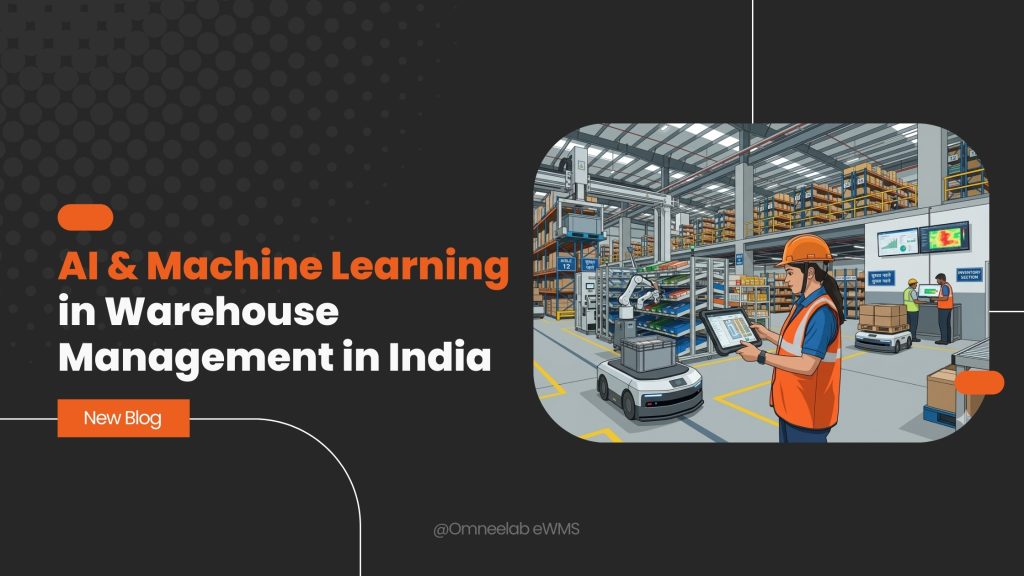
That’s not science fiction. That’s the power of AI and machine learning in warehouse management in 2026. Indian businesses are at a turning point. The e-commerce boom, the rise of quick commerce, and expanding D2C brands have made traditional warehouse operations painfully inadequate. If your warehouse still runs on spreadsheets, gut feelings, and rigid rule-based software, you’re leaving money on the table.
In this guide, we’ll break down exactly how artificial intelligence in warehousing works, why it matters for Indian businesses right now, the top use cases you can implement today, and how to get started without breaking the bank. Let’s dive in.
What Is AI-Powered Warehouse Management?
At its core, AI-powered warehouse management refers to the use of machine learning, computer vision, and predictive analytics to enhance visibility, precision, and decision-making across every warehouse operation. Instead of following static, pre-programmed rules, an intelligent warehouse management system learns from your data and gets smarter over time.
Think of it this way: a traditional WMS is like a recipe book. It follows fixed instructions. An AI-powered WMS is like a chef who learns your customers’ preferences, adjusts recipes based on what’s available, and anticipates what they’ll order tomorrow.
How AI Differs from Traditional Rule-Based WMS
A traditional WMS operates on “if-this-then-that” logic. If stock drops below 50 units, reorder. If an order comes in, assign it to the nearest picker. These rules work, but they don’t adapt.
Machine learning in warehouse management changes the game. ML algorithms analyze historical sales data, market trends, seasonality, and even external factors like weather patterns to make dynamic decisions. The system doesn’t just react. It predicts, adapts, and continuously improves.
For example, instead of a fixed reorder point, an AI system might recognize that demand for a particular SKU spikes every Thursday because of a recurring promotional campaign, and adjust replenishment triggers accordingly.
Key AI & ML Technologies Used in Warehousing
Several AI technologies are converging to transform warehouse operations in India:
- Predictive Analytics: Forecasting demand, identifying slow-moving stock, and optimizing inventory turnover
- Computer Vision: Automated quality inspection, barcode-free item identification, and damage detection during receiving
- Natural Language Processing (NLP): Voice-directed picking and conversational interfaces for warehouse workers
- Deep Learning: Pattern recognition for anomaly detection, shrinkage prevention, and complex demand sensing
- Reinforcement Learning: Optimizing slotting strategies and picking routes through trial-and-error learning
Why Indian Businesses Need AI in Warehousing in 2026
India’s warehousing landscape has changed dramatically. What worked five years ago simply doesn’t cut it anymore. Here’s why AI warehouse management India has become essential.
The E-Commerce & Quick Commerce Explosion
India’s e-commerce market continues its explosive growth trajectory. Platforms like Flipkart, Amazon India, Meesho, and newer quick commerce players like Zepto and Blinkit have fundamentally changed customer expectations. Dark stores need to fulfill orders in minutes, not days. Without AI-driven demand sensing and intelligent slotting, meeting these timelines is nearly impossible.
Rising Customer Expectations & Same-Day Delivery
Your customers don’t care about your warehouse challenges. They want their orders fast, accurate, and damage-free. AI-based order fulfillment helps warehouses predict busy periods and stay organized before orders even arrive, dramatically improving SLA compliance and order accuracy rates.
Labor Challenges & Cost Pressures
Finding and retaining skilled warehouse workers in India remains a persistent challenge, especially in Tier-2 and Tier-3 cities. AI-driven workforce planning helps optimize shift scheduling, balance workloads, and ensure that the right number of workers are deployed at the right time, reducing both overtime costs and idle time.
Tier-2/Tier-3 Expansion & Infrastructure Gaps
As D2C brands and e-commerce companies expand beyond metros, they encounter warehouses with limited infrastructure and connectivity. Cloud-based, SaaS WMS platforms with built-in AI capabilities allow even smaller facilities to access intelligent warehouse management without massive upfront investment.
Top AI & Machine Learning Use Cases in Warehouse Management
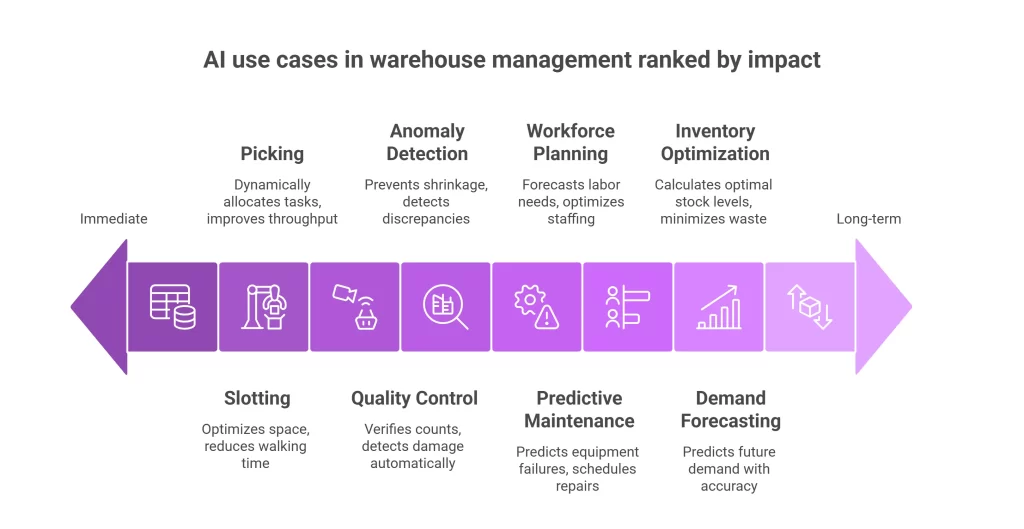
Let’s get practical. Here are the eight most impactful AI use cases in WMS that Indian businesses can leverage right now.
1. Demand Forecasting & Predictive Analytics
This is arguably the highest-impact application. ML algorithms analyze historical sales data, promotional calendars, market trends, festive season patterns, and even economic indicators to predict future demand with remarkable accuracy.
Instead of relying on last year’s numbers and hoping for the best, demand-driven replenishment powered by AI ensures you stock the right products in the right quantities at the right time. No more overstocking slow movers or running out of bestsellers during Diwali.
2. Intelligent Inventory Optimization & Replenishment
AI doesn’t just forecast demand. It translates those forecasts into actionable inventory decisions. Machine learning inventory optimization algorithms continuously calculate optimal reorder points, safety stock levels, and buffer stock requirements based on real-time data.
For FMCG companies dealing with perishable goods, this is especially critical. AI can factor in shelf life, batch-level traceability, and expiry dates to minimize waste while maintaining inventory visibility.
3. AI-Powered Slotting & Space Utilization
Here’s a use case that delivers immediate ROI. AI tools analyze order patterns and product velocity to optimize slotting, ensuring the most popular items are placed nearest to the packing station. This reduces walking time, speeds up fulfillment, and maximizes warehouse space utilization.
A warehouse that previously required workers to walk 8-10 kilometers per shift can cut that distance significantly through intelligent slotting alone.
4. Smart Order Picking & Dynamic Task Allocation
Traditional picking follows fixed routes and static assignments. AI-powered WMS platforms use dynamic task allocation to assign real-time tasks to workers based on their location, current workload, skill level, and order priority.
Combined with paperless picking systems, this dramatically improves warehouse throughput and reduces errors. The system learns which workers perform best at which tasks and optimizes assignments accordingly.
5. Computer Vision for Quality Control & Counting
Computer vision in warehouse management allows AI to “see” and monitor operations. Cameras and sensors can automatically verify item counts during receiving, detect damaged packaging, and confirm that the correct items are being picked, all without manual intervention.
This technology pairs powerfully with barcode and RFID systems to create multiple layers of accuracy verification.
6. Predictive Maintenance for Warehouse Equipment
Conveyor belts, forklifts, sorting systems: when warehouse equipment breaks down unexpectedly, operations grind to a halt. AI monitors equipment performance data and predicts failures before they happen, allowing maintenance teams to schedule repairs during off-peak hours.
7. AI-Driven Workforce Planning & Scheduling
ML algorithms analyze order volume patterns, seasonal trends, and historical productivity data to forecast labor requirements. This means you’re not overstaffed on slow days or understaffed during peak periods. For 3PL warehouses managing multiple clients, this capability is invaluable.
8. Anomaly Detection for Inventory Shrinkage Prevention
Inventory shrinkage costs Indian businesses crores every year. AI excels at detecting unusual patterns, like unexpected stock discrepancies, abnormal picking patterns, or suspicious timing of inventory movements, that might indicate theft, damage, or process errors.
How AI Works Inside a Modern WMS
You might be wondering: how does AI actually function within a warehouse management system? It’s simpler than you think.
Learning from Operational Data
AI works inside your WMS by learning from the operational data that flows through your integrated systems every day. Every order processed, every item picked, every delivery completed generates data. ML models analyze this data to identify patterns, correlations, and opportunities that humans simply can’t spot at scale.
Integrating Signals from Multiple Sources
A truly intelligent WMS doesn’t operate in isolation. It pulls signals from your ERP system, e-commerce platforms, shipping partners, IoT sensors, and even external data sources. The more data points the AI has, the better its predictions become.
Continuous Improvement Through ML Model Refinement
Unlike static software, AI-powered systems get better with time. Every prediction is compared against actual outcomes, and the models are refined continuously. After a few months of operation, the system understands your specific warehouse dynamics better than any human analyst could.
Traditional WMS vs. AI-Powered WMS: A Detailed Comparison
| Parameter | Traditional WMS | AI-Powered WMS |
|---|---|---|
| Decision Making | Rule-based, static | Data-driven, dynamic |
| Demand Forecasting | Manual or basic formulas | ML-powered predictive analytics |
| Slotting | Fixed, periodic review | Continuous, AI-optimized |
| Task Assignment | Sequential, zone-based | Dynamic, real-time allocation |
| Inventory Optimization | Fixed reorder points | Adaptive, demand-sensing |
| Error Detection | Post-event reporting | Real-time anomaly detection |
| Learning Ability | None, requires manual updates | Self-improving over time |
| Scalability | Limited by rule complexity | Scales with data volume |
| Cost Structure | Lower upfront, higher long-term | Higher initial, lower operational |
| Best For | Small, simple operations | Growing, complex, multi-channel |
Real-World Impact: AI in Indian Warehousing
How AI-Powered Slotting Saves Hours Daily
Consider a mid-sized e-commerce fulfillment warehouse in Bangalore processing 5,000 orders daily. Before AI-powered slotting, pickers walked an average of 12 kilometers per shift. After implementing intelligent slotting that continuously repositions fast-moving SKUs closer to packing stations, walking distance dropped by 35%, and daily throughput increased by 25%.
Predictive Demand Planning for Festive Season Surges
An FMCG distributor in Mumbai used to over-order by 40% before every festive season “just in case.” With ML-powered demand forecasting analyzing three years of historical data, promotional calendars, and market signals, they reduced excess inventory by 30% while actually improving their fill rate. That’s the power of predictive analytics in warehousing.
How OmneeLab Brings AI to Indian Warehouses
OmneeLab’s AI-powered WMS is purpose-built for Indian businesses. From intelligent slotting and demand sensing to real-time warehouse KPI dashboards and seamless integration with platforms like Flipkart, Shopify, and ONDC, OmneeLab makes cognitive warehouse management accessible to businesses of all sizes.
Challenges of Implementing AI in Indian Warehouses
Let’s be honest. AI isn’t a magic wand. Here are the real challenges Indian businesses face.
Data Quality & Availability
AI is only as good as the data it learns from. Many Indian warehouses still have inconsistent data, manual entry errors, and siloed systems. Before implementing AI, you need clean, structured, and connected data.
Infrastructure & Connectivity Gaps
Warehouses in Tier-2 and Tier-3 cities often struggle with unreliable internet connectivity. Cloud-based AI systems need stable connections, though edge computing solutions are increasingly bridging this gap.
Cost of Implementation for SMEs
While enterprise-grade AI solutions can be expensive, the rise of SaaS-based AI-powered WMS platforms has made the technology far more accessible. Small businesses can now access AI capabilities through affordable monthly subscriptions.
Change Management & Workforce Upskilling
Introducing AI into a warehouse isn’t just a technology project. It’s a people project. Workers need training, managers need to trust the system’s recommendations, and processes need to be redesigned. This cultural shift often takes longer than the technical implementation.
Integration with Legacy Systems
Many Indian businesses run on legacy ERP systems or custom-built software. Ensuring seamless WMS-ERP integration with AI capabilities requires careful planning and the right integration approach.
How to Get Started with AI in Your Warehouse
Ready to take the leap? Here’s a practical, step-by-step approach.
Step 1: Audit Your Current WMS & Data Readiness. Assess what data you’re currently collecting, its quality, and where the gaps are. Ensure your barcode or RFID systems are generating clean, consistent data.
Step 2: Identify High-Impact AI Use Cases. Don’t try to implement everything at once. Start with the use case that addresses your biggest pain point, whether that’s demand forecasting, slotting optimization, or inventory shrinkage detection.
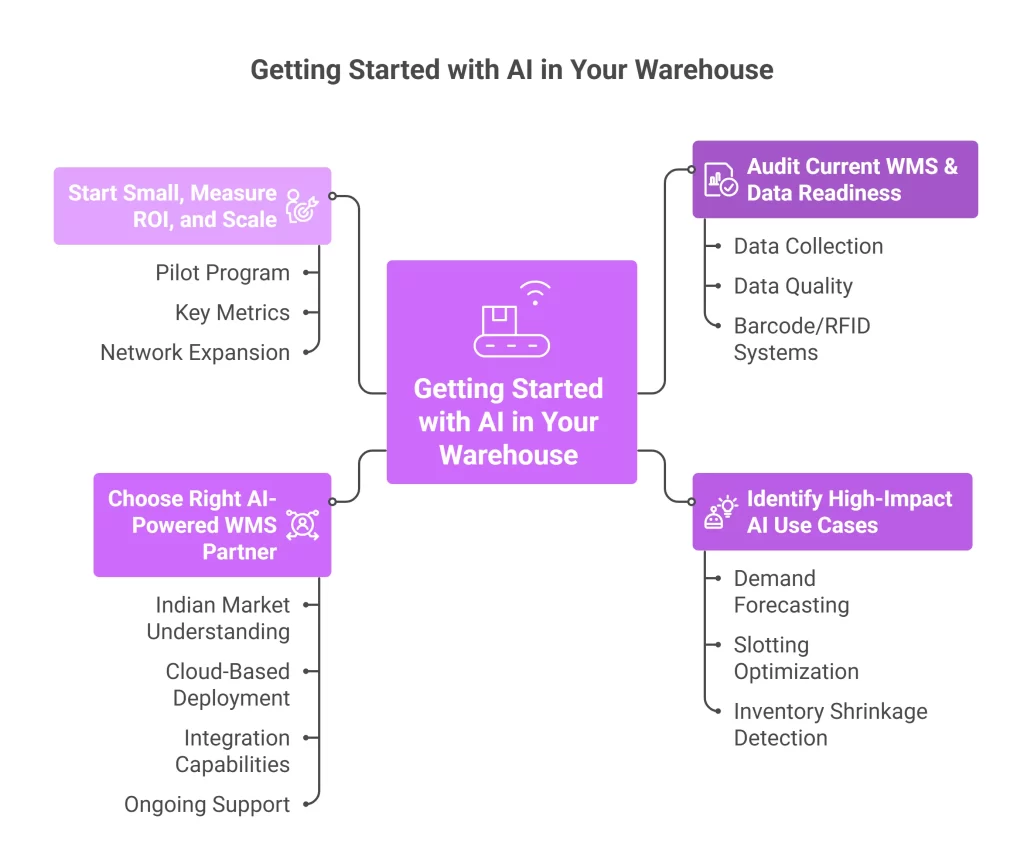
Step 3: Choose the Right AI-Powered WMS Partner. Look for a partner that understands the Indian market, offers cloud-based deployment, integrates with your existing e-commerce platforms and logistics partners, and provides ongoing support.
Step 4: Start Small, Measure ROI, and Scale. Pilot the AI solution in one warehouse or one product category. Track key metrics like order accuracy, fulfillment speed, and cost per order. Once you see results, scale across your network.
The Future Beyond 2026: What’s Next?
The AI journey in warehousing is just beginning. Here’s what’s on the horizon.
Digital Twins for Warehouse Simulation will allow businesses to create virtual replicas of their warehouses, testing layout changes, process modifications, and demand scenarios before implementing them in the real world.
Generative AI in Supply Chain Planning will move beyond prediction to prescription, automatically generating optimal supply chain strategies and even drafting SOPs for inventory management.
Edge Computing & Real-Time Decision Making will bring AI processing directly to the warehouse floor, enabling split-second decisions even without cloud connectivity, a huge advantage for Indian warehouses with inconsistent internet.
Fully Autonomous Dark Stores & Micro-Fulfillment Centers will combine AI-powered WMS with advanced automation to create facilities that operate with minimal human intervention, particularly for quick commerce fulfillment.
Final Thoughts
AI and machine learning in warehouse management aren’t futuristic concepts anymore. They’re practical, accessible tools that Indian businesses of all sizes can leverage today. Whether you’re a D2C brand shipping from a single warehouse, a 3PL provider managing multiple clients, or a pharmaceutical company with strict compliance requirements, AI-powered WMS can help you work smarter, faster, and more profitably.
The question isn’t whether you should adopt AI in your warehouse. It’s how quickly you can get started.
Ready to explore how AI can transform your warehouse operations? Discover OmneeLab’s AI-powered WMS and see the difference intelligent warehouse management can make for your business.
FAQs
AI uses machine learning, computer vision, and predictive analytics to improve demand forecasting, slotting, task allocation, and inventory accuracy. It makes warehouse operations faster, smarter, and more cost-efficient.
Yes. Cloud-based SaaS WMS platforms now offer AI features like demand sensing and smart slotting through affordable monthly subscriptions, eliminating the need for large upfront investments.
No. AI augments human workers by assigning real-time tasks, optimizing routes, and reducing manual errors. The goal is to help people work smarter, not replace them.
Businesses typically see 15-30% better order accuracy, 20-35% faster picking, and 25-40% improved demand forecasting. Most companies achieve positive ROI within 6-12 months.
A traditional WMS follows fixed rules and needs manual updates. An AI-powered WMS learns from operational data, adapts to changing patterns, and continuously improves its decisions over time.

Kapil Pathak is a Senior Digital Marketing Executive with over four years of experience specializing in the logistics and supply chain industry. His expertise spans digital strategy, search engine optimization (SEO), search engine marketing (SEM), and multi-channel campaign management. He has a proven track record of developing initiatives that increase brand visibility, generate qualified leads, and drive growth for D2C & B2B technology companies.