A customer orders a ₹45,000 phone from your Flipkart store. Ten days later, a return lands at your warehouse. The box looks right and the seal sticker is there. But the phone inside is a cheap clone.
You file a claim. The marketplace asks one simple question: can you prove which unit you shipped?
If your warehouse only tracks products by SKU, the honest answer is no. And that is exactly where electronics sellers lose money.
Phones, earbuds, smartwatches and power banks are small, valuable and easy to swap. That makes them a favourite target for return fraud, warranty abuse and warehouse theft. A WMS for electronics with IMEI and serial number tracking closes those gaps. It gives every single unit its own identity and its own history.
In this guide, you’ll learn:
- Why SKU-level tracking breaks down for electronics
- What IMEI and serial tracking in a WMS actually means
- The five scan points that build a complete audit trail
- How serial proof helps you fight return fraud and win marketplace claims
- The 2026 compliance rules electronics sellers in India should know
- A feature checklist and a simple rollout plan
Why SKU-Level Tracking Fails for Electronics
Think of SKU-level tracking like a class register that only counts heads. It tells you 40 students are present. It can’t tell you which 40.
That works fine for T-shirts or shampoo. One unit of a SKU is the same as any other. Electronics are different. Two phones of the same model and colour share a SKU, but they are not the same product.
Each unit has its own:
- IMEI or serial number, set by the manufacturer
- Warranty start date, which begins when that unit is sold
- Condition, such as new, open box, refurbished or damaged
- Source, meaning the vendor, invoice and inward date it came in on
Now picture a simple question from your support team: “Did we ship serial number XYZ123 to this customer?” With SKU-level data, nobody can answer it. The system only knows that one unit of that model left the building.
Here are a few more questions a SKU-only system can’t answer:
- Is the unit that came back the same one we shipped?
- Which units came from the faulty lot the brand just flagged?
- Where exactly is that one demo unit we sent back to stock?
- Did we accidentally ship a refurbished unit on a “new” order?
Every unanswered question costs money. It shows up as rejected claims, warranty disputes and stock that quietly goes missing. If you want a deeper look at the basics, our guide to inventory serialization in ecommerce is a good starting point.
What Is IMEI and Serial Number Tracking in a WMS?
Serial number tracking in a warehouse management system means the system records each unit’s unique ID at every step. Instead of “50 units of Model X in Bin A4,” it knows the exact 50 IDs sitting in that bin.
IMEI tracking is the same idea, applied to devices that connect to mobile networks. Every phone, cellular smartwatch or 4G dongle carries an IMEI. A dual-SIM phone usually carries two.
So when an order ships, the WMS doesn’t just reduce stock by one. It ties a specific ID to that order, that invoice and that AWB number. Months later, anyone on your team can search that ID and see its full story.
IMEI vs Serial Number vs SKU vs Barcode
These terms get mixed up all the time. Here is how they differ:
| Identifier | What it identifies | Who assigns it | Example use |
|---|---|---|---|
| IMEI | One mobile network device (15 digits) | Manufacturer, using a GSMA-allotted prefix | Proving which phone went to which customer |
| Serial number | One unit of any electronic product | Manufacturer or brand | Warranty checks on earbuds, laptops, speakers |
| SKU | A product type (model, colour, variant) | You, the seller | Stock counts and listings |
| Barcode / EAN | Usually a product type, sometimes a unit | Brand or GS1 | Fast scanning at pick and pack |
The key point? An EAN barcode on the box often identifies the model, not the unit. Scanning it tells you what was packed, not which one. For unit-level proof, you need the IMEI or serial barcode.
Which Products Need Which Level?
Not everything in an electronics warehouse needs unit-level tracking. A simple split:
- IMEI + serial: smartphones, tablets with SIM slots, cellular smartwatches, hotspots, dongles
- Serial only: laptops, TWS earbuds, Bluetooth speakers, smartwatches without SIM
- Batch or lot: cables, cases, screen guards, low-value chargers
We cover this trade-off in detail in unit-level vs batch-level traceability.
The Five Scan Points of an IMEI Tracking WMS
A serial number is only useful if it is captured at the right moments. Miss one step, and the chain of custody breaks. It works a lot like a courier tracking page: every handover gets a scan.
Here are the five points where an IMEI tracking WMS should record each unit.
1. Inward and GRN
This is where the unit’s story begins. As stock arrives, the team scans each IMEI or serial number into the system.
A good WMS also checks what it scans:
- Matches the vendor list. Serials are cross-checked against the supplier’s packing list or ASN.
- Valid format. An IMEI has 15 digits, and the last one is a check digit, so typos can be caught on the spot.
- No duplicates. If an ID already exists in your system, the unit is flagged before it reaches a shelf.
Catching a bad unit here is far cheaper than finding it after a customer complaint. Read more about getting the goods received note (GRN) process right.
2. Putaway and Bin Mapping
Once checked, each serial is linked to a bin or location. High-value units, like flagship phones, often go into a locked cage zone.
Now a cycle count becomes a serial count. Instead of “we have 48, system says 50,” you know exactly which two IDs are missing.
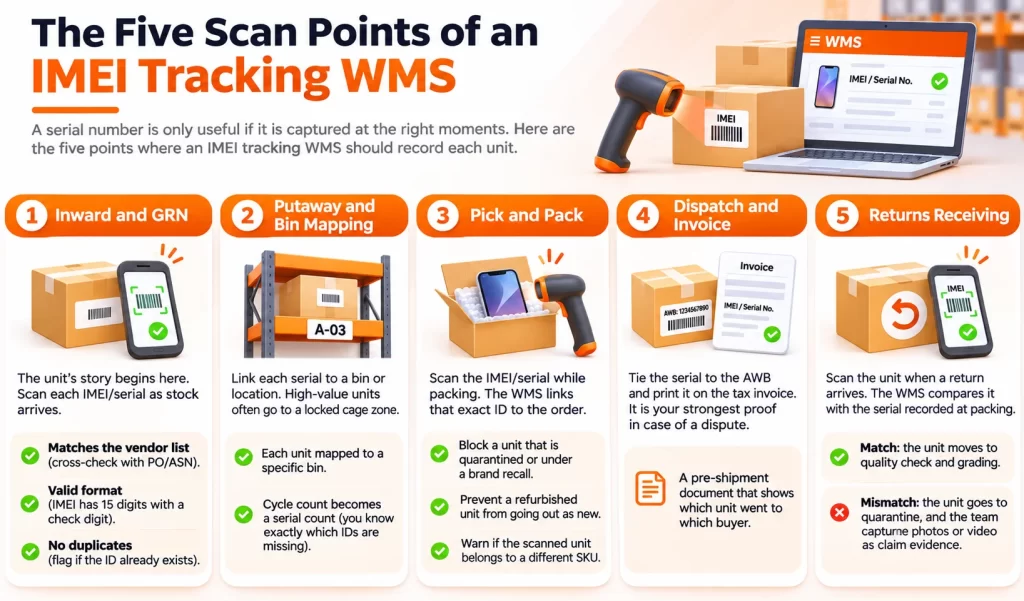
3. Pick and Pack
This is the most important scan for fraud protection. When a picker packs an order, they scan the unit’s IMEI or serial. The WMS links that exact ID to the order.
The system can also stop mistakes before they ship:
- Blocking a unit that is quarantined or under a brand recall
- Blocking a refurbished unit on an order for a new one
- Warning when the scanned unit belongs to a different SKU
4. Dispatch and Invoice
At dispatch, the serial gets tied to the AWB number and printed on the tax invoice. That invoice becomes your strongest proof later. It is a document created before any dispute, showing which unit went to which buyer.
5. Returns Receiving
When a parcel comes back, the team scans the unit before anything else happens. The WMS compares it with the serial recorded at packing.
- Match: the unit moves to quality check and grading.
- Mismatch: the unit goes to quarantine, and the team captures photos or video as claim evidence.
That single comparison is what turns a “he said, she said” dispute into a clear record.
How Serial Tracking Stops Return Fraud and Wins Claims
Return fraud in electronics rarely looks dramatic. It’s usually quiet, and it adds up fast. Here are the patterns most Indian sellers run into:
- Product swap: a genuine phone goes out, and a clone or older model comes back.
- Empty box or brick: the box returns with a stone, soap bar or nothing inside.
- Part swap: the device comes back, but the original charger or battery is missing.
- Used and returned: earbuds or a smartwatch are used for days, then sent back as “defective.”
- Honest mistakes: a customer with two returns sends back the wrong item.
Why Claims Get Rejected
Amazon’s SAFE-T claims and Flipkart’s seller protection claims both come down to evidence. The question is always the same: can you show the unit that came back is not the one you sent?
Sellers on Amazon’s own seller forums regularly report claims denied for one reason. They had photos of the box, but no record proving which serial number they shipped. A photo taken after the return doesn’t prove what left your warehouse.
What Strong Evidence Looks Like
With serial tracking at packing and returns, every order can carry its own evidence pack:
- The serial or IMEI scanned at packing, with a timestamp and packer ID
- The same serial printed on the tax invoice
- The serial scanned at returns, showing the mismatch
- Photos or video of the returned unit, captured during the return scan
That pack is created as part of normal work. Nobody has to dig through spreadsheets after the fact.
This matters even more if you sell across several channels, since each marketplace has its own return rules. Our guide to reverse logistics and returns management covers how to build one returns flow for all of them. If Flipkart is your main channel, see how a WMS for Flipkart sellers fits into it.
2026 Compliance: IMEI Registration and BIS Rules
Fraud isn’t the only reason to track IMEIs. In India, regulators now care a lot about which devices enter the market and how they are labelled.
IMEI Registration on Device Setu (ICDR)
In November 2025, the Department of Telecommunications (DoT) cautioned manufacturers, importers and resellers about mandatory IMEI registration. The rules sit under the Telecommunications Act, 2023 and the Telecom Cyber Security Rules, 2024.
A few points stand out:
- It is not just phones. Devices such as cellular smartwatches, tablets, mobile hotspots, USB modems, modules and dongles that carry an IMEI are covered too.
- Registration happens before sale or import. It is done on the Device Setu (ICDR) portal, covering company, brand, device model and individual IMEI numbers.
- Tampering is a serious offence. Changing or duplicating an IMEI can lead to penalties.
So where does a WMS fit in? Registration itself is done by the brand or importer. But your warehouse is where those IMEIs physically show up. A WMS that records every IMEI at inward gives you a clean, searchable log of what came in, from whom and when. It can also flag duplicate or invalid IMEIs before they ever reach a customer.
Note: this is a summary, not legal advice. Check your exact obligations with a compliance advisor.
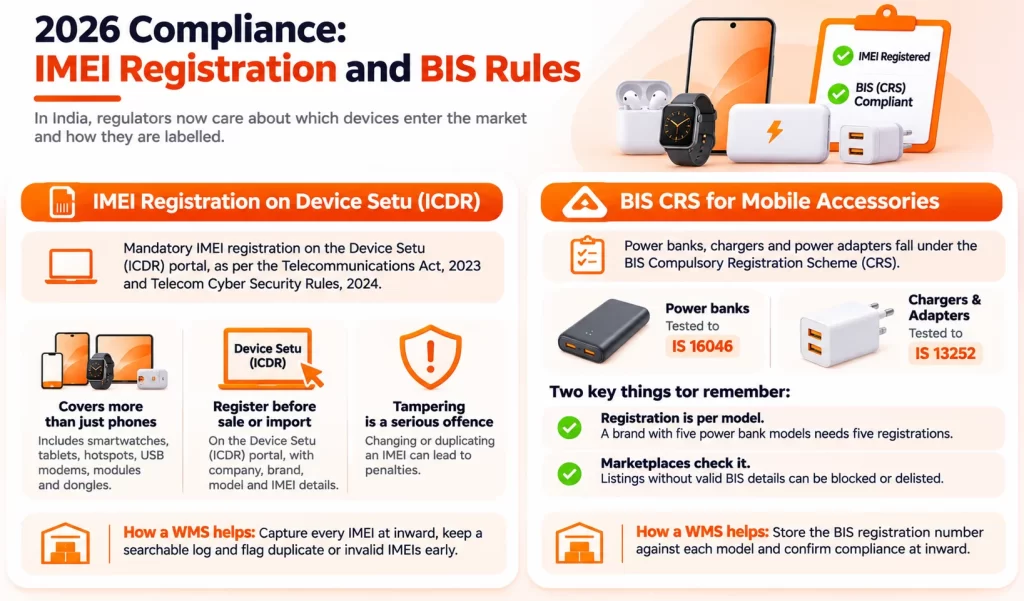
BIS CRS for Mobile Accessories
Accessory sellers have a parallel rule to watch. Power banks, chargers and power adapters fall under the BIS Compulsory Registration Scheme (CRS). Power banks are tested to IS 16046, and chargers and adapters to IS 13252.
Two things make this a warehouse topic:
- Registration is per model. A brand with five power bank models needs five registrations.
- Marketplaces check it. Listings without valid BIS details can be blocked or delisted.
A WMS that stores the BIS registration number against each model helps here. Your team can confirm compliance at inward instead of discovering a gap after a listing goes down.
Mobile Accessories: Serial or Batch Tracking?
Should you scan a serial on every ₹199 cable? Probably not. Serial tracking adds a scan at each step, and that time only pays off when the unit is worth protecting.
Ask three questions about each product:
- Is it high value? Anything above a few thousand rupees is a swap target.
- Does it carry a warranty? If the brand honours warranty by serial, you need it.
- Is it often returned as defective? High return rates mean more disputes to win.
Here is how a typical mobile accessories catalogue splits:
| Product | Recommended tracking | Why |
|---|---|---|
| TWS earbuds, smartwatches | Serial | High value, warranty-backed, common swap target |
| Power banks | Serial or batch | Mid value; BIS model data matters more than unit ID |
| Fast chargers, adapters | Batch | Lower value; batch helps with quality recalls |
| Cables, cases, screen guards | Batch or SKU only | Low value; unit scans add cost without much benefit |
A flexible warehouse management system for mobile accessories lets you set this rule per SKU. Serial-tracked items demand a scan; batch items move at normal speed.
This matters more as accessories move into quick commerce. Platforms like Blinkit, Zepto and Instamart now stock earbuds and chargers in small dark stores. Fast replenishment with clean unit data is a real edge there. See how a dark store WMS for quick commerce handles that speed.
What to Look For in a WMS for Electronics
Many tools claim “serial number support.” Some only let you type a serial into a notes field. That won’t hold up in a claim. Use this checklist to separate real serialized inventory management from a checkbox feature.
Core Serial Features
- Capture at every scan point: inward, putaway, pick, pack, dispatch and returns
- IMEI validation: checks the 15-digit format and check digit, and blocks duplicates
- Dual IMEI support: stores both IMEIs of a dual-SIM phone against one unit
- Parent-child mapping: links a master carton’s label to every unit inside, so one scan can receive a full carton
- Serial history search: type any ID and see its full journey in seconds
Returns and Fraud Controls
- Returns QC with media: photos and video attached to the return record
- Automatic mismatch flags: a returned serial that doesn’t match the shipped one goes straight to quarantine
- Condition grading: new, open box, refurbished, damaged, each with its own stock bucket
- Lot locking: blocks a whole batch from picking when a brand issues a recall
Security and Integrations
- Cage zones and role-based access: only named staff can pick high-value units
- Serial-level cycle counts: find missing units by ID, not just by quantity
- Serial on invoice: prints the IMEI or serial on the GST invoice automatically
- Channel and ERP sync: connects with Amazon, Flipkart, Shopify, quick commerce apps and your ERP or accounting system
- Mobile scanner app: works on handheld devices that read small 2D codes
The security features matter more than people think. Electronics are a top target for internal theft too, not only customer fraud. Our post on preventing inventory shrinkage covers the wider picture.
Questions to Ask Any Vendor
Before you sign, ask for a live demo and get answers to these:
- Can you show me a returned unit being flagged for a serial mismatch?
- How does a full carton get received without scanning 50 units one by one?
- Where does the serial appear on the invoice and the marketplace order?
- How long does a serial history search take on a year of data?
- Can I switch serial tracking on or off per SKU?
How to Roll Out Serial Tracking in Six Steps
You don’t need to switch your whole warehouse overnight. A phased rollout keeps orders moving while your team learns the new habit.
- Classify your SKUs. Mark each product as IMEI, serial, batch or SKU-only, using the three questions above. Start with your top 20 high-value SKUs.
- Get clean data from suppliers. Ask vendors to share serial or IMEI lists with each shipment, ideally as a file you can import. This makes inward checks fast and accurate.
- Sort out labels and scanners. Check that every unit has a scannable serial barcode. Where it doesn’t, print your own labels at inward. Use 2D scanners that read small codes on phone boxes.
- Start with packing and returns. These two scans give you fraud protection right away. Add putaway and cycle count scans once the team is comfortable.
- Pilot one category. Run serial tracking on phones or earbuds for two to four weeks. Fix the snags before you expand.
- Measure what changed. Track a few numbers before and after: Marketplace claim approval rate, Return mismatches caught at the dock, Inventory accuracy at the unit level, Average time to pack an order
Expect packing to slow down slightly in the first weeks. That’s normal. Most teams get back to their old speed once scanning becomes muscle memory, and fewer lost claims usually make up for the extra seconds.
Give Every Unit an Identity
Electronics and mobile accessories don’t behave like regular stock. Two units with the same SKU can have different warranties, conditions and histories. Treating them as identical is what leaves sellers exposed.
Here’s a quick recap:
- SKU-level tracking can’t prove which unit you shipped, and that’s the question every claim turns on.
- Five scan points (inward, putaway, pick and pack, dispatch, returns) build a complete chain of custody.
- Serial proof on the invoice and at returns turns fraud disputes into clear-cut cases.
- 2026 rules on IMEI registration and BIS CRS make clean unit and model data a compliance need, not just an ops nice-to-have.
- Not every SKU needs a serial scan. Match the tracking level to value, warranty and return risk.
A WMS for electronics with proper IMEI and serial tracking gives you that control without slowing your team down. Omneelab WMS is built for Indian brands, D2C sellers and 3PLs that run multi-channel warehouses, with scan-based inward, picking and returns workflows.
Want to see how serial tracking would work in your warehouse? Book a free 30-minute demo and we’ll walk through your SKUs, scan points and returns flow.
Frequently Asked Questions
Serialized inventory means each unit is tracked by its own unique ID, such as a serial number or IMEI. The warehouse knows not just how many units of a product it holds, but exactly which ones, where they sit and where each one went.
Serial tracking follows one unit at a time. Batch or lot tracking follows a group of units made or received together. Serial tracking suits high-value, warranty-backed items like phones and earbuds. Batch tracking suits low-value accessories like cables, where recalls happen by lot.
Yes, a good electronics WMS links both IMEI 1 and IMEI 2 to a single unit record. Either number can then be scanned or searched to pull up the same phone, its order and its invoice.
For mobile devices sold or imported into India, yes. Manufacturers, importers and brand owners register device IMEIs on the Device Setu (ICDR) portal before first sale or import. Resellers should make sure the stock they sell is registered and never tampered with. Check your specific case with a compliance advisor.
When a customer raises a warranty claim, the serial shows the exact sale date, invoice and order for that unit. That stops claims on units sold elsewhere or outside the warranty period. It also helps brands spot faulty lots quickly, since every defective serial traces back to its inward batch and vendor.

Kapil Pathak is a Senior Digital Marketing Executive with over six years of experience specializing in the logistics and supply chain industry. His expertise spans digital strategy, search engine optimization (SEO), search engine marketing (SEM), and multi-channel campaign management. He has a proven track record of developing initiatives that increase brand visibility, generate qualified leads, and drive growth for D2C & B2B technology companies.