Picture this. It is 9 PM on a Saturday in Bhiwandi. Three thousand orders are stacked up. Your team is scanning barcodes on a phone running a four-year-old app, and the spreadsheet that is supposed to tell you which SKU sits in which rack just froze. Sound familiar?
If you nodded, you are not alone. Indian warehouses are scaling faster than the tools running them. Whether you ship for Flipkart, Meesho, Amazon, or your own D2C site, the right warehouse management software (WMS) decides whether your peak sale is a record day or a meltdown.
This guide compares the best warehouse management software in India for 2026. No fluff. No sponsored rankings. Just honest pros, cons, pricing bands, and “best for” verdicts on 10 WMS tools that Indian businesses actually use. By the end, you will know which one fits your warehouse, your budget, and your roadmap.
Looking for help picking? Skip to the buyer evaluation framework or jump straight to the top 10 comparison.
TL;DR: The Top 10 WMS in India, Ranked
Short on time? Here is the quick verdict on the best WMS software in India for 2026.
- Omneelab WMS: Best overall for mid-market Indian sellers and D2C brands.
- Unicommerce: Best for marketplace-heavy sellers with multi-channel volume.
- Increff: Best for fashion and apparel brands with high SKU complexity.
- Vinculum: Best for omnichannel retailers wanting deep ERP integrations.
- Easyops: Best for small marketplace sellers on a tight budget.
- Eshopbox: Best when you want WMS plus fulfillment as a service.
- Anchanto: Best for cross-border sellers operating in Southeast Asia too.
- SAP EWM: Best for large enterprises with deep pockets and complex flows.
- Zoho Inventory: Best for true micro-businesses doing under 500 orders a month.
- TallyPrime with warehouse module: Best for Tally-first MSMEs needing light WMS.
Now let us dig into how to choose, what each one actually does, and where the catches are.
How to Choose a WMS in India: The 8-Criterion Framework
Buying WMS software is a lot like buying a car. The brochure looks great. The test drive feels fine. The pain only shows up six months in, on the wrong Mumbai monsoon morning. So let us strip the buying process down to eight questions every Indian warehouse manager should ask before signing.
1. Does it really understand Indian compliance?
This is the part global WMS vendors keep getting wrong. Indian warehousing runs on GST, e-way bills, HSN codes, and state-level rules that change without warning. A WMS that cannot auto-generate e-way bills, sync GSTR data, or handle multi-state stock transfers will cost you in fines and finance-team hours. The official e-way bill portal is the source of truth for rules.
2. Which marketplaces and apps does it integrate with, out of the box?
Indian sellers live across Amazon, Flipkart, Meesho, Myntra, JioMart, Nykaa, Ajio, Tata CLiQ, and now ONDC. Add Shopify, WooCommerce, and Magento for D2C. If a WMS only “supports” five marketplaces through paid middleware, you will pay forever. Always ask for a written list of native integrations.
3. Is it built for cloud, or is it on-prem in a cloud wrapper?
Modern cloud WMS means you log in, you scale, and there is no IT team in the loop. Many “cloud” WMS tools in India are actually old desktop products bolted onto a server. The test: can you log in from your phone in a rickshaw and approve a putaway? If yes, it is true cloud.
4. How fast can you go live?
Implementation in India typically takes anywhere from 4 weeks (SMB SaaS) to 16 weeks (mid-market) to 9 months (enterprise SAP-style). If a vendor promises “two days,” check whether they include training, data migration, and integration setup. If a vendor quotes nine months, ask why.
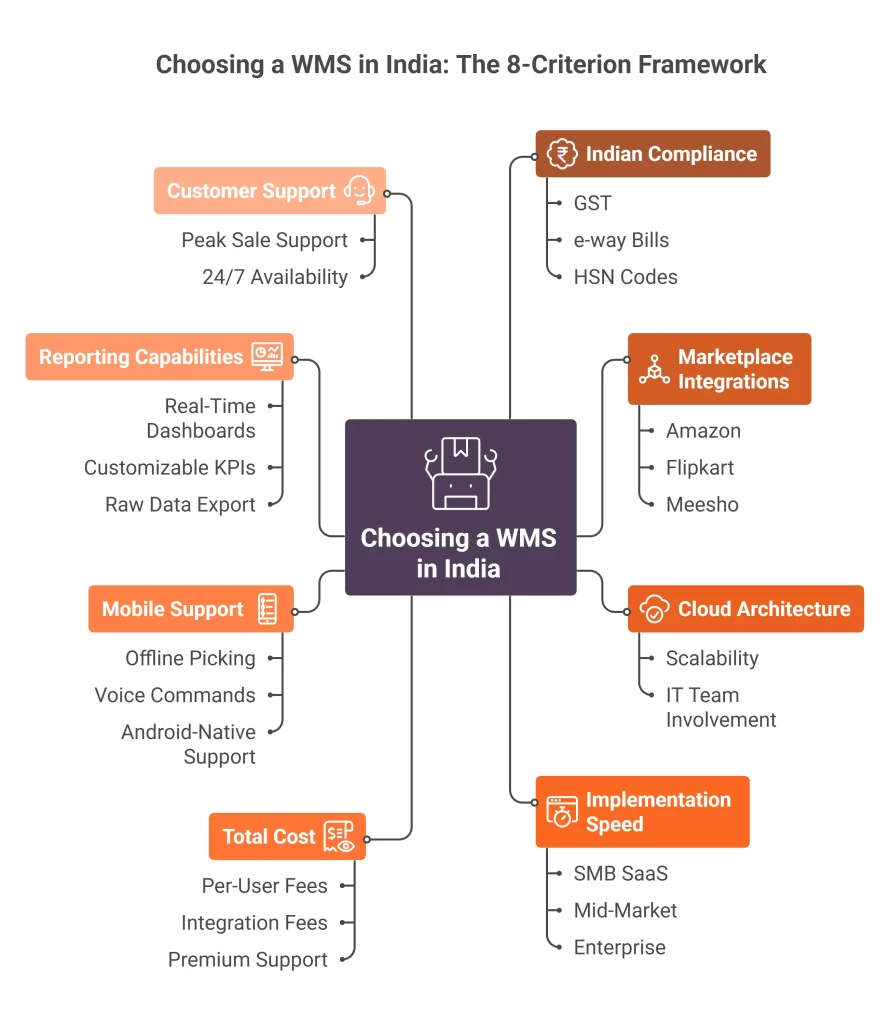
5. What is the real total cost?
Sticker price is rarely the full story. Add: per-user fees, integration fees, premium support, annual maintenance, and “professional services.” A WMS that looks cheap at ₹15,000 a month can hit ₹4 lakh a year once everything is loaded in.
6. Does it run on mobile, properly?
Indian warehouses are not desks. They are aisles. A mobile-first WMS with offline picking, voice commands, and Android-native handheld support beats a fancy desktop UI every single time. Test the mobile app before signing.
7. How honest are the reports?
Reports are the difference between “we are doing fine” and “we have a problem in Kolkata.” Look for real-time dashboards, customizable KPIs, and the ability to export raw data. If the demo report looks suspiciously clean, ask to see one from a real customer (anonymised).
8. Will support pick up the phone?
Indian warehousing runs Diwali, Republic Day sale, end-of-month closing. The vendor who replies on Slack at 11 PM during your peak sale is worth twice the one with a slick brochure.
Now, with this checklist in mind, let us look at the contenders.
The 10 Best Warehouse Management Software in India for 2026
Below are honest reviews of the 10 top WMS tools in India. We have looked at pricing, integrations, India-specific features, and where each one shines (and where it struggles).
1. Omneelab WMS
Best for: Mid-market sellers, D2C brands, and growing 3PLs.
Omneelab is a cloud-native WMS built for Indian warehouses from the ground up. The product, called EWMS, comes with native GST and e-way bill workflows, mobile-first picking, and direct integrations with most major Indian marketplaces. Think of it as the Maruti Swift of WMS: not the cheapest, not the flashiest, but it just works in Indian conditions.
What customers like:
- Native integrations with Flipkart, Meesho, JioMart, and Nykaa.
- A solid story for pharma, cold chain, and FMCG with batch and expiry tracking.
- Setup typically wraps up in 4 to 8 weeks for SMBs.
What to watch out for: It is not the cheapest option for very small sellers doing under 1,000 orders a month. The deeper analytics module is sold as a separate add-on.
Pricing band: Mid-market SaaS, custom by warehouse size.
2. Unicommerce
Best for: Multi-channel sellers with heavy marketplace volume.
Unicommerce is the most recognised name in Indian WMS. It listed on the stock exchange in 2024, which says something about scale. The product is mature, marketplace-integration heavy, and runs the warehouses of some of India’s biggest D2C brands.
What customers like:
- Broadest marketplace integration list in the country.
- Mature returns and reverse logistics flows.
- Strong reporting suite for finance teams.
What to watch out for: It is enterprise-feeling, with an interface that can feel dated. Pricing climbs steeply once you add channels, users, and warehouses. Some users report long support response times during peak sales.
Pricing band: Mid to upper SaaS, custom quote.
3. Increff
Best for: Fashion, apparel, and high-SKU-count brands.
Increff started life as an inventory intelligence tool for fashion brands. It now offers a full WMS plus its smart-inventory module. If your business sells thousands of size and colour variants, Increff’s SKU-level intelligence is hard to beat.
What customers like:
- Fashion-grade SKU and serial tracking.
- Strong analytics and demand-forecasting layers.
- Clean modern interface.
What to watch out for: It is opinionated software. If your warehouse runs custom processes, expect some friction during onboarding. Pricing is on the higher side for non-fashion brands.
Pricing band: Mid to upper SaaS.
4. Vinculum
Best for: Omnichannel retailers with deep ERP integrations.
Vinculum has been around since 2007 and feels it. The product is broad, integrated, and built for retailers who run physical stores plus online plus marketplaces. If you live inside SAP, Oracle, or Microsoft Dynamics, Vinculum has likely already built that connector.
What customers like:
- Deep ERP and POS integrations.
- Solid omnichannel order routing.
- Multi-country and multi-currency support.
What to watch out for: The product can feel sprawling. SMBs may find it overpowered. Some reviewers report a steeper learning curve.
Pricing band: Mid to upper SaaS, ERP add-ons priced separately.
5. Easyops
Best for: Small marketplace sellers on a budget.
Easyops (formerly Browntape) is the friendly neighbourhood WMS for sellers who started on Amazon or Flipkart and have grown into the lakhs-of-orders-per-month range. It is light, marketplace-first, and easy to get going.
What customers like:
- Quick setup, often within a week.
- Affordable for SMBs.
- Simple inventory sync across major marketplaces.
What to watch out for: It is more of an order and inventory tool than a full WMS. If you run a multi-zone warehouse with batch tracking or complex put-away rules, you will outgrow it within a year.
Pricing band: Entry to mid SaaS.
6. Eshopbox
Best for: Brands that want WMS plus fulfillment-as-a-service.
Eshopbox is interesting because it is not just software. It is also a 3PL network. You can either run their software inside your warehouse, or hand over fulfillment to their facilities entirely. For D2C brands tired of running their own ops, this hybrid model is appealing.
What customers like:
- Done-for-you fulfillment option.
- Pan-India warehouse network.
- Simple onboarding for small D2C brands.
What to watch out for: You give up some control with the managed model. Pricing depends heavily on order volumes and storage tiers, so do the math carefully.
Pricing band: Variable, depending on software-only versus 3PL bundle.
7. Anchanto
Best for: Cross-border sellers operating across Southeast Asia.
Anchanto is a Singapore-headquartered SaaS WMS with a strong Indian footprint. If your business sells across India, UAE, Singapore, and Indonesia, Anchanto removes a lot of multi-country complexity.
What customers like:
- Solid multi-country, multi-currency support.
- Clean SaaS interface.
- Good for 3PLs operating across geographies.
What to watch out for: India-specific features like e-way bill workflows are sometimes behind purely Indian competitors. Pricing in INR can feel steep because of the SGD base.
Pricing band: Mid SaaS.
8. SAP EWM (Extended Warehouse Management)
Best for: Large enterprises with deep pockets and complex flows.
SAP EWM is the heavyweight. It runs the warehouses of giants like Tata, Reliance retail divisions, and many auto manufacturers. If you have hundreds of SKUs, multiple shifts, and integration with global SAP modules, EWM has the depth you need.
What customers like:
- Best-in-class for highly complex warehouses.
- Deep integration with SAP S/4HANA and other SAP modules.
- Enterprise-grade scalability.
What to watch out for: It is expensive. Implementations of 6 to 18 months are normal. You will need a partner, a budget that often crosses ₹1 crore, and patience. Not for SMBs.
Pricing band: Enterprise, custom.
9. Zoho Inventory
Best for: True micro-businesses doing under 500 orders a month.
Zoho Inventory is technically not a full WMS. However, for very small Indian sellers and bootstrapped D2C brands, it does enough. Inventory, simple orders, basic warehouse rules, and tight integration with the rest of Zoho’s suite.
What customers like:
- Affordable, plays well with Zoho Books and CRM.
- Easy to learn for non-technical founders.
- Quick deployment.
What to watch out for: Once you hit a few thousand orders a month or need multi-warehouse, multi-zone picking, you will hit walls. Treat it as a stepping stone, not a long-term WMS.
Pricing band: SMB SaaS, starts low.
10. TallyPrime with Warehouse Module
Best for: Tally-first MSMEs needing very light WMS.
A surprising number of Indian businesses still run on Tally. The warehouse module gives MSMEs a basic inventory and stock-tracking layer without leaving Tally’s familiar interface. Not a WMS in the strict sense, but a sensible bridge for businesses just starting out.
What customers like:
- Familiar interface for finance teams.
- Tight GST and e-way bill workflows.
- Low cost of ownership.
What to watch out for: It is a stock module, not a true WMS. No multi-channel marketplace sync, no mobile picking, no real-time dashboards. Outgrow it fast.
Pricing band: Entry, low.
Quick Comparison Table
Here is the at-a-glance view. Treat pricing as directional. Always get a custom quote.
| WMS | Best For | India Compliance | Marketplace Native | Mobile App | Pricing Band |
|---|---|---|---|---|---|
| Omneelab WMS | Mid-market, D2C | Strong | 12+ | Yes | Mid SaaS |
| Unicommerce | Multi-channel | Strong | 15+ | Yes | Mid-Upper SaaS |
| Increff | Fashion, apparel | Good | 10+ | Yes | Mid-Upper SaaS |
| Vinculum | Omnichannel | Good | 12+ | Yes | Mid-Upper SaaS |
| Easyops | Small sellers | Basic | 8+ | Yes | Entry-Mid SaaS |
| Eshopbox | Fulfillment hybrid | Strong | 10+ | Yes | Variable |
| Anchanto | Cross-border | Moderate | 12+ | Yes | Mid SaaS |
| SAP EWM | Enterprise | Add-on | Via middleware | Yes | Enterprise |
| Zoho Inventory | Micro-business | Good | 5+ | Yes | Entry SaaS |
| TallyPrime | MSME Tally users | Strong | None | Limited | Entry |
Best WMS by Use Case
Different businesses have different headaches. Here is who we would recommend for the most common Indian use cases.
Best WMS for Small Businesses in India
If you do under 5,000 orders a month and have one warehouse, look at Easyops, Zoho Inventory, or Omneelab WMS (entry tier). The trade-off is simple. Easyops gets you started fastest. Zoho fits if you already use the Zoho stack. Omneelab gives you more room to grow without re-platforming in year two.
Best WMS for E-commerce and D2C Brands
For D2C brands selling on Shopify, WooCommerce, or your own site plus 2-3 marketplaces, Omneelab, Unicommerce, and Increff are the strong picks. Increff has the edge on fashion. Omneelab and Unicommerce are more general-purpose. Check our stock management guide for Indian e-commerce for deeper context.
Best WMS for 3PL Operators
If you run a 3PL business serving multiple clients, your WMS needs to handle multi-tenant billing, client-specific SLAs, and detailed invoicing. Omneelab, Vinculum, and Eshopbox lead here. See our 3PL warehouse management guide for the full evaluation criteria.
Best WMS for Quick Commerce and Dark Stores
Q-commerce changes the math. Order-to-dispatch in 10 minutes means picking speed, location accuracy, and slotting matter more than reporting. Omneelab’s dark-store WMS module and Increff are the strongest picks. Read our dark store WMS guide for the operational details.
Best WMS for Pharma and Cold Chain
If you handle pharma, batch-and-expiry tracking is not optional. Omneelab, SAP EWM, and Increff offer proper batch, lot, and serial tracking. SAP is overkill unless you are enterprise scale. See our pharma WMS guide for compliance specifics.
WMS Pricing in India: What to Actually Expect
Pricing is the murkiest part of WMS evaluation. Vendors hide it behind demo calls. So let us pull back the curtain.
- Entry SaaS (Zoho Inventory, Easyops, Tally module): ₹1,000 to ₹15,000 a month for small operations. Suitable for under 5,000 orders a month and one warehouse.
- Mid SaaS (Omneelab, Anchanto entry, Easyops growth): ₹25,000 to ₹1,00,000 a month. Suitable for 5,000 to 50,000 orders a month, multi-channel.
- Upper SaaS (Unicommerce, Increff, Vinculum): ₹75,000 to ₹3,00,000 a month. For multi-warehouse, multi-channel, mid-to-large operations.
- Enterprise (SAP EWM, custom Vinculum): ₹50 lakh to ₹2 crore total cost of ownership over three years. Includes licensing, implementation, training, integrations.
Hidden costs to watch for:
- Per-user fees that add up as your team grows.
- Integration fees for “non-standard” marketplaces.
- Annual maintenance contracts that range from 18 to 22 percent of license cost.
- Professional services for any customisation.
Always ask for a 3-year TCO (total cost of ownership) breakdown in writing.
India-Specific Considerations You Cannot Ignore
A global WMS that does not understand Indian rules will cost you money. Here are the four India-specific musts when picking the best warehouse management software in India.
GST and HSN Code Workflows
Your WMS should auto-classify SKUs by HSN, calculate GST at item level, and sync with your GSTR returns. Tools that “support GST” without this depth force your finance team into manual reconciliation every month.
E-Way Bill Generation
Inter-state stock movement above ₹50,000 needs an e-way bill. A WMS that auto-generates the e-way bill from the goods-issue document saves hours. Manual generation creates errors. Errors create fines. The GST council’s official portal is worth bookmarking.
Marketplace Integration Depth
A logo on the vendor’s website does not mean a real integration. Ask: does the WMS handle Flipkart F-Assured tagging? Does it sync Meesho’s commission slabs? Can it process Amazon Easy Ship versus FBA fulfillment routing? The answer is rarely the same as the brochure.
Hindi and Regional Language Support
Your floor staff in Bhiwandi or Gurgaon may not be English-first. A WMS with proper Hindi (and ideally Tamil, Telugu, Bengali) mobile-app support is no longer a luxury. It is operational basic. Indian logistics policy is also shifting under PM Gati Shakti and the National Logistics Policy, which means future-proof systems must adapt fast.
WMS Trends to Watch in 2026
The WMS market in India is moving fast. Five trends are reshaping how warehouses run.
AI-Powered Pick and Put-Away
AI is moving from buzzword to real value. Modern WMS tools now use machine learning to suggest the fastest pick path, predict demand spikes, and auto-slot fast-movers near dispatch. We covered this in our deep dive on AI in warehouse management.
Quick Commerce Pressure
Blinkit, Zepto, Swiggy Instamart, and Flipkart Minutes have made 10-minute delivery the new normal in 12 metros. WMS tools that cannot model micro-fulfillment centres will lose this segment entirely.
ONDC and Open Network Selling
The Open Network for Digital Commerce is creating a new layer of sellers. WMS vendors that integrate natively with ONDC give their customers access to a faster-growing seller pool.
Voice and Wearable Picking
Heads-up wearables and voice-directed picking are quietly becoming standard in mid-market Indian warehouses. They speed up picks by 15 to 25 percent.
Green and Compliance Reporting
ESG reporting is becoming a procurement requirement for big retailers. WMS tools that surface energy consumption, waste, and carbon impact are starting to win RFPs they would not have last year.
So, Which Is the Best Warehouse Management Software in India for 2026?
Honestly, there is no single answer. The best WMS for India is the one that matches your business, not the most expensive logo. To recap:
- For mid-market and D2C brands, Omneelab WMS hits the sweet spot of cost, integrations, and India-specific compliance.
- For high-volume marketplace sellers, Unicommerce is the safe, mature choice.
- For fashion and apparel, Increff is hard to beat.
- For omnichannel with deep ERP needs, Vinculum holds the edge.
- For small businesses just starting out, Easyops or Zoho Inventory.
- For enterprises, SAP EWM, if you can afford it.
Pick the one that solves your current pain and gives you room to grow over the next three years. Avoid the trap of buying for where you wish you were. That is how warehouses end up with shelfware.
Ready to see how Omneelab WMS would actually fit your operation? Book a 30-minute demo here and we will walk through your warehouse, your marketplaces, and your order volume. No slide deck. Just a working conversation.
Frequently Asked Questions
There is no truly free WMS that scales in India. Open-source options like Odoo Community work, but you pay in IT and integration effort. For most Indian small businesses, entry-tier SaaS like Zoho Inventory or Easyops at ₹1,000 to ₹5,000 a month is the better deal.
WMS pricing in India runs from around ₹1,000 a month for micro-business SaaS to over ₹1 crore for enterprise SAP EWM. Most Indian SMBs spend ₹25,000 to ₹1,00,000 a month on mid-market WMS like Omneelab or Easyops. Always ask for a 3-year total cost of ownership before signing.
A WMS runs your warehouse: receiving, picking, packing, and stock control. An ERP runs your whole business: finance, HR, sales, and procurement. Most Indian mid-market businesses run both, with a proper WMS-ERP integration keeping operations and finance in sync.
Not really. Zoho Inventory is a solid inventory tool, but it lacks multi-zone picking, advanced put-away, and batch-and-expiry workflows. For under 1,000 orders a month it is fine, but you will outgrow it fast and need a real WMS like Omneelab or Unicommerce.
A small business on Zoho or Easyops can go live in 1 to 2 weeks. A mid-market deployment on Omneelab, Unicommerce, or Increff usually takes 4 to 12 weeks. Enterprise SAP EWM rollouts run 6 to 18 months. Data cleanliness and integration count drive the timeline more than warehouse size.
Article last updated: May 2026. We refresh this guide quarterly. If you spot something outdated or missing, write to us and we will fix it.

Kapil Pathak is a Senior Digital Marketing Executive with over six years of experience specializing in the logistics and supply chain industry. His expertise spans digital strategy, search engine optimization (SEO), search engine marketing (SEM), and multi-channel campaign management. He has a proven track record of developing initiatives that increase brand visibility, generate qualified leads, and drive growth for D2C & B2B technology companies.