Indian warehousing is undergoing its biggest transformation in decades. Driven by the explosive growth of e-commerce, quick commerce, and D2C brands, smart warehouse technology in India is no longer a futuristic concept reserved for global giants. It is a practical, accessible reality that Indian businesses of all sizes are adopting in 2026.
At the heart of this transformation is the Warehouse Management System (WMS). WMS serves as the brain of every smart warehouse, orchestrating IoT sensors, AI-powered analytics, automation equipment, barcode/RFID systems, and mobile devices into a unified, intelligent operation. Without WMS, these technologies are disconnected tools. With WMS, they become a connected, data-driven warehouse ecosystem that delivers speed, accuracy, and scalability.
This guide covers everything Indian businesses need to know about smart warehouse technology in India: what it means, how WMS powers it, the technology stack involved, the automation maturity roadmap, industry-specific applications, government policy support, ROI calculations, implementation timelines, and the future trends shaping warehousing through 2030. Whether you are modernizing a single warehouse or building a network of smart fulfillment centers, this guide will help you make informed decisions.
What is a Smart Warehouse and How Does It Work?
A smart warehouse is a facility that uses interconnected technologies to automate operations, minimize human error, and make data-driven decisions in real-time. Unlike traditional warehouses that rely on paper-based processes, manual counting, and human memory, a smart warehouse uses sensors, software, and automation to manage every activity from receiving to dispatch.
The key difference is intelligence. A traditional warehouse reacts to problems after they occur. A smart warehouse predicts, prevents, and optimizes continuously.
Here is how they compare:
| Dimension | Traditional Warehouse | Smart Warehouse |
|---|---|---|
| Inventory Tracking | Manual counting, spreadsheets | Real-time tracking via barcode, RFID, IoT sensors |
| Order Picking | Paper pick lists, single-order picking | WMS-optimized wave/batch/zone picking with mobile guidance |
| Decision Making | Manager intuition, experience-based | AI/ML-driven analytics, predictive insights |
| Error Rate | 3 to 5% picking errors | Under 0.5% with scan-verified processes |
| Visibility | Delayed, end-of-day reports | Real-time dashboards, instant alerts |
| Scalability | Linear (more people = more capacity) | Exponential (technology multiplies output) |
| Equipment | Forklifts, manual carts | AMRs, AGVs, conveyor systems, robotic arms |
| Energy Management | Unmonitored | IoT-optimized lighting, HVAC, power usage |
A smart warehouse does not require every technology at once. Indian businesses can start with WMS + barcode scanning and progressively add IoT, AI, and automation as they scale. This phased approach is what makes smart warehouse technology in India accessible to businesses of all sizes.
Related reading: Technologies in Warehousing and Logistics in India
Why Smart Warehouse Technology in India is Accelerating in 2026
Several converging forces are driving the rapid adoption of smart warehouse technology in India:
1. E-commerce and Quick Commerce Explosion
India’s e-commerce market is projected to exceed $120 billion in 2026. Quick commerce players like Blinkit, Zepto, and Swiggy Instamart are pushing delivery timelines to 10 to 30 minutes, which demands warehouse operations that are faster and more precise than ever before. Traditional warehouses simply cannot meet these speed requirements without smart technology.
2. Government Policy Support
The Indian government is actively supporting warehouse modernization in India through multiple initiatives:
- National Logistics Policy (2022) aims to reduce logistics costs from 14% to 8% of GDP through technology adoption and infrastructure development
- PM Gati Shakti provides integrated infrastructure planning that includes modern warehousing hubs
- Make in India encourages domestic manufacturing, which increases demand for smart warehousing to manage production inventory
- GST unification has enabled larger, centralized warehouses that benefit most from smart technology
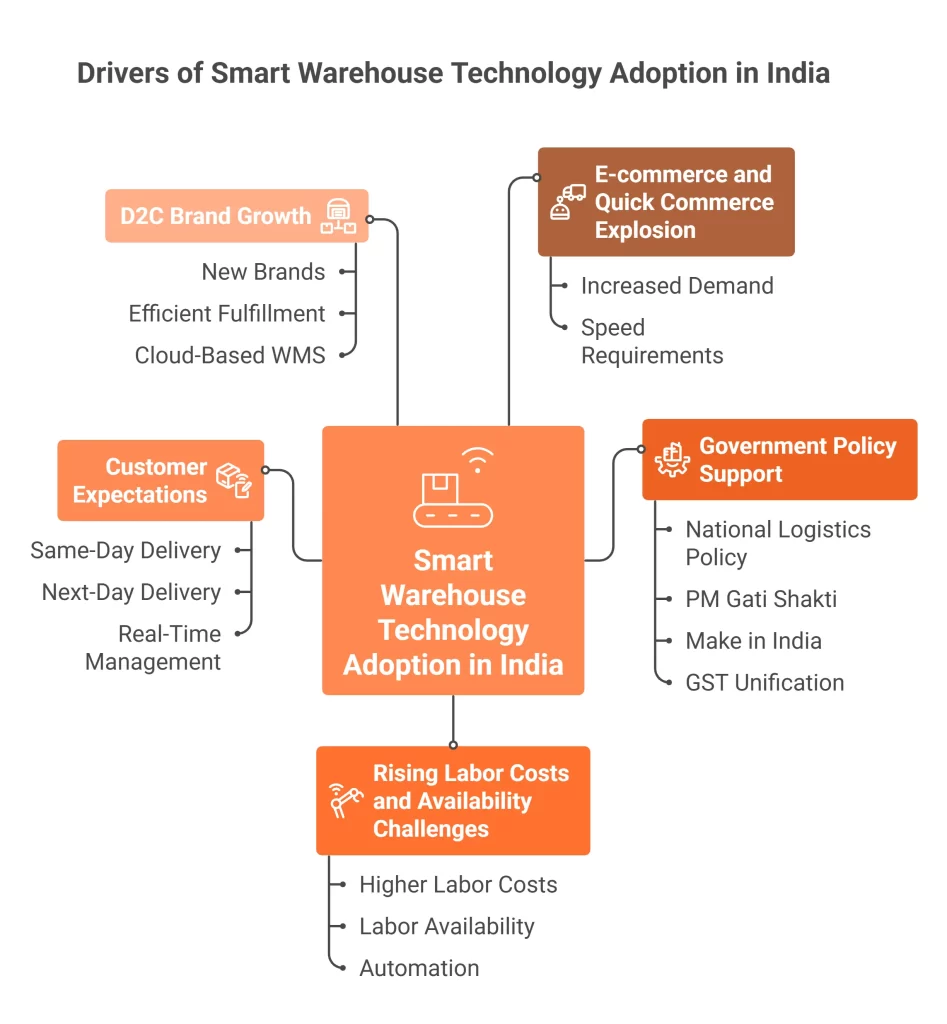
3. Rising Labor Costs and Availability Challenges
Warehouse labor in Indian metros is becoming more expensive and harder to retain. Smart warehouse technology reduces dependence on manual labor by automating repetitive tasks like picking, sorting, and counting, while making remaining workers significantly more productive through WMS-guided workflows.
4. Customer Expectations
Indian consumers now expect same-day or next-day delivery as standard. Meeting these expectations consistently requires real-time warehouse management powered by WMS, not manual processes that introduce delays and errors.
5. D2C Brand Growth
Thousands of D2C brands are launching in India every year, each needing efficient fulfillment from day one. Cloud-based WMS makes smart warehouse technology in India accessible to these brands without massive upfront investment.
Related reading: Future of Warehouse Management Trends 2025
WMS: The Brain of Every Smart Warehouse in India
Every smart warehouse technology, whether it is an IoT sensor, an AI algorithm, or a robotic arm, needs a central orchestration layer to function effectively. That layer is the Warehouse Management System (WMS).
Think of it this way:
- IoT sensors collect data (temperature, humidity, motion, weight)
- AI/ML algorithms analyze data and generate predictions
- Automation equipment (AMRs, conveyors, robotic arms) executes physical tasks
- Barcode/RFID systems identify and verify items
WMS connects all of these. It receives sensor data, feeds it to AI models, translates AI recommendations into actionable tasks, and dispatches those tasks to automation equipment or human workers via mobile devices.
Without WMS, you have disconnected technologies generating data that nobody acts on. With WMS, you have an intelligent warehouse that thinks, decides, and acts in real-time.
How WMS Orchestrates Smart Warehouse Operations
| Smart Technology | What It Does | How WMS Orchestrates It |
|---|---|---|
| IoT Sensors | Monitors temperature, humidity, motion, weight | WMS receives sensor data, triggers alerts, adjusts workflows (e.g., move perishables to cold zone) |
| AI/ML | Predicts demand, optimizes slotting, forecasts labor needs | WMS feeds historical data to AI models, implements AI recommendations automatically |
| Barcode/RFID | Identifies and verifies items at every touchpoint | WMS requires scan verification at receiving, picking, packing, dispatch, creating a chain of custody |
| Mobile Devices | Guides workers through tasks on the warehouse floor | WMS pushes optimized task lists to mobile devices with step-by-step instructions |
| AMRs/AGVs | Moves goods autonomously across the warehouse | WMS assigns movement tasks to robots, optimizes routes, manages traffic |
| Conveyor Systems | Sorts and routes packages automatically | WMS controls sorting logic based on carrier, destination, priority |
| Pick-to-Light | Illuminates correct bin locations for pickers | WMS activates lights based on current pick list and bin assignments |
OmneeLab’s AI-powered WMS gives you real-time visibility, automated workflows, and intelligent insights that serve as the foundation for building a truly smart warehouse.
Related reading: AI in Warehouse Management in India
Smart Warehouse Technology Stack: IoT, AI, Automation and Beyond
The smart warehouse technology stack in India consists of multiple layers, each building on the previous one. Here is the complete stack:
Layer 1: Cloud-Based WMS (Foundation)
Everything starts with WMS. A cloud-based WMS in India provides:
- Real-time inventory tracking across all locations
- Automated order allocation and picking optimization
- Barcode/RFID scan verification at every touchpoint
- Multi-marketplace and carrier integration
- Mobile app for warehouse floor operations
- KPI dashboards and analytics
Cloud WMS is the foundation because it digitizes all warehouse data, making it available for IoT, AI, and automation layers to use.
Related reading: Role of Cloud Retail WMS in Supply Chain
Layer 2: Barcode, RFID, and QR Code Systems
The identification layer ensures every item, bin, rack, and pallet in the warehouse has a scannable identity. This enables:
- Error-free receiving and putaway
- Scan-verified picking (wrong item? scan rejects it)
- Automated packing verification
- Real-time inventory accuracy of 99%+
For Indian businesses, barcode scanning is the most cost-effective starting point. RFID is ideal for high-value or high-volume operations where line-of-sight scanning is impractical.
Related reading: Barcode vs RFID in Warehouse Management: Cost Comparison
Also read: What is RFID Technology: How It Works and Industry Benefits
Layer 3: IoT Sensors and Connected Devices
IoT adds environmental awareness to the warehouse. Sensors monitor:
| Sensor Type | What It Monitors | WMS Action |
|---|---|---|
| Temperature sensors | Cold chain zones (2 to 8°C, 15 to 25°C) | Alerts if temperature deviates, triggers stock movement |
| Humidity sensors | Moisture-sensitive storage areas | Adjusts HVAC, alerts warehouse manager |
| Weight sensors (smart shelves) | Real-time stock levels on shelves | Auto-triggers replenishment when stock drops below threshold |
| Motion/proximity sensors | Worker and equipment movement | Optimizes traffic flow, prevents collisions |
| GPS/BLE trackers | Asset and pallet location | Real-time asset tracking across large warehouses |
| Energy monitors | Power consumption by zone | Optimizes lighting and HVAC for cost savings |
WMS processes all IoT data through its API integration layer, converting raw sensor readings into actionable warehouse decisions. For example, if a temperature sensor in a cold chain zone detects a rise above the safe threshold, WMS immediately alerts the warehouse manager, flags affected inventory for quality check, and adjusts putaway rules to redirect incoming perishables to a functioning zone.
Related reading: WMS for Cold Chain Warehousing in India
Also read: Batch and Expiry Tracking in FMCG
Layer 4: AI and Machine Learning
AI transforms WMS from a reactive system into a predictive system:
| AI Capability | What It Does | Business Impact |
|---|---|---|
| Demand Forecasting | Predicts order volumes by SKU, channel, and location | Pre-position inventory, reduce stockouts by 30 to 40% |
| Dynamic Slotting | Automatically reorganizes bin locations based on SKU velocity | Reduce picking time by 20 to 35% |
| Smart Carrier Selection | ML-based carrier recommendation by pin code, cost, SLA, success rate | Reduce shipping costs by 10 to 15% |
| Anomaly Detection | Flags unusual patterns (shrinkage, process failures, demand spikes) | Prevent losses before they escalate |
| Labor Forecasting | Predicts workforce needs based on expected order volume | Optimize staffing, reduce overtime costs |
| Predictive Maintenance | Monitors automation equipment health, predicts failures | Prevent downtime, extend equipment life |
Layer 5: Automation and Robotics
The physical automation layer includes:
- Autonomous Mobile Robots (AMRs) that transport goods across the warehouse floor
- Automated Guided Vehicles (AGVs) that follow fixed paths for heavy material movement
- Automated Storage and Retrieval Systems (ASRS) for high-density storage
- Pick-to-Light and Put-to-Light systems for guided picking and sorting
- Voice Picking systems for hands-free picking operations
- Conveyor and sortation systems for automated package routing
- Collaborative robots (cobots) that work alongside human workers
- Drone inventory counting for aerial barcode/RFID scanning
WMS orchestrates all automation equipment through API integrations, assigning tasks, optimizing routes, managing traffic, and monitoring performance.
Warehouse robotics in India is still in early adoption, but AMRs and conveyor systems are becoming increasingly common in large e-commerce and 3PL warehouses. The key is that WMS must be in place first, as it provides the intelligence layer that makes automation effective.
Related reading: Manual and Automated Inventory Management
Also read: Paperless Picking Guide for Modern Warehouses
The Smart Warehouse Automation Maturity Model for Indian Businesses
Not every warehouse needs (or can afford) full automation on day one. Here is a practical 5-level maturity model that Indian businesses can follow:
| Level | Name | What Gets Implemented | Monthly Investment | Best For |
|---|---|---|---|---|
| Level 1 | Manual | Paper-based processes, no technology | Minimal | Very small operations, under 50 orders/day |
| Level 2 | Semi-Automated | Cloud WMS + barcode scanning + mobile devices | ₹2,000 to ₹15,000/month | SMEs, D2C startups, 50 to 500 orders/day |
| Level 3 | WMS-Driven | Full WMS with AI features + marketplace/carrier integrations + KPI dashboards | ₹15,000 to ₹50,000/month | Growing businesses, 500 to 5,000 orders/day |
| Level 4 | IoT-Enabled | WMS + IoT sensors + real-time analytics + predictive features | ₹50,000 to ₹2,00,000/month | Mid-market, 3PLs, 5,000 to 20,000 orders/day |
| Level 5 | Fully Autonomous | WMS + IoT + AI + AMRs/AGVs + ASRS + digital twins | ₹2,00,000+/month or custom | Enterprise, large 3PLs, 20,000+ orders/day |
Key principle: Start at Level 2 (WMS + barcode). This alone delivers 30 to 50% improvement in accuracy and speed. Then progress through levels as your business scales and ROI justifies the investment.
Most Indian businesses in 2026 are at Level 2 or Level 3. The goal is to reach Level 3 or 4 within 12 to 18 months of starting the smart warehouse journey.
Smart Warehouse Technology for Quick Commerce and Dark Stores in India
Quick commerce is the fastest-growing segment driving demand for smart warehouse technology in India. Players like Blinkit, Zepto, and Swiggy Instamart operate networks of dark stores that must fulfill orders in under 10 minutes.
What Makes Quick Commerce Warehousing Different
| Dimension | Traditional Warehouse | Quick Commerce Dark Store |
|---|---|---|
| Size | 10,000 to 100,000+ sq ft | 1,000 to 5,000 sq ft |
| SKU Count | 5,000 to 50,000+ | 2,000 to 5,000 |
| Pick-to-Dispatch Time | 2 to 24 hours | Under 3 minutes |
| Replenishment | Weekly/monthly | Daily/multiple times per day |
| Perishable % | 10 to 20% | 40 to 60% |
| Demand Pattern | Predictable, seasonal | Hyperlocal, real-time, weather-dependent |
WMS Requirements for Dark Stores and Micro-Fulfillment Centers
WMS for quick commerce must deliver:
- Sub-3-minute pick-to-dispatch through optimized micro-layouts and instant task assignment
- Real-time inventory sync across 50 to 500+ dark store locations
- Automated replenishment triggers from hub warehouse to dark stores based on real-time consumption
- Batch and expiry tracking with FEFO (First Expiry First Out) picking for perishables
- Hyperlocal demand forecasting that accounts for weather, events, and neighborhood patterns
- Rider/delivery app integration for seamless handoff
Related reading: Dark Store WMS for Quick Commerce in India
Also read: Managing Perishable Inventory
Smart Warehouse Technology for Different Industries in India
Different industries require different smart warehouse configurations:
FMCG and Food
- Batch and expiry tracking with FEFO picking rules
- Temperature monitoring via IoT sensors for cold chain compliance
- High-velocity dynamic slotting for fast-moving SKUs
- Automated replenishment based on consumption patterns
Related reading: WMS for Food and Beverage Companies in India
Pharmaceutical
- Regulatory compliance with drug license tracking and full batch traceability
- Temperature-controlled zones (2 to 8°C and 15 to 25°C) monitored by IoT sensors
- Serialization for unit-level tracking and recall management
- Audit trail for every inventory movement
Related reading: Pharmaceutical Warehouse Management System
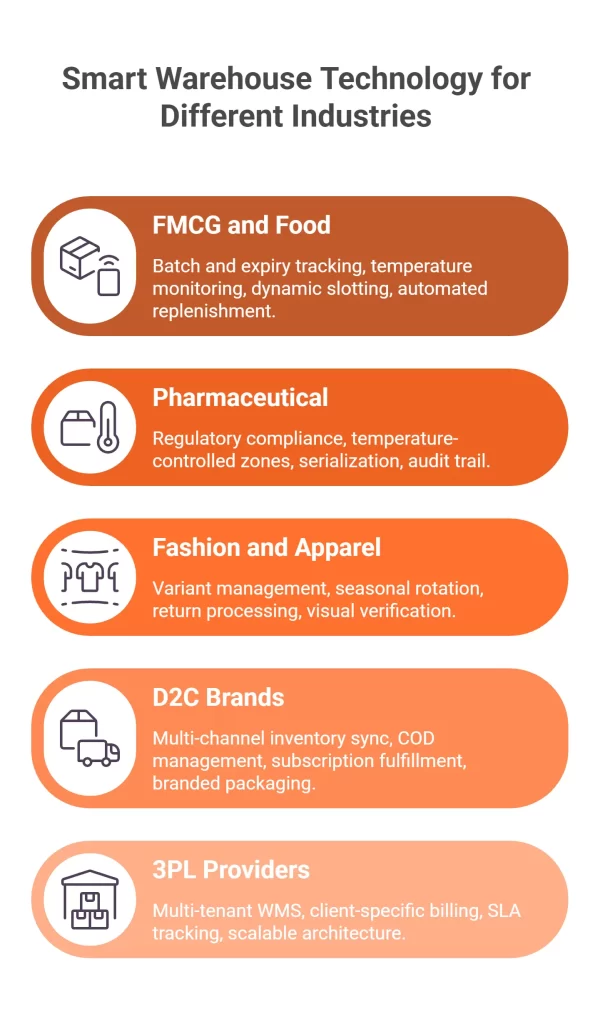
Fashion and Apparel
- Size/color/style variant management across thousands of SKUs
- Seasonal inventory rotation with rapid clearance workflows
- High return rate processing (25 to 30%) with automated grading and restocking
- Visual verification at packing stations for quality assurance
Related reading: Fashion Brand WMS: Seasonal Inventory Management Strategies in India
D2C Brands
- Multi-channel inventory sync across Shopify, Amazon, Flipkart, and own website
- COD order management with RTO prediction
- Subscription fulfillment for recurring orders
- Branded packaging workflows with custom inserts
3PL Providers
- Multi-tenant WMS managing multiple clients in a single warehouse
- Client-specific billing (per order, per pallet, per sq ft)
- SLA tracking and reporting per client
- Scalable architecture to onboard new clients quickly
Related reading: 3PL Warehouse Management Guide: Scaling Logistics
Smart Warehouse KPIs to Track with WMS
A smart warehouse is only as good as the metrics it tracks. Here are the KPIs that matter, with targets for both traditional and smart warehouse benchmarks:
| KPI | What It Measures | Traditional Target | Smart Warehouse Target |
|---|---|---|---|
| Order Accuracy Rate | % of orders shipped correctly | 95 to 97% | 99.5%+ |
| Pick-to-Ship Time | Time from order received to dispatched | 8 to 24 hours | Under 2 hours |
| Inventory Accuracy | System vs physical stock match | 85 to 90% | 99%+ |
| Warehouse Throughput | Orders processed per hour | 50 to 100 | 200 to 500+ |
| Labor Productivity (UPH) | Units picked per hour per worker | 30 to 50 | 80 to 150+ |
| Space Utilization | % of warehouse space used effectively | 60 to 70% | 85 to 95% |
| Equipment Uptime | % time automation is operational | N/A | 98%+ |
| Return Processing Time | Time to process and restock a return | 3 to 5 days | Under 24 hours |
| Energy Consumption | Power usage per order fulfilled | Untracked | Tracked and optimized via IoT |
| Order Cycle Time | Total time from order placement to delivery | 3 to 7 days | Same-day to next-day |
WMS dashboards display these KPIs in real-time, enabling warehouse managers to identify bottlenecks instantly and take corrective action before they impact customer experience.
Related reading: Warehouse KPIs and Metrics Dashboard Guide
ROI of Smart Warehouse Technology in India
The return on investment for smart warehouse technology in India is measurable and significant:
| Metric | Improvement with Smart Warehouse Technology |
|---|---|
| Order Accuracy | Improves from 95% to 99.5%+ (reduces returns, penalties, customer complaints) |
| Fulfillment Speed | 30 to 50% faster order processing |
| Labor Productivity | 40 to 60% more units picked per hour per worker |
| Fulfillment Cost per Order | Reduces by 20 to 35% |
| Inventory Shrinkage | Reduces by 50 to 70% through real-time tracking |
| Space Utilization | Improves by 20 to 30% through dynamic slotting |
| Return Processing | 60 to 80% faster with automated grading and restocking |
Cost vs Benefit: When Does Smart Warehouse Technology Pay for Itself?
| Business Size | Monthly WMS Investment | Monthly Savings (Estimated) | Payback Period |
|---|---|---|---|
| SME (200 to 500 orders/day) | ₹5,000 to ₹15,000 | ₹20,000 to ₹50,000 (error reduction, labor savings) | 1 to 2 months |
| Mid-Market (500 to 5,000 orders/day) | ₹15,000 to ₹50,000 | ₹1,00,000 to ₹3,00,000 | 1 to 3 months |
| Enterprise (5,000+ orders/day) | ₹50,000 to ₹2,00,000+ | ₹5,00,000 to ₹15,00,000+ | 2 to 4 months |
For most Indian businesses, cloud-based WMS pays for itself within the first 1 to 3 months through error reduction, labor productivity gains, and faster fulfillment alone.
Smart Warehouse Implementation Timeline in India
One of the most common questions is: “How long does it take to implement smart warehouse technology?” Here is a phased timeline:
| Phase | What Gets Implemented | Timeline | Investment Level |
|---|---|---|---|
| Phase 1: Foundation | Cloud WMS + barcode scanning + mobile devices | 2 to 4 weeks | Low (₹2,000 to ₹15,000/month) |
| Phase 2: Connectivity | IoT sensors + real-time dashboards + API integrations | 4 to 8 weeks | Medium |
| Phase 3: Intelligence | AI/ML features + predictive analytics + dynamic slotting | 2 to 3 months | Medium to High |
| Phase 4: Automation | AMRs/AGVs + conveyor systems + pick-to-light | 3 to 6 months | High |
| Phase 5: Autonomy | Robotic picking + drone counting + digital twins | 6 to 12 months | Very High |
Key principle: You do not need to implement everything at once. Start with Phase 1 (WMS foundation) and progress as your business scales and ROI justifies the next phase. OmneeLab’s cloud-based WMS can get you to Phase 1 in as little as 2 weeks.
Related reading: WMS Software for Small Business in India
The Future of Smart Warehouse Technology in India: 2026 to 2030
The next wave of smart warehouse technology in India will be driven by five emerging trends:
1. Digital Twins
Virtual replicas of physical warehouses that simulate operations in real-time. WMS feeds live data to the digital twin, enabling warehouse managers to test layout changes, staffing models, and process modifications in a virtual environment before implementing them physically. This eliminates costly trial-and-error.
2. Autonomous Warehouses
Fully robotic warehouses with minimal human intervention. While India is 3 to 5 years away from full autonomy, semi-autonomous zones within warehouses are already emerging. These zones use AMRs, ASRS, and robotic picking arms orchestrated by WMS to handle high-volume, repetitive tasks.
3. Predictive Operations
AI-powered WMS that predicts problems before they occur: equipment failures, demand spikes, labor shortages, and inventory stockouts. Instead of reacting to disruptions, smart warehouses will prevent them entirely through predictive analytics.
4. Drone Inventory Counting
Automated drones that fly through warehouses scanning barcodes and RFID tags, completing full inventory counts in hours instead of days. This technology is already being piloted in large Indian warehouses and is expected to become mainstream by 2028.
5. Sustainability-Focused Smart Warehouses
IoT sensors monitoring energy consumption, optimizing lighting and HVAC, reducing carbon footprint per order fulfilled. Government incentives for green warehousing are expected to accelerate this trend. Smart WMS will track and report sustainability metrics alongside operational KPIs.
Conclusion
The transformation of Indian warehousing from manual, paper-based operations to intelligent, connected facilities is not a distant future. It is happening right now, in 2026. Smart warehouse technology in India is accessible, affordable, and delivers measurable ROI from the very first month.
The most important lesson from this guide is that WMS is the foundation. Every other smart warehouse technology, whether IoT sensors, AI algorithms, or robotic arms, depends on WMS to function effectively. Without WMS, you have
Frequently Asked Questions About Smart Warehouse Technology in India
Basic Smart Warehouse Questions
A smart warehouse is a facility that uses interconnected technologies including WMS, IoT sensors, AI/ML, barcode/RFID systems, and automation equipment to automate operations, minimize errors, and make data-driven decisions in real-time. WMS serves as the central brain that orchestrates all these technologies.
Smart warehouse technology works through layers. WMS forms the foundation, digitizing all warehouse data. Barcode/RFID systems provide item identification. IoT sensors add environmental awareness. AI/ML adds predictive intelligence. Automation equipment adds physical execution. WMS connects and orchestrates all layers.
WMS is the brain of every smart warehouse. It receives data from IoT sensors, feeds it to AI models, translates AI recommendations into actionable tasks, and dispatches those tasks to automation equipment or human workers via mobile devices. Without WMS, smart warehouse technologies are disconnected and ineffective.
Cost, Implementation and ROI Questions
Costs vary by maturity level. Basic cloud WMS starts at ₹2,000/month. Full WMS with IoT integration ranges from ₹50,000 to ₹2,00,000/month. Complete smart warehouse with automation can cost ₹5,00,000 to ₹1,00,00,000+ depending on scale. Most businesses start with WMS and scale progressively.
Cloud WMS (Phase 1) takes 2 to 4 weeks. Adding IoT (Phase 2) takes 4 to 8 weeks. AI features (Phase 3) take 2 to 3 months. Full automation (Phase 4 to 5) takes 3 to 12 months. OmneeLab’s cloud WMS can be live in as little as 2 weeks.
Yes. Small businesses should start at Level 2 (cloud WMS + barcode scanning) which costs as little as ₹2,000/month. This alone delivers 30 to 50% improvement in accuracy and speed. The ROI typically pays for the investment within 1 to 2 months.
Technical and Terminology Questions
Warehouse 4.0 refers to the application of Industry 4.0 principles to warehousing: IoT connectivity, AI-driven decision making, automation, cloud computing, and data analytics. A smart warehouse powered by WMS is essentially a Warehouse 4.0 facility.
WMS (Warehouse Management System) manages inventory, orders, and warehouse workflows. WES (Warehouse Execution System) manages real-time automation equipment like conveyors, sorters, and robots. Modern WMS platforms like OmneeLab combine WMS and WES capabilities, eliminating the need for separate systems.
Yes. WMS orchestrates robot tasks including AMRs (Autonomous Mobile Robots), AGVs (Automated Guided Vehicles), and robotic picking arms through API integration. WMS assigns tasks, optimizes routes, manages traffic, and monitors robot performance.
India-Specific Questions
The National Logistics Policy (2022) aims to reduce logistics costs through technology adoption. PM Gati Shakti provides integrated infrastructure planning including modern warehousing hubs. Make in India encourages domestic manufacturing that drives smart warehouse demand. Various state-level incentives also support warehouse modernization.
Follow the 5-phase maturity model. Start with cloud WMS + barcode scanning (2 to 4 weeks). Add IoT sensors and integrations (4 to 8 weeks). Enable AI features (2 to 3 months). Introduce automation equipment (3 to 6 months). Progress to full autonomy (6 to 12 months). The key is starting with WMS as the foundation.
Key KPIs include order accuracy rate (target 99.5%+), pick-to-ship time (under 2 hours), inventory accuracy (99%+), warehouse throughput (200 to 500+ orders/hour), labor productivity (80 to 150+ units/hour), space utilization (85 to 95%), and return processing time (under 24 hours).

Kapil Pathak is a Senior Digital Marketing Executive with over six years of experience specializing in the logistics and supply chain industry. His expertise spans digital strategy, search engine optimization (SEO), search engine marketing (SEM), and multi-channel campaign management. He has a proven track record of developing initiatives that increase brand visibility, generate qualified leads, and drive growth for D2C & B2B technology companies.