If you’re running a third party logistics operation, you already know the truth: growth is exciting, but it’s also messy. More clients mean more SKUs, more orders, more complexity, and more chances for things to go sideways. That’s where solid 3PL warehouse management becomes your best friend.
Whether you’re a startup 3PL trying to land your first big ecommerce client or an established provider juggling dozens of accounts across multiple facilities, this guide walks you through everything you need to know. We’ll cover the technology, the processes, the metrics, and the real-world strategies that separate thriving 3PL operations from those that buckle under pressure. Let’s dig in.
What Is 3PL Warehouse Management?
At its core, 3PL warehouse management is the system of processes, technologies, and strategies that third party logistics providers use to store, manage, and ship inventory on behalf of their clients. Unlike a traditional warehouse that handles products for a single company, a 3PL fulfillment warehouse juggles inventory for multiple clients simultaneously.
Think of it like running a hotel instead of owning a home. You’re managing different guests (clients) with different needs, preferences, and expectations, all under one roof. Every client wants their orders picked accurately, shipped fast, and tracked in real time. Your job is to make that happen without breaking a sweat, or at least without letting anyone see you sweat.
Third party logistics management involves everything from receiving and putaway to pick pack and ship, inventory tracking and visibility, returns management, and billing. If you’re new to the fundamentals, our introduction to warehouse management covers the foundational concepts every logistics professional should know. It’s a complex operation, and the companies that do it well have a massive competitive advantage.
How Does a 3PL Warehouse Work?
A typical 3PL warehouse follows a structured workflow that keeps operations running smoothly across multiple client accounts. Here’s the simplified version:
- Receiving: Inbound shipments arrive from your clients’ suppliers or manufacturers. Your team inspects, counts, and logs everything into the warehouse management system. A properly documented Goods Received Note (GRN) process is critical at this stage to ensure accuracy from the start.
- Putaway: Products are stored in designated locations based on slotting optimization strategies that minimize travel time during picking.
- Inventory Management: Real-time inventory management ensures every unit is accounted for across all client accounts. Barcode scanning and RFID technology keep things accurate. Learn more about RFID for inventory management and its pros and cons to decide if it’s right for your operation.
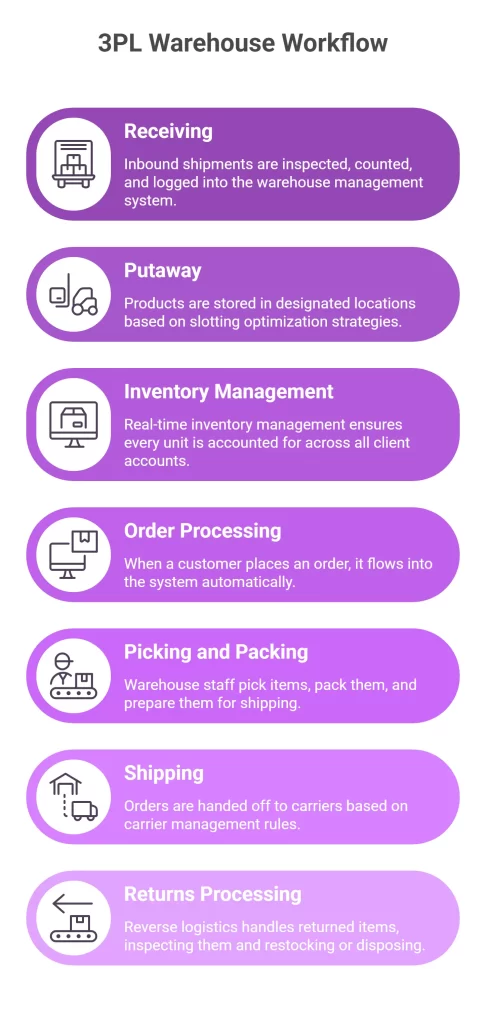
- Order Processing: When a customer places an order through your client’s ecommerce platform or sales channel, it flows into your system automatically.
- Picking and Packing: Warehouse staff pick items from their locations, pack them according to client specifications, and prepare them for shipping. Our detailed guide to warehouse order picking processes, methods, and types breaks this down further.
- Shipping: Orders are handed off to carriers based on carrier management rules, shipping preferences, and cost optimization.
- Returns Processing: Reverse logistics handles returned items, inspecting them and restocking or disposing based on client rules. For a deeper dive, check out our guide on reverse logistics and returns management with WMS.
Every step in this chain needs to work seamlessly, especially when you’re handling omnichannel fulfillment for clients selling on Amazon, Shopify, Walmart, and their own websites simultaneously.
Why Companies Use 3PL Warehousing
Before we talk about scaling, it helps to understand why the demand for 3PL services keeps growing. Companies outsource their logistics to 3PL providers for several compelling reasons:
- Cost savings: No need to lease warehouse space, hire staff, or invest in technology.
- Scalability: 3PL providers can flex capacity up or down based on seasonal demand.
- Expertise: Logistics is your specialty, not theirs. They’d rather focus on product development and marketing.
- Speed: Established 3PL networks can offer faster delivery times, including last mile delivery optimization.
- Technology access: Clients get the benefit of advanced WMS software, demand forecasting tools, and EDI integration without the capital investment.
This growing demand is exactly why scaling logistics business operations is such a hot topic. The opportunity is there, but only if your 3PL warehouse operations can keep up.
The Role of a 3PL Warehouse Management System
You simply cannot scale a 3PL business without the right technology. A 3PL warehouse management system is the backbone of your entire operation. It’s different from a standard WMS because it’s built to handle multi-client warehouse management from the ground up.
What Features Should a 3PL WMS Have?
When evaluating 3PL WMS software, look for these essential capabilities:
- Multi-client architecture: Separate inventory, billing, and reporting for each client within a single platform.
- Real-time inventory visibility: Clients should be able to log in and see their stock levels, order status, and shipping updates anytime. As highlighted in our article on inventory visibility trends and challenges, fragmented data across systems remains one of the biggest obstacles, and a unified WMS solves this .
- Billing and invoicing: Multi-client billing in 3PL warehousing is notoriously complicated. Your WMS should automate storage fees, pick fees, shipping charges, and value-added services.
- Integration capabilities: Seamless connections with ecommerce platforms (Shopify, WooCommerce, Amazon), ERP systems, shipping carriers, and EDI partners. Our guide on top WMS integration types and benefits explains what to look for.
- Automation support: Compatibility with warehouse automation tools like conveyor systems, automated sorting, and robotic picking.
- Reporting and analytics: Dashboards that track 3PL warehouse KPIs for each client and your overall operation.
- Returns management: Built-in workflows for reverse logistics processing.
A cloud-based WMS is generally the best choice for growing 3PL providers because it offers flexibility, lower upfront costs, and easier updates compared to on-premise solutions.
WMS vs. ERP for 3PL Operations
A question that comes up often is the difference between a WMS and an ERP for 3PL businesses. An ERP (Enterprise Resource Planning) system manages broad business functions like accounting, HR, and procurement. A WMS focuses specifically on warehouse operations. Most successful 3PL providers use both, with the WMS handling the day-to-day warehouse work and the ERP managing the business side. The key is making sure they integrate smoothly. Our detailed breakdown of WMS-ERP integration covers how to get this right.
3PL Warehouse Management: Key Technology Comparison
Choosing the right technology stack is one of the most important decisions for any 3PL provider. The table below compares the core technology categories, their primary functions, and their impact on scaling your operations:
| Technology | Primary Function | Best For | Scalability Impact | Implementation Complexity |
|---|---|---|---|---|
| Cloud-Based WMS | Multi-client inventory, order, and billing management | All 3PL providers | Very High | Medium |
| Barcode Scanning | Item-level tracking and pick accuracy | Small to mid-size 3PLs | High | Low |
| RFID Technology | Bulk scanning, real-time asset tracking | High-volume, high-SKU operations | Very High | Medium-High |
| EDI Integration | Automated data exchange with clients and carriers | B2B-focused 3PLs | High | Medium |
| Pick-to-Light Systems | Guided picking for speed and accuracy | High-volume pick operations | High | Medium |
| Automated Sorting | Order routing and carrier allocation | Multi-carrier shipping hubs | Very High | High |
| AI/ML Demand Forecasting | Predictive inventory and labor planning | Mature 3PL operations | Very High | High |
| Robotics (AMRs/AGVs) | Goods-to-person picking, transport automation | Large-scale fulfillment centers | Very High | Very High |
This comparison should help you prioritize investments based on your current scale and growth trajectory. Most 3PLs start with a cloud-based WMS and barcode scanning, then layer on more advanced technologies as volume increases.
How to Scale a 3PL Logistics Business
Now let’s get to the good stuff. Scaling a 3PL business isn’t just about adding more warehouse space and hiring more people. It requires strategic thinking across technology, processes, people, and client relationships.
1. Invest in Scalable Technology Early
The biggest mistake growing 3PL companies make is waiting too long to upgrade their technology. If you’re still managing operations with spreadsheets or a basic WMS that wasn’t designed for multi-client environments, you’re building on a shaky foundation.
Invest in 3PL logistics software solutions that can grow with you. Look for platforms that support multiple warehouses, handle increasing order volumes without performance issues, and offer robust API integrations. The cost of switching systems later is always higher than investing in the right platform from the start. For guidance on selecting the right platform, our article on choosing the right warehouse management solution is a great starting point.
2. Standardize Your Processes
Consistency is everything when you’re scaling. Document your standard operating procedures for every warehouse function: receiving, putaway, picking, packing, shipping, and returns. When you onboard new clients or open new facilities, these SOPs become your playbook.
Standardized processes also make it easier to train new employees, maintain quality across shifts, and identify bottlenecks. Your 3PL onboarding process for new clients should follow a repeatable framework that covers inventory setup, integration testing, SLA definition, and go-live procedures.
3. Master Multi-Client Warehouse Management
Handling multiple clients in one warehouse is both the biggest opportunity and the biggest challenge in 3PL. You need clear physical and digital separation of inventory, distinct billing rules, and the ability to prioritize orders based on each client’s SLA compliance requirements.
Some strategies that work well:
- Zone-based storage: Dedicate specific warehouse zones to high-volume clients.
- Shared storage with system separation: For smaller clients, use shared racking with WMS-level inventory segregation.
- Wave planning: Group picks across multiple clients to maximize efficiency while maintaining order accuracy.
- Client-specific packaging: Store branded packaging materials in designated areas for quick access.
For providers managing inventory across multiple locations, our guide on multi-warehouse inventory management offers practical strategies for maintaining control at scale.
4. Embrace Warehouse Automation
As your volume grows, manual processes become bottlenecks. 3PL warehouse automation doesn’t have to mean million-dollar robotic systems right away. Start with practical upgrades:
- Barcode scanning and RFID for faster, more accurate inventory tracking
- Automated label printing to speed up shipping operations
- Conveyor systems for high-volume pick and pack lines
- Automated sorting for multi-carrier shipping operations
- Pick-to-light or voice picking systems to reduce errors and increase speed
The goal is to increase throughput per labor hour while maintaining or improving accuracy. Every percentage point of improvement in pick accuracy saves money and keeps clients happy.
5. Track the Right KPIs
You can’t improve what you don’t measure. The key KPIs for 3PL warehouse management include:
- Order accuracy rate: Percentage of orders shipped correctly. Target 99.5% or higher.
- On-time shipping rate: Percentage of orders shipped within the promised timeframe.
- Inventory accuracy: How closely your system counts match physical counts.
- Order cycle time: Time from order receipt to shipment.
- Cost per order: Total fulfillment cost divided by orders shipped.
- Dock-to-stock time: How quickly inbound shipments are received and made available.
- Client satisfaction scores: Regular feedback from your clients on service quality.
Use these metrics to identify trends, spot problems early, and demonstrate value to your clients during business reviews. For a comprehensive look at building performance dashboards, explore our warehouse KPIs, metrics, and dashboard guide.
6. Optimize Your Warehouse Layout
As you scale, your 3PL warehouse layout design needs to evolve. What worked when you were shipping 500 orders a day won’t work at 5,000. Regularly review your:
- Slotting strategy: Keep fast-moving items in easily accessible locations.
- Pick paths: Minimize travel time with logical product placement.
- Staging areas: Ensure enough space for packing, shipping, and returns processing.
- Dock allocation: Optimize shipping and receiving operations to prevent congestion.
A well-designed warehouse layout can improve productivity by 20-30% without adding a single employee.
7. Build Strong Client Relationships
Scaling isn’t just about operations. It’s about relationships. Your best growth strategy is keeping existing clients happy so they grow with you and refer new business your way.
Be transparent about performance. Share KPI dashboards regularly. Proactively communicate about issues before clients discover them. Offer value-added services like kitting, custom packaging, or subscription box assembly to deepen the relationship and increase revenue per client.
3PL Warehouse Cost Optimization Strategies
Profitability in 3PL comes down to managing costs while delivering excellent service. Here are proven strategies for 3PL warehouse cost optimization:
- Labor management: Use a labor management system to track productivity by employee and identify training opportunities. Schedule staff based on demand forecasting rather than fixed shifts.
- Space utilization: Maximize cubic storage capacity with appropriate racking systems. Consider cross-docking for products that don’t need storage.
- Carrier rate shopping: Negotiate volume discounts with multiple carriers and use your WMS to automatically select the cheapest option that meets delivery requirements.
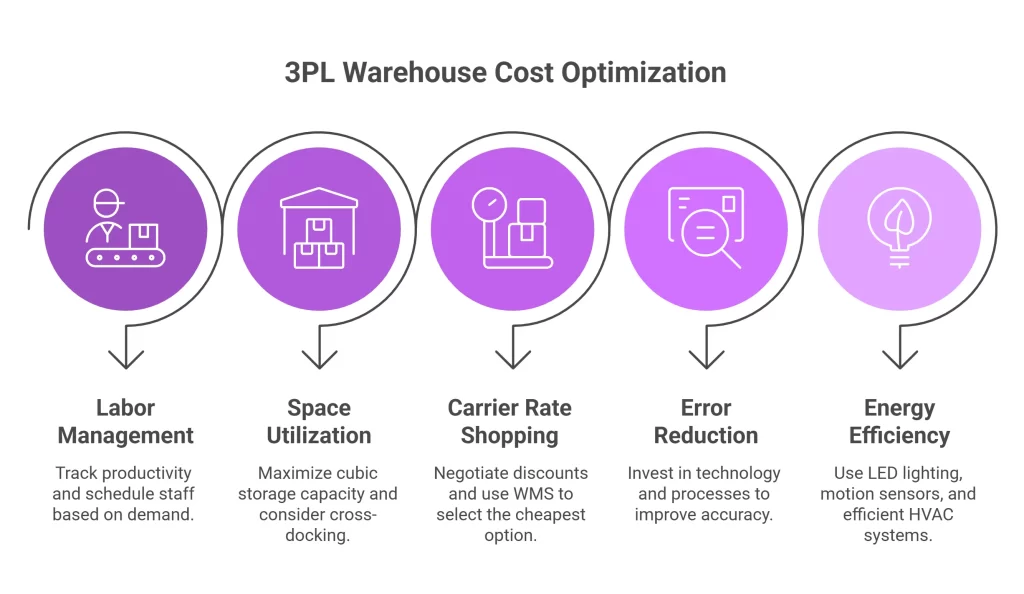
- Error reduction: Every mispick, misship, or inventory discrepancy costs money. Invest in accuracy-improving technology and processes. Understanding common inventory management challenges helps you proactively address the root causes of costly errors.
- Energy efficiency: LED lighting, motion sensors, and efficient HVAC systems reduce operating costs, especially in cold chain logistics operations.
3PL Industry Trends Shaping the Future
The third party logistics industry is evolving rapidly. Staying ahead of these trends will help you scale successfully:
- AI-powered demand forecasting is helping 3PL providers predict volume spikes and staff accordingly. AI and machine learning algorithms analyze vast amounts of supply chain data to predict trends, optimize routes, and detect anomalies .
- Micro-fulfillment centers are bringing inventory closer to end consumers for faster last mile delivery.
- Sustainable logistics practices are becoming a competitive differentiator as brands prioritize eco-friendly supply chain partners.
- Advanced robotics are becoming more affordable, making warehouse automation accessible to mid-sized 3PL providers.
- Real-time visibility platforms are raising client expectations for transparency across the entire supply chain. Digitizing supply chains to increase visibility is an achievable task if companies take an incremental approach and focus on their most essential goals .
- Contract logistics models are becoming more flexible, with shorter commitments and performance-based pricing.
How to Choose the Right 3PL Provider (For Your Clients’ Perspective)
Understanding what your potential clients look for helps you position your 3PL business for growth. When companies evaluate how to choose a 3PL provider, they typically consider:
- Technology capabilities: Can you integrate with their systems?
- Scalability: Can you handle their growth?
- Location: Are your facilities positioned for efficient distribution?
- Industry experience: Do you understand their vertical, whether it’s ecommerce fulfillment, cold chain, or B2B distribution?
- Pricing transparency: Are your 3PL pricing models clear and competitive?
- References and track record: Can you prove your performance with data?
Make sure your sales process addresses every one of these concerns with specific evidence and case studies.
Common Challenges in Scaling a 3PL Warehouse
Let’s be honest about the obstacles. The biggest challenges in scaling a 3PL warehouse include:
- Technology growing pains: Migrating to new systems while maintaining daily operations.
- Labor shortages: Finding and retaining qualified warehouse staff in competitive markets.
- Client diversity: Managing vastly different requirements across your client base.
- Cash flow management: Funding growth while waiting on client payments.
- Maintaining quality: Keeping accuracy and speed high as volume increases.
- Regulatory compliance: Meeting safety standards and 3PL warehouse safety requirements across jurisdictions.
The providers who scale successfully are the ones who anticipate these challenges and build systems to address them proactively rather than reactively.
Conclusion
Scaling a 3PL warehouse management operation is one of the most rewarding challenges in the logistics industry. The demand for third party logistics services continues to grow as ecommerce expands and supply chains become more complex. But growth only translates to profit when it’s built on a foundation of strong processes, smart technology, and a relentless focus on client satisfaction.
Start by getting your 3PL warehouse management system right. Standardize your operations. Track your KPIs religiously. Invest in automation where it makes sense. And never stop optimizing your costs, your layout, and your client relationships.
The 3PL providers who thrive in the coming years won’t just be the biggest. They’ll be the most efficient, the most adaptable, and the most obsessed with delivering value to their clients.
Ready to take your 3PL operations to the next level? Start by auditing your current warehouse management processes against the best practices outlined in this guide. Identify your biggest gaps, prioritize your investments, and build a roadmap for sustainable growth.
Frequently Asked Questions
3PL warehouse management refers to the processes, technology, and strategies that third party logistics providers use to handle storage, inventory management, order fulfillment, and shipping for multiple clients simultaneously. Unlike traditional warehousing that serves a single company, 3PL operations require multi-client management with separate inventory tracking, billing, reporting, and SLA compliance for each account.
Scaling a 3PL business requires a cloud-based warehouse management system built for multi-client environments, along with barcode scanning, RFID, EDI integration, and carrier management tools. As volume grows, warehouse automation solutions like conveyor systems, pick-to-light technology, and integration with ecommerce platforms and ERP systems become essential for maintaining efficiency.
A 3PL WMS maintains complete digital separation between client accounts while allowing shared physical warehouse space, tracking each client’s inventory independently with unique SKU mappings and storage locations. Zone-based storage strategies, slotting optimization, and wave planning maximize efficiency while real-time visibility dashboards let each client monitor their stock levels independently.
The essential 3PL warehouse KPIs include order accuracy rate (targeting 99.5%+), on-time shipping percentage, inventory accuracy, order cycle time, cost per order fulfilled, and dock-to-stock time. These metrics should be tracked at both the overall warehouse level and individual client level to ensure SLA compliance and identify areas for operational improvement.
Cloud-based 3PL WMS platforms typically range from $500 to $3,000+ per month depending on features, client volume, and warehouse count. Most providers see ROI within 6 to 12 months through improved accuracy and faster operations.

Kapil Pathak is a Senior Digital Marketing Executive with over four years of experience specializing in the logistics and supply chain industry. His expertise spans digital strategy, search engine optimization (SEO), search engine marketing (SEM), and multi-channel campaign management. He has a proven track record of developing initiatives that increase brand visibility, generate qualified leads, and drive growth for D2C & B2B technology companies.